What? You still blogging about the magpies? The nest is empty! Yes, just before Memorial Day, an adult magpie was killed in front of our living room window. I was hoping it wasn’t one of our mating pair, but of course it was, as soon after we discovered two dead babies on the ground near where the adult had been killed. Then the nest and even our yard turned quiet. Where had the widowed mate gone?
It was a bit of a challenge letting go of that magpie family we had been watching for 8 weeks from every front window of our house, building the nest, the male feeding the female as she nested, and finally both of them taking care of the babies. I had been expecting the babies to fledge about the time one of the adults was killed.
I was surprised at how sad I was. How could I have become so attached to that pair of nesting magpies? I did a lot of research on magpies, (hence five blogs!) and discovered how they are one of the smartest animals on the planet, how they mate for life. Here’s an informative link: https://www.nature-anywhere.com/blogs/bird-feeding-academy/bird-card-the-black-billed-magpie
In captivity a Black-billed magpie can live up to 20 years but the average life-span in the wild is 2-4 years. They don’t even start breeding until they are a couple years old. Only about 14% of magpies ever succeed in breeding. They may successfully raise only 7-11 chicks to adulthood in a lifetime.
When a magpie discovers the body of a dead magpie he will call out as loud as he can to attract other magpies to the area. Together they will squawk loudly for up to 15 minutes, leave grass ‘wreaths’ and then silently leave the scene. Some funerals have had up to 40 mourners.
Here’s a youtube link to a video of a funeral – (you might want to turn down your sound!)
Now you need to turn up your sound (!!) to fully experience the event that happened early Saturday morning, June 3. At 7am David and I simultaneously bolted upright from deep slumber. (Hey, we’re retired.) What’s going on? It took me a bit to realize what we were hearing through our open upstairs bedroom windows. What in the world? I scrambled to find my i-Phone to capture a video from our bedroom of the loud screaming magpie fracas around the nest in our front may tree.
As it turned out, I needn’t have rushed to find my phone to take a video. Play my 47-second video over and over again about 17 times and you will have experienced what could only have been the funeral for the deceased magpies. After about 15 minutes the magpies all flew off and the tree fell silent. The funeral helped me grieve and find closure as well.
Lastly, here’s a sweet parting song on Youtube called “Magpie” by Ian Tyson. A few lyrics:
“Always wakin’ up my wife and I,
You ol’ coyote in the sky.
The west ain’t never gonna die,
Just as long as you can fly…”
.
The sun has set on the magpies.
And, I guess I could focus now on putting out the hummingbird feeders.
It’s been 50 days since I last blogged about the magpies nesting in our front may tree. What an interesting experience it has been, witnessing this pair of black-billed magpies build their nest just 20 feet from our front door. They built an elaborate domed nest over several weeks, which I describe in my first blog written on March 29. I had been stepping out our front door to take photos of the worst southeast Idaho winter we’ve had in over 30 years (ahem), and inadvertently also photographed the building of the nest. I was confounded by its discovery and my first impulse was to devise ways to run the magpies off, those noisy, smart, pesky, bully birds whom nobody seems fond of. My only previous history with magpies was to chase them off our property for the past 22 years and hold them to blame for the disappearance of baby songbirds.
But I was suddenly fascinated with them, and discovered lots of interesting facts and history about magpies, which I blogged about while watching and waiting for the pair to lay eggs. I wrote my last blog on April 16, when I was pretty sure the female was beginning to nest. Magpies mate for life and raise one brood per year. They typically lay 3-6 eggs, which hatch in 16-20 days. The male feeds the female throughout incubation. The babies fledge after 3-4 weeks.
The lucky thing was, I could view the nest from our front dining room window. And our kitchen window. And our upstairs bedroom and office windows. I found myself looking for them constantly, I’d hear a squawk and race to the window. I loved watching this pair. And taking photos and videos. It made me so happy to see them together.
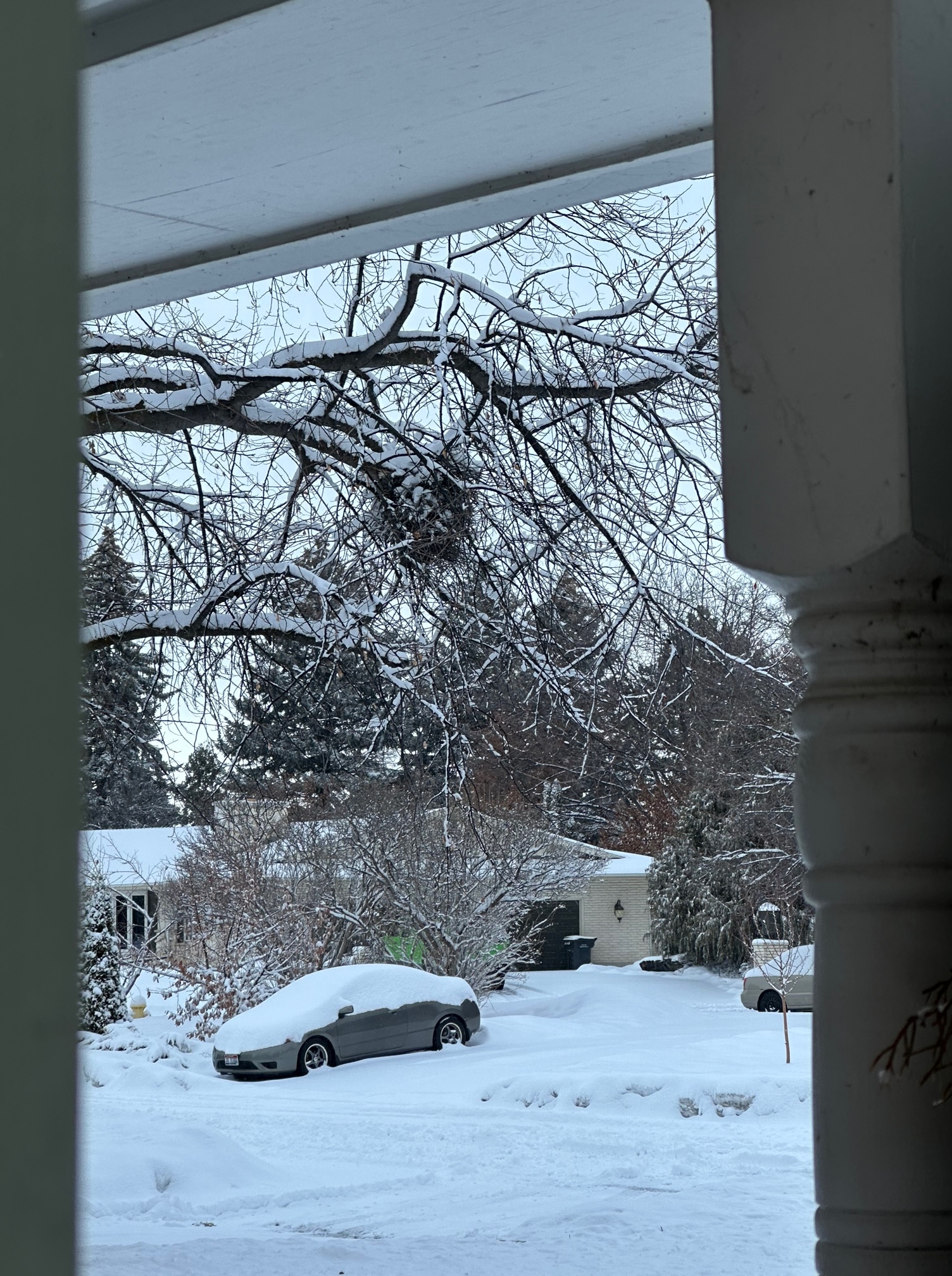
Winter seemed like it would never end. We had another snow storm on April 21. I worried a bit about how the female would keep the eggs warm and the male would find enough food under a new blanket of snow to feed them both.
April 21, 2023
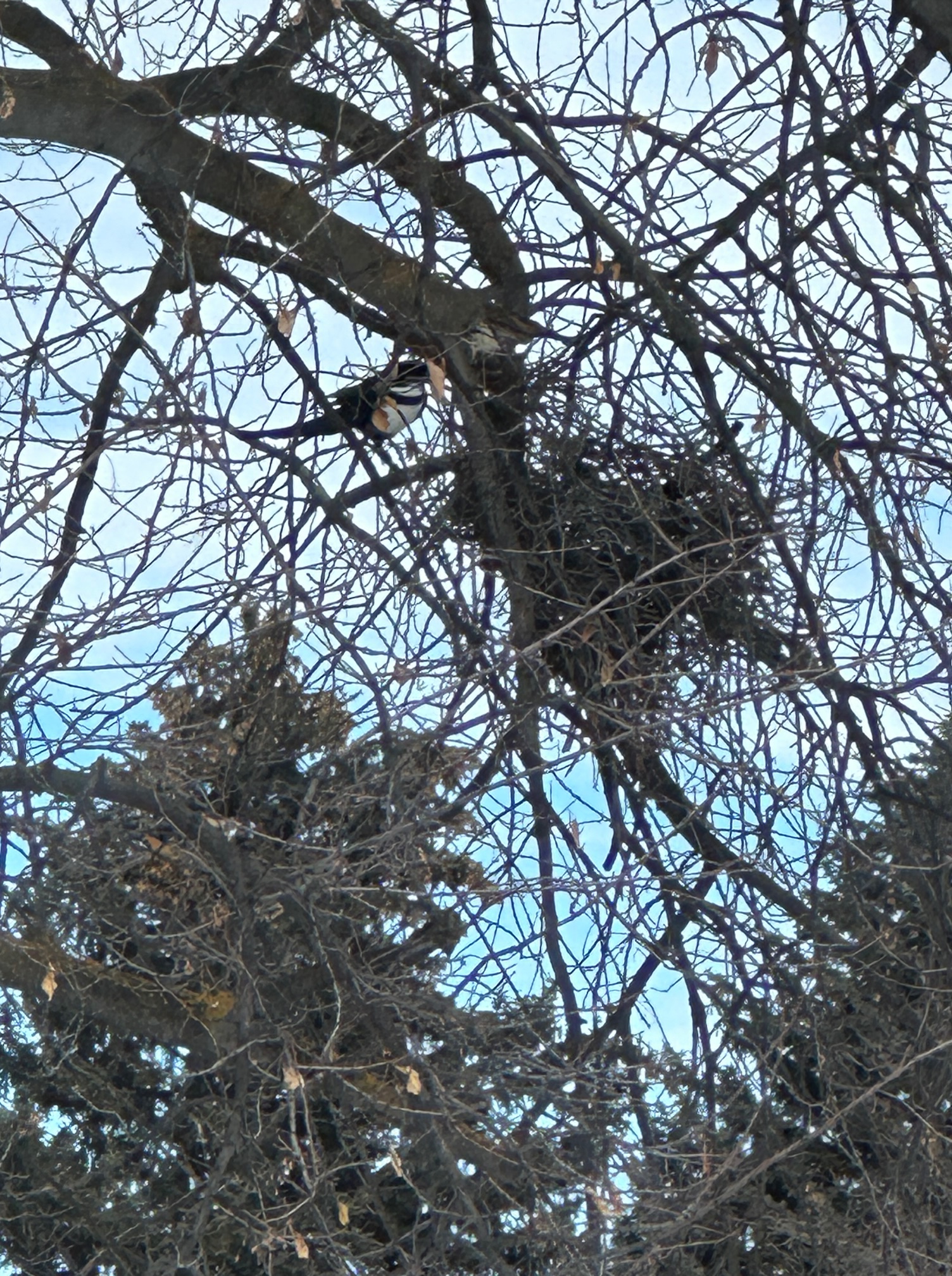
The nesting female would hop out of the nest and shake herself off, fly to a nearby tree or lawn to exercise her wings, but then head right back to the nest. Her long tail was a bit bent from roosting.
I’ve captured lots of photos and videos of the magpies. (Surprise, surprise)
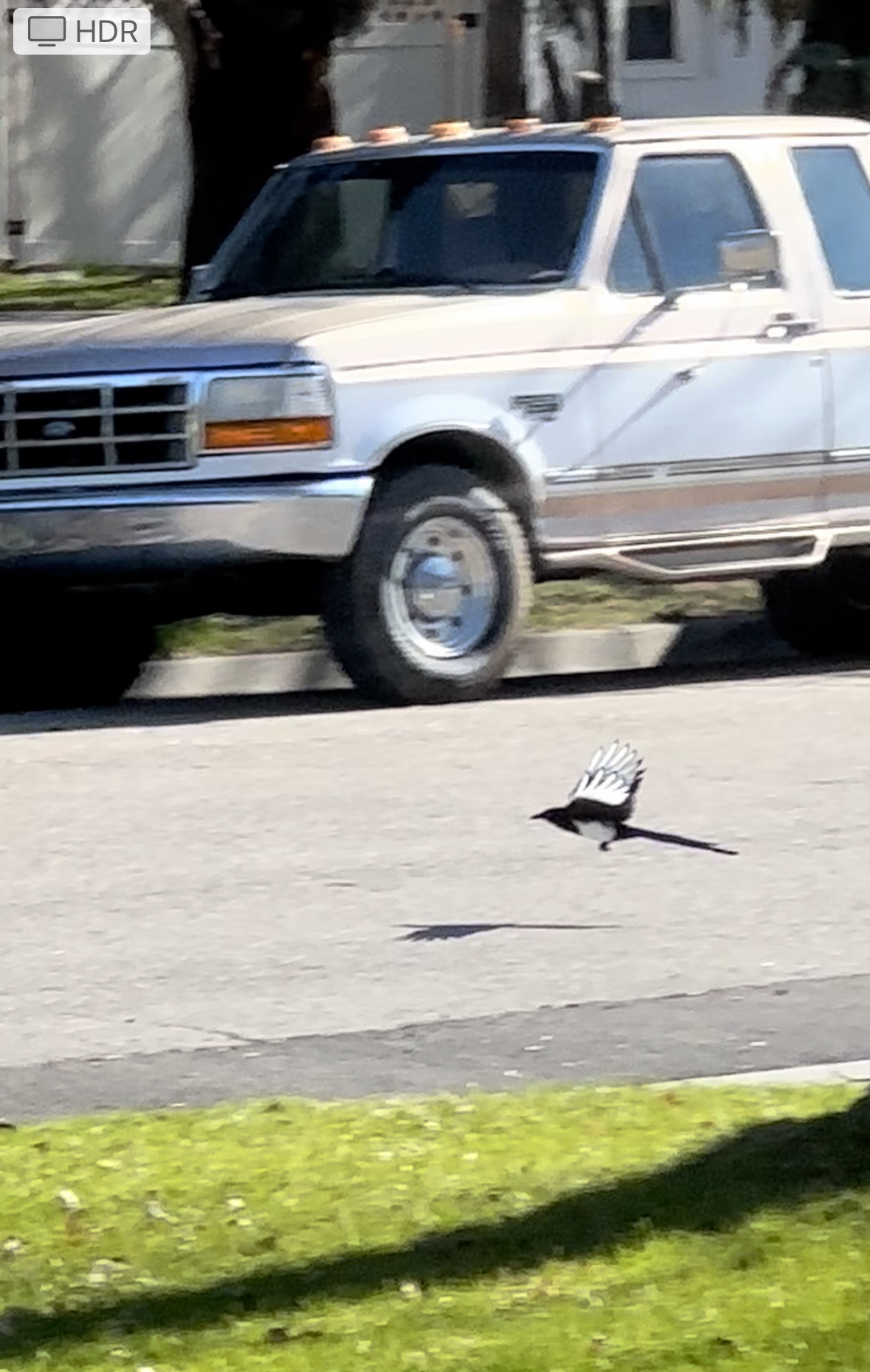
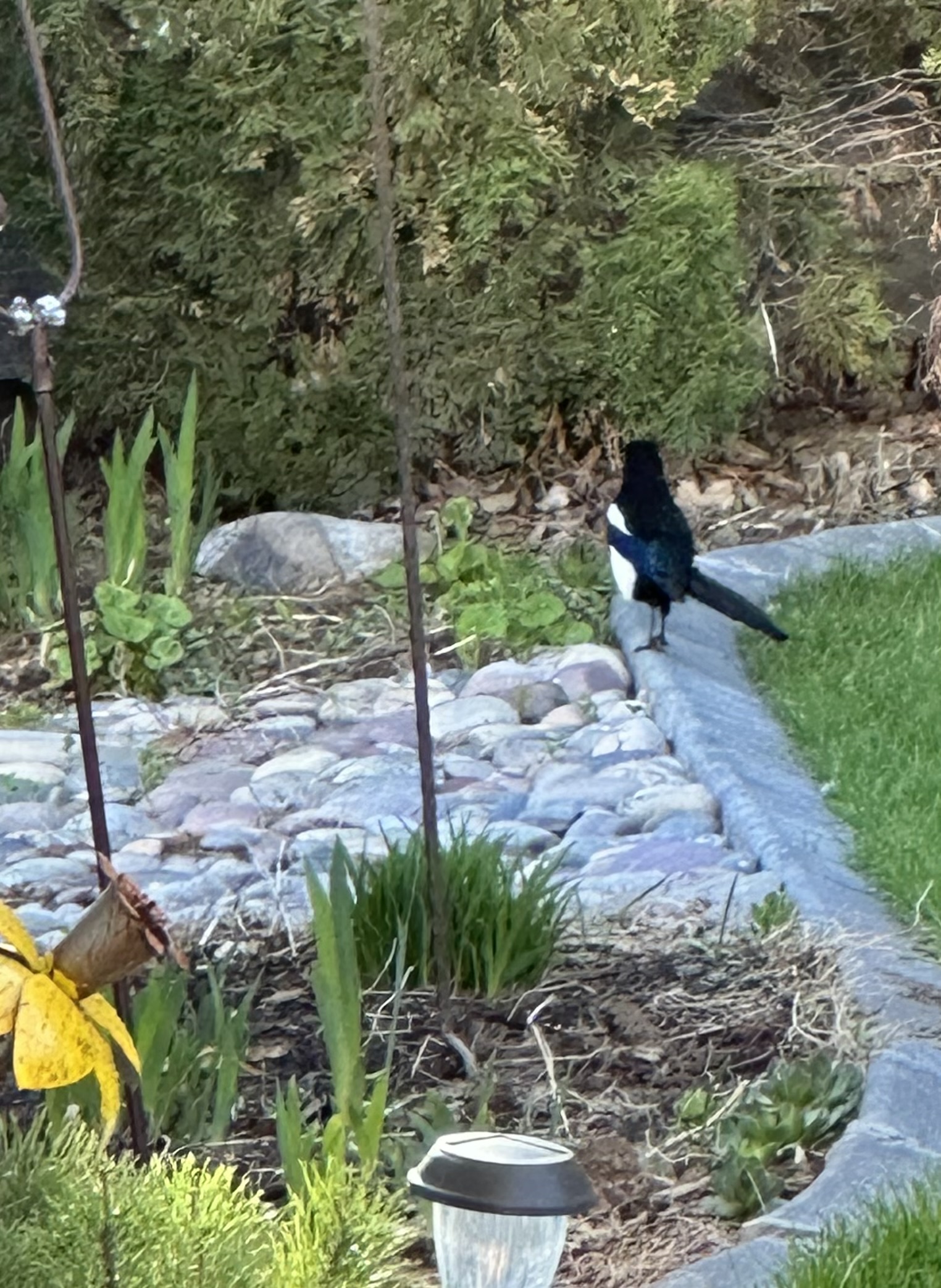
Magpies in flight, magpies in our back garden.
To say I was obsessed with the magpies would be a gross understatement. One Sunday I came down with the blues. I had flats of annuals to plant but just couldn’t get myself motivated. But I knew the cure. The magpies saved me. Seeing both magpies hop out of the nest buoyed my spirits.
Of course, I’ve yet to plant the flowers in the gardens. I don’t want to miss anything with the magpies.
Both parents were feeding the babies now. Such a happy time. I captured a video of them canoodling on the roof across the street. So sweet!
I planted the flower pots on the deck on May 20. Three days later, on the evening of May 23rd, we got hammered with a huge rain/hail storm, dumping 1-3 inches of rain and hail over a couple of hours. I took a short video of the storm through our dining room window, capturing the edge of the may tree with the magpie nest.
The magpies survived in their domed and roofed nest. I wonder about the robins and other songbirds? Our flower pots were completely hammered.
I expected the babies to fledge around Memorial Day. The may tree had leafed out and the babies were very quiet. Although you could hear tiny sqawks when one of the parents arrived in the nest.
Yes, the magpies had survived the hail storm, but on Saturday morning, May 27, I heard a magpie squawking like mad in our front bushes by our fountain up next to the house. I opened the front door and it flew off. Huh. Maybe an intruder? David came to me later that afternoon. “I don’t know if you saw it, but there are magpie feathers scattered in an area by the front fountain.” What?? I ran out there. Sure enough. A scattering of feathers – a magpie had been killed. Did a cat get it? Magpies are relatively slow flyers. Was it an owl or hawk? Oh, surely it’s not one of our magpies! But how could it not be? Although we have seen other magpies around. I clung to the hope…please, please, let it not be one of ours!
That afternoon about 4 PM I spotted one of the parents feeding the babies. I quick! captured a video
Yes! Such a hopeful sign.
But that would be the last time. On Memorial Day, two days later, I found a dead baby magpie in the same spot where I had discovered its … father? mother? With only one parent it would have either died of hypothermia or starved to death. I took a photo of the dead baby. It had feathers and I bet it was about ready to fledge. I came in the house and told David. Do you want to see the photo of the dead baby? I asked. Why would I want to see that?? he said. I dunno. Dang it! I was so sad.
Two days later David was out digging up dandelions in our front yard and found another baby in the grass just 10 feet away from where I had seen the other one. Maybe the remaining magpie had kicked the babies out of the nest so they would die quickly and wouldn’t have to suffer starvation.
The nest was empty now and our whole place was quiet. I could hear magpies chattering in neighbors’ yards but honestly didn’t spot a one in our yard for several days.
Then this past Saturday, just two mornings ago, the most amazing thing happened. I’m a heavy sleeper in the early morning hours and I nearly always miss the chirping of the birds. But I was awakened by a huge racket in our front may tree. It was really something. I jumped up and scrambled to find a phone to take a video.But I needn’t have hurried. The racket in our front may tree, coming from what must have been about 20-30 magpies, went on for nearly 15 minutes. It was a funeral for our little family.
Which brings me to the topic of my next blog.
In the meantime, I hope to finally get our flowers and tomatoes planted. I’m sure they’re all rootbound as hell.
Whenever I tell someone about the magpies nesting in our front yard they almost always react with an “Oh no!” or an expression of, ‘oh, you poor thing.’ Over the 22 years we have lived in this house the only interaction I’ve had with magpies was to run them off, because I don’t want them messing with the robins and other pretty sounding songbirds. Which is easy. You just open the front door and the magpies fly off. I’ve even run them off the the neighbor’s yard across the street, to protect the nesting duck in their front marigold patch. I’d open our front door and clap. Off they flew. They have very sharp senses. I’ve never seen a magpie nest, or even imagined magpies nesting near us during the past 22 years we’ve lived at this address. Until now.
It is still a surprise to look out at our front may tree.
Friday, April 14, 2023
I don’t see no nest, do you? Yeah, it’s like the elephant in the room, or in this case, the elephant in the tree. I’ve been closely watching them and I’m about positive the female laid her first eggs this past Tuesday, April 11. I told a friend that, she said, no way. There is no way those eggs will survive the weather. I wonder too. We had about 3 days of spring, when she appeared to be nesting and perhaps laid her first eggs, then winter was back.
Thursday, April 13
The female would hop out of the nest, shake herself off, then hop back in. Good thing the nest is domed. Although not leak proof! The male is close-by. And sure enough he is feeding the female.
And look! The robin is back! Assuring us, everything is fine.
Magpies have such a horrible reputation, the yakkity, garbage eating bullies of the bird world that will destroy your gardens and decimate the populations of nearby nesting, more sweet sounding songbirds. But how much of that is true? I did a little research. The Romans believed magpies were highly intelligent with excellent reasoning abilities. In ancient Greece, magpies were sacred to the God of wine, Bacchus. Native Americans considered magpies to be sacred messengers of the creator or even a guardian with shamanic properties. They wore magpie feathers to signify fearlessness.
In Korea the magpie is celebrated as a “bird of great good fortune, of sturdy spirit and a provider of prosperity and development.” Korean children were taught that “when you lose a tooth, throw it on the roof singing a song for the magpie. The bird will hear your song and bring you a new tooth.” https://en.wikipedia.org/wiki/Oriental_magpie. Similarly, in China magpies are seen as an omen of good fortune and killing one would bring the reverse. The Manchu Dynasty (the Great Qing Dynasty and last dynasty that governed China from 1636-1912) adopted the magpie as a symbol of its imperial rule, declaring it the official ‘bird of joy.’ Mongolians believed magpies controlled the weather.
The magpie was seen as a very important, positive mythological bird in history, until the Christians arrived on the scene. https://www.birdspot.co.uk/culture/magpies-and-superstition The story was told that when Jesus was crucified, two birds came to perch on his cross, a dove and a magpie. The dove grieved for Jesus and caught his tears but the magpie did not. Thus, magpies were eternally damned in the eyes of Christianity because they supposedly did not grieve the death of Christ. In the 19th century a vicar reported one of his servants explaining that the magpie is the only bird not to enter Noah’s ark, preferring to sit outside chattering and swearing in the pouring rain. The church also started the rumor that magpies carry a drop of the devil’s blood in their tongues. If you were to cut the tongue to release the blood then the magpie would be capable of human speech. BTW, the magpie is already capable of mimicking human speech, how in the world would a human cut its tongue? So who is smarter, (guns and opposable thumbs aside) humans or magpies? One could wonder…
In Britain there is probably no other bird more associated with superstition than the magpie. It is generally considered bad luck to come across a lone magpie. Not entirely sure why, but magpies often mate for life, so seeing a single magpie may mean it has lost its mate and therefore, the chance of it bringing bad luck is higher. Coming across a larger group of magpies could actually bring you good fortune and wealth. To help ward off the bad luck that might come your way when meeting a single magpie you might want to either salute the magpie, or say “Good morning general” or “Good morning captain!’ or say “Good morning Mr. Magpie, how is your lady wife today?” or “Good morning Mr. Magpie, how are Mrs. Magpie and all the little magpies?” or say, “Hello Jack, how’s your brother?” or Doff your hat, spit three times over your shoulder, or lastly, blink rapidly to fool yourself into thinking you’ve seen two magpies. You know, to ward off back luck, just in case.
It’s Sunday, April 16, and we checked on the magpies, first thing. Sure enough they were both out there. I started writing my blog and noticed things started to seem more quiet than usual. I kept glancing out the window, especially when I heard magpie calls. For some reason for the past few hours I’ve only seen one. I’ve seen the female emerge from the nest, alight on a limb and call. And then return to the nest. I’ve glanced out to see a magpie fly out of the nest, was it the male, flying off after feeding the female inside the nest? I hope so. I have to admit that I’m a bit worried. I hope they are fine; I’m just missing the signs. Why is it so quiet and why have I only seen one over the past several hours? Could something have happened to the male? You know their reputation around here. Oh man. I shared my concern with David, had he seen the two of them? No, not since 7:30 this morning. “But hey” David reminded me, “You’ve been running them off for the past 22 years, all worried about the robins, and now you’re heartbroken with worry that something might have happened to the magpies?”
Yep, pretty much. If I see even one magpie I’m going to salute it, “Good morning Mr. Magpie, how is Mrs. Magpie and all the little magpies?” And hope with all my heart that they are fine.
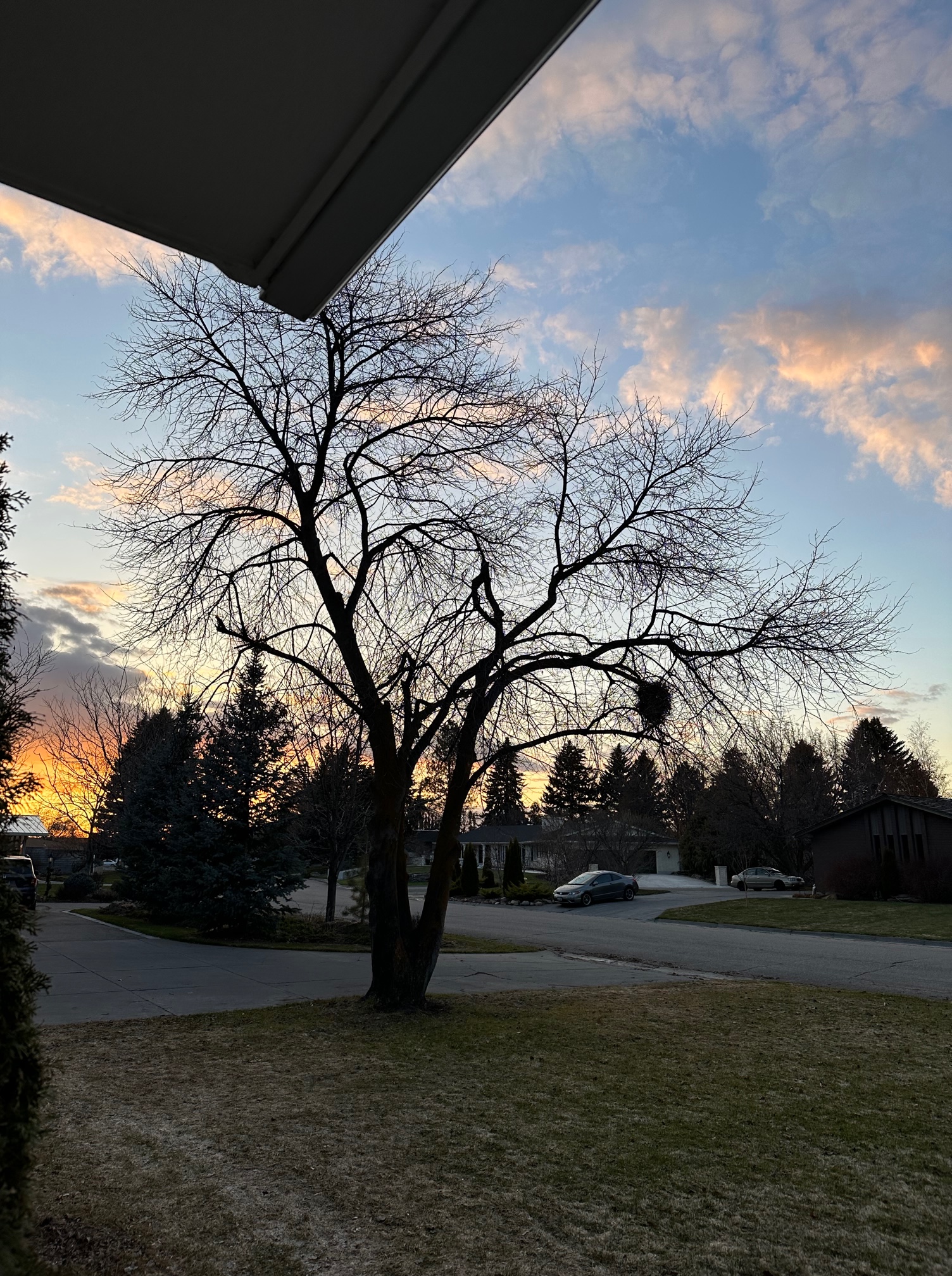
A pair of magpies has built a nest right in our front yard in a huge may tree that hasn’t leafed out yet. I’ve been mostly photographing them through our front dining room window. They used to fly off as soon as I opened the front door. But they’ve become more comfortable and bold of late, or maybe undeterred in their quest to raise a family. This morning I walked out on the front stoop and took this video. They don’t appear to be nesting yet. You will see the mate fly across the view in this video.
You could play that video in a continuous loop and that’s pretty much what it sounds like around here. Even as I write this blog that magpie has alighted somewhere on another end of the property going ‘yaak’ ‘yaak’ ‘yaak’. It’s a different sound than the “yak-yak-yak-yak’ we were hearing, until about a week ago. Is it some huge announcement to the the animal world, “This is our territory and we’re raising a family!” I hope they have only claimed as territory the west end of our front yard surrounding the tree.
They are never far apart from each other.
Magpies mate for life. They are usually at least two years old when they choose a mate and they stay together year-round. If one of them dies then the other may find a new mate. They will even try to find a surrogate parent to help with raising the young if a mate dies while they are nesting. Although I did wonder if they also divorce, and sure enough, according to this Wiki link, https://en.wikipedia.org/wiki/Black-billed_magpie – divorces are possible: one South Dakota study found about an 8% rate of divorce, but another 7-year study in Alberta found divorce rates up to 63% (hey, so they’re smart and complicated, like humans).
Black-billed magpies, also known as the American magpie, are native to the northwestern half of the the US and Canada. Here’s a screenshot of the map in the Wiki article showing their habitat.
Magpies (and other corvids like crows, ravens and jays) are considered to be the smartest non-mammal animals. Of course we humans are much smarter, the smartest of all animals and mammals, with our guns and opposing thumbs, the species at the top of the food chain. When Lewis and Clark first encountered black-billed magpies in South Dakota in September of 1804, they reported the birds as being very bold, hopping into the tents of Plains Indians in search of meat, some which were tame enough to take food from the hand. Magpies followed the buffalo herds, picking insects and ticks off their backs but when the white man came along and decimated the buffalo herds in the 1870’s, magpies switched to cattle, horses and mules. By the 1960’s they had also moved into the emerging towns and cities of the west.
During the first half of the 20th century magpies developed a bad reputation because they stole game bird eggs and also because they picked at the sores on the backs of cattle, for example, their fresh wounds from being branded, and saddle sores on horses and other unhealed wounds. So humans systematically trapped and shot magpies. Bounties of one cent per egg or two cents per head were offered in many states. In Idaho the death toll eventually amounted to an estimated 150,000. In 1933, 1033 magpies were shot in an exterminating contest in Washington’s Okanogan Lakes Region, by two 6-person teams of bounty hunters. Many magpies also died from eating poison set out for coyotes and other predators.
Luckily magpies survived human’s extermination efforts in the early part of the 20th century, and they are common and widespread today. Their main natural predators are owls, crows, raptors, dogs and cats. They can have eggs stolen out of their nests by raccoons, hawks, weasels and minks. Most males appear to begin breeding in their second year. Mean life expectancy in the wild is 3.5 years for males and 2.0 years for females. Although, in captivity magpies can possibly live up to 20 years. It’s a hard scrabble life for magpies.
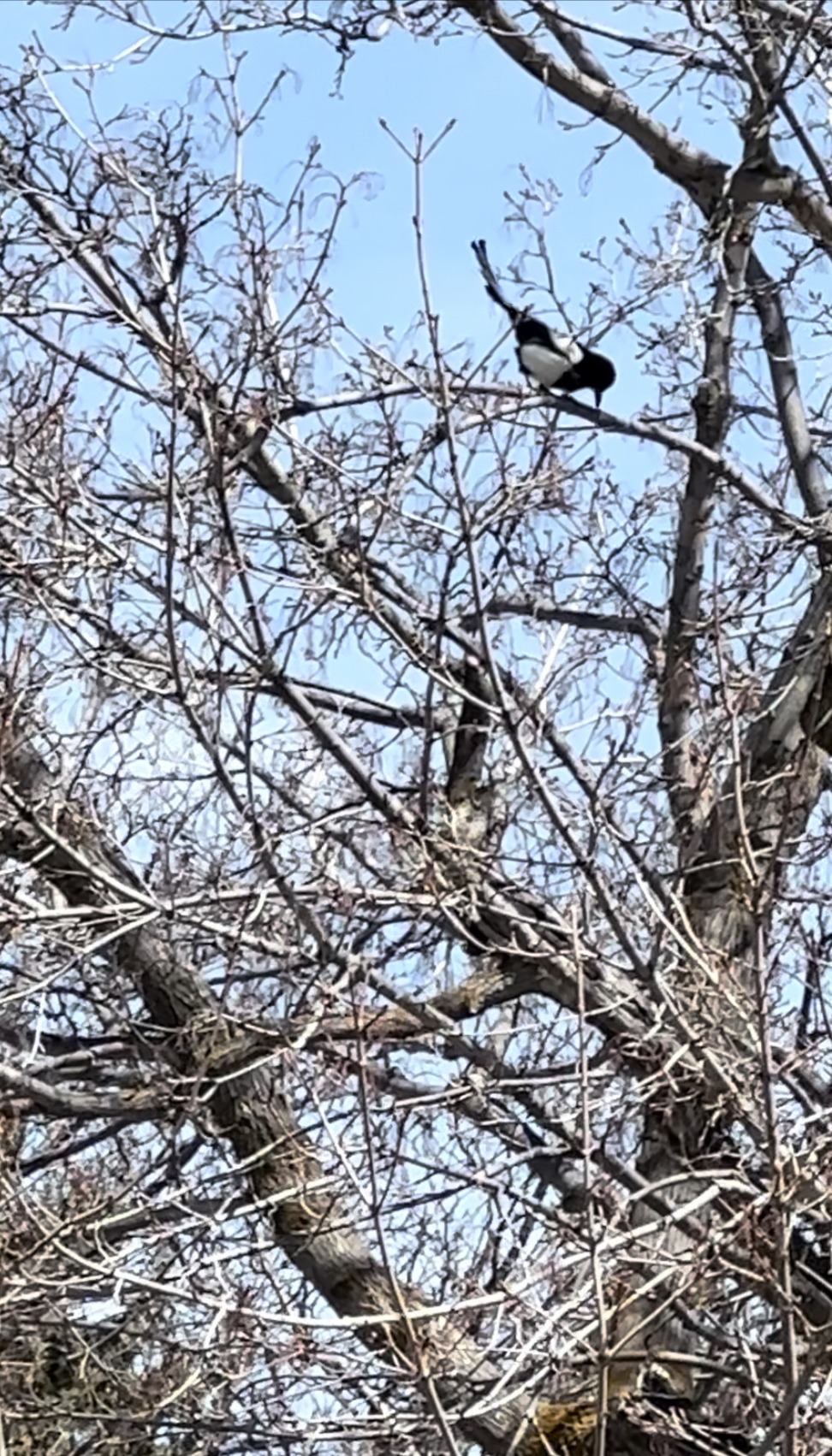
I’ve been watching the magpies closely today. One of them is chirping constantly.
I saw the two of them together on a limb near the nest and then one of them hopped into the nest and stayed there until I got tired of watching, a good ten minutes. The female incubates and the male feeds the female throughout incubation and guards the nest. I’m wondering … is the female laying eggs now? The female lays up to 13 eggs, but the usual clutch size is 6 or 7. Incubation period is 16-21 days.
One magpie, (the male?) is still talking constantly. I just now stepped out the front door and captured this video:
Tuesday, April 11, 2:26 PM. Did we possibly just witness the male deliver food into the nest for the incubating female? Has she started laying and incubating eggs!? It’s admittedly a good day to lay eggs. We’ve had a two-day sunny warm spell here with temps soaring into the mid-sixties. Of course, the weather forecast calls for a 25-degree drop in temperature over the next 48 hours.
I have to admit – I’ve become quite attached to these magpies. Ol’ grandma here will keep a close watch and do my best to scare off predators and any unwanted visitors, like their wily close cousins the crows.
At this point, I just don’t want anything seriously bad to happen to this budding little magpie family. Is that just too much to ask of Mother Nature and the Universe? Yes?
I dreamed last night that I was wandering barefoot through a lush landscape, surrounded by green green grass, buzzing bees and butterflies, flowers everywhere, warm sun basking my face, a symphony of songbirds filling the air. I woke up to a loud ‘ghak-ghak-ghak-ghak!’ Oh yes, the magpies. They have built a nest in our front may tree just a stone’s throw from our upstairs bedroom window.
Magpies are no songbirds. How could they possibly be? But according to Google – magpies belong to the Corvidae songbird family that also includes ravens, crows and jays. Songbird? Really? Their language includes a variety of trill, crackle and whistle calls. In other words, they are noisy. They are also aggressive scavengers, omnivores, who will eat just about anything- insects, fruit, rancid food, sick animals, pluck baby songbirds out of their nests, get into your garbage and make a mess, eat leftovers off your patio table. Are they so aggressive that they would hop right up next to you as you’re eating your dinner on the patio, and be willing to pluck your eye out trying to snatch the food off your fork?
Yeah, I wasn’t thrilled in early March to discover magpies building a nest in our front may tree. They were well into their nest building but we could still stop it! I approached David. Hit him up with all the arguments per above, emphasizing the threat to our hitherto relaxed dinners on the patio watching the robins. Honey, you could get out the adjustable 50′ ladder – climb up there and just knock down that nest!
“The nest is fine,” said David. Wha…?
So I was left to my own devices. Google was full of ideas, because apparently, a lot of other people were trying to scare off magpies as well: https://pestpush.com/get-rid-of-magpies/ Did you know that they are a protected species by law? According to federal and many state regulations, they cannot be hunted, harmed or killed without a permit to do so. So you have to get creative. Aha, magpies don’t like shiny objects. So now we have a use for our voluminous outdated CD collection. Hang a dozen CD’s around the nest! You have to use multiple tactics. So how about we also dangle half-filled plastic water bottles from the tree branches, they’ll blow and slosh around like wayward ships in the southeast Idaho wind and scare the crap out of them! Magpies don’t like loud noises. I could blast some acid Rock music toward the nest off our front porch roof! Maybe that would run them off. Or send our next door neighbors over here to run us off.
You can make a scarecrow and stick it out there, but you have to move it around every few days to keep the magpies guessing. Stuff a shirt and pants and stick them on a pole. Stuff a paper bag with newspaper for the head and draw a big face on it, affix it to the body and shove the pole into the ground. Except I don’t know how you’d keep the head from blowing off the body with the winds around here. Watch it blow off and roll like a tumbleweed across your neighbors’ yards to the end of the block where the road curves north.
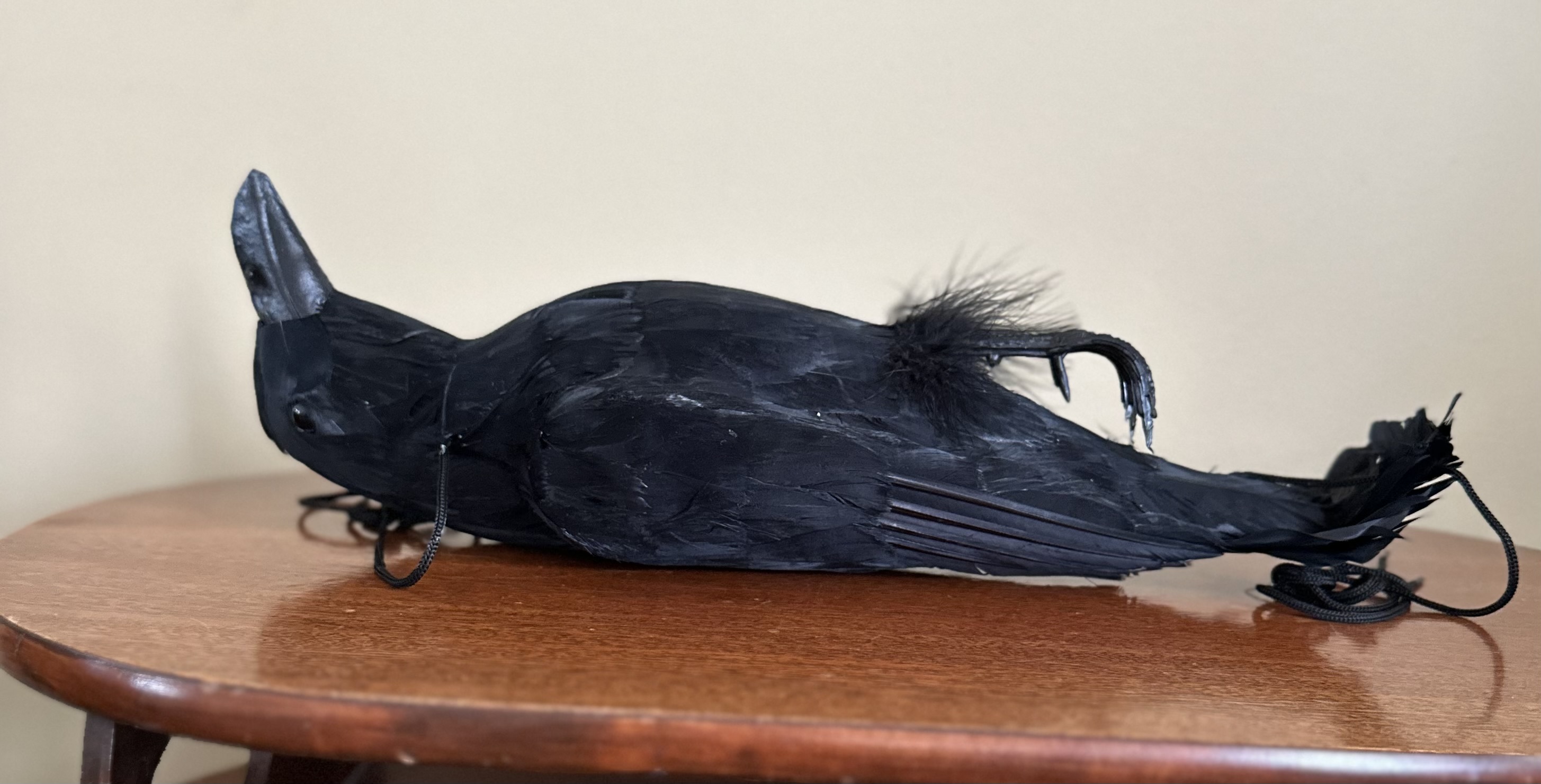
You can use decoys, like fake owls and such, but again, the magpies quickly catch on to your tricks. I called my dear friend, Rene, and told her about the magpies. Ugh! She was sympathetic alright. She had had a problem with crows last summer. She had smartly ordered a dead crow decoy to hang in her yard as a stark warning to crows (since they’re so smart!) – this is what happens to you if you stick around. Except, the thing took weeks to arrive, having been shipped from China. The crows had already moved on by the time she got it. No worries. She gave it to me, still in the box. Surely magpies will be frightened by a dead crow. Except I caught David hauling it out to the trash. Hey, stop! That’s the dead crow I’m gonna use to scare the magpies! It might be too late to remedy the nest situation but we might need it later when those pesky birds get into the vegetable garden. Here, I took photos of it.
It’s dead all right. And creepy. Even if it doesn’t work on crows or magpies, it might be enough to scare young children from tromping through your garden.
As I investigated strategies to chase the magpies off, I also learned a lot more about magpies. One of the things I read, “If you are more stubborn than a magpie you can reclaim your home from the winged pests.” Well, as Merlin the Wizard might say, “It is possible, but not certain.” Case in point, this homeowner in Calgary, Alberta, Canada, named Patti Fellows, trying to prevent magpies from nesting in her cedar tree. She rallied her neighbors who helped her wrap her tree in burlap. Then they drew a big face on it. The magpies hopped on the material and ripped it to shreds. Fellows ended up chopping down her cedar tree to be rid of the magpies. The photos are pretty funny. Here’s the link to the article: https://www.cbc.ca/news/canada/calgary/alberta-magpies-1.5133870
Last but not least, let me just share this link: https://www.hit.com.au/story/magpies-remember-your-face-for-up-to-5-years-we-are-not-okay-107240 Studies have shown that magpies can remember a face for up to 5 years. They will remember someone who was good to them and equally, those who weren’t so good, like doing mean things to be rid of them. As I’m hanging those CD’s (likely wearing a hazmat suit) I could sing to the magpies “Everything is Beautiful … in its own way” by Ray Stevens. (A 1970 Grammy-Award winning song only recognizable by boomers.) As in, beautiful if those magpies decide to nest somewhere else next spring?
The magpies are not roosting yet. Both of them are hanging out scavenging for food and certainly keeping an eye on the nest. I was watching them interact with a squirrel. Both of them hop alongside him as he’s foraging for food. Are they trying to steal it from him? Are they making friends with him? The squirrel nearly buried himself in a snow drift right outside our kitchen window, plunging head-first to dig out something with only his hind legs and tail to wrench himself back out. One of the magpies stood just 10 inches away watching him, just as I was. The squirrel resurfaced with his bounty and bounded off with the magpie hopping right behind him. He tried to race up a once familiar tree (now with the nest) when both magpies swooped in, dived bombed him, and chased him half way across our neighbors yard to the west. Okay, so magpies know about that policy, “keep your friends close but your enemies closer.”
Yeah well I’ve decided just to try and be friends with the magpies. I’m glad the nest is in our front yard and not our back yard. I’m hoping to enjoy some relaxation on our back patio this summer without being swooped and dive-bombed by nesting magpies.
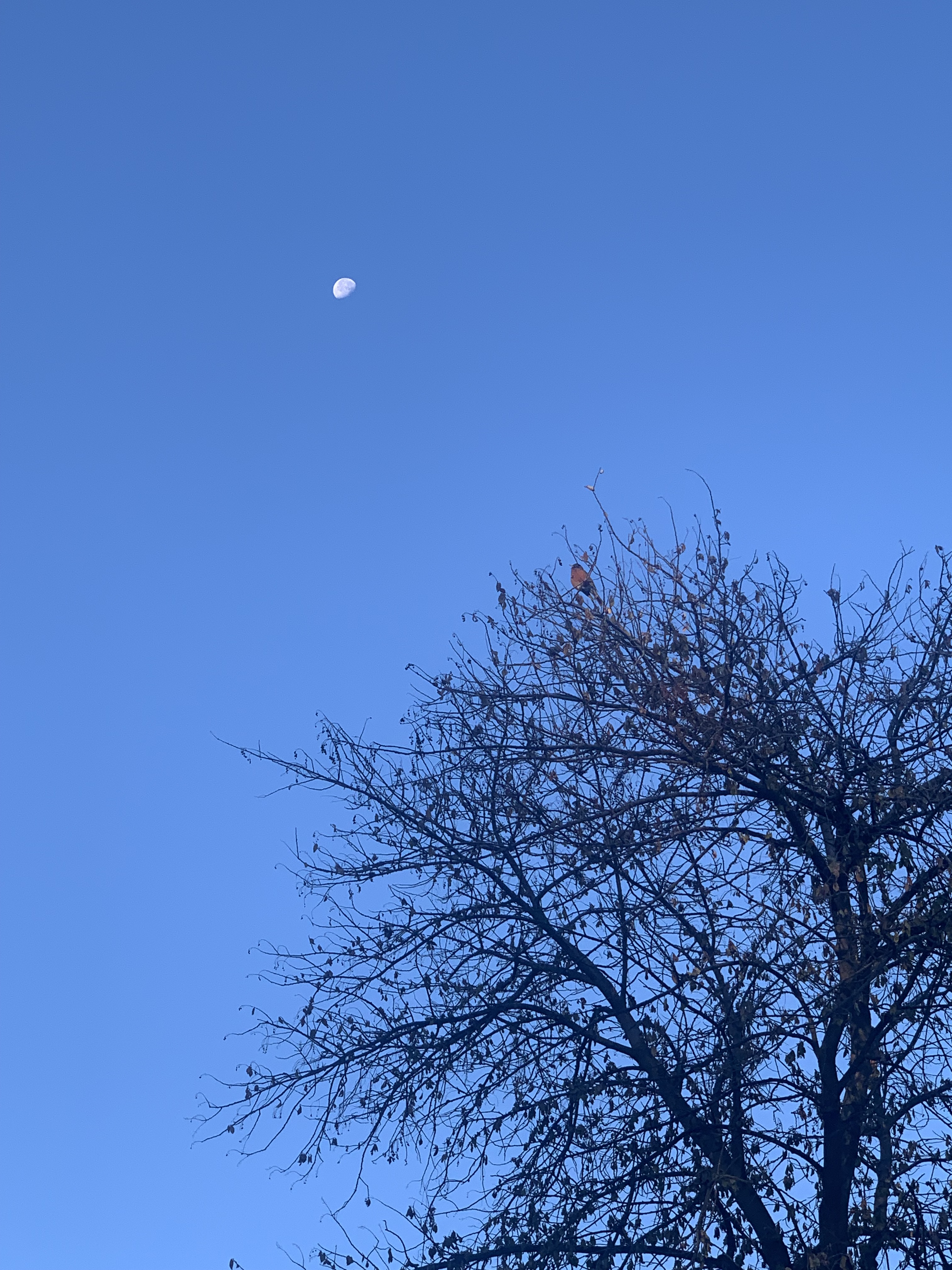
A huge may tree adorns the west boundary of our front yard. A robin has been perched in the top of it throughout this past winter. Our robin. He (she?) was there last winter. I’m frequently greeted by her chirping when I go out to retrieve the morning paper. Hi Mrs. Robin! Good morning to you too! (Of course I took a photo of her)
November 13, 2022 – 7:58 AM
Every summer we witness a few robin fledglings, either by watching them fledge in a backyard nest or spotting little ones chirping and hopping behind their parents. We always have a nest somewhere. I love to study them and blog about them. I must have written at least 24 robin blogs. One year, about 5 summers ago (?) we had a nest in our back yard, the eggs had hatched, the parents were busy busy feeding the noisy little babies. Then one morning, the nest was empty. What? After this discovery I recalled how I had just run three magpies off our deck. YOU! YOU DID THIS! I just figured the magpies had ganged up on the robins (those bullies!) and snatched the little ones.
Imagine my alarm when, three or four weeks ago, I saw a magpie sail past our dining room window with a large sprig in its beak. Uh-oh! I lost sight of it and looked to see where it landed with that sprig. Huh. No clue.
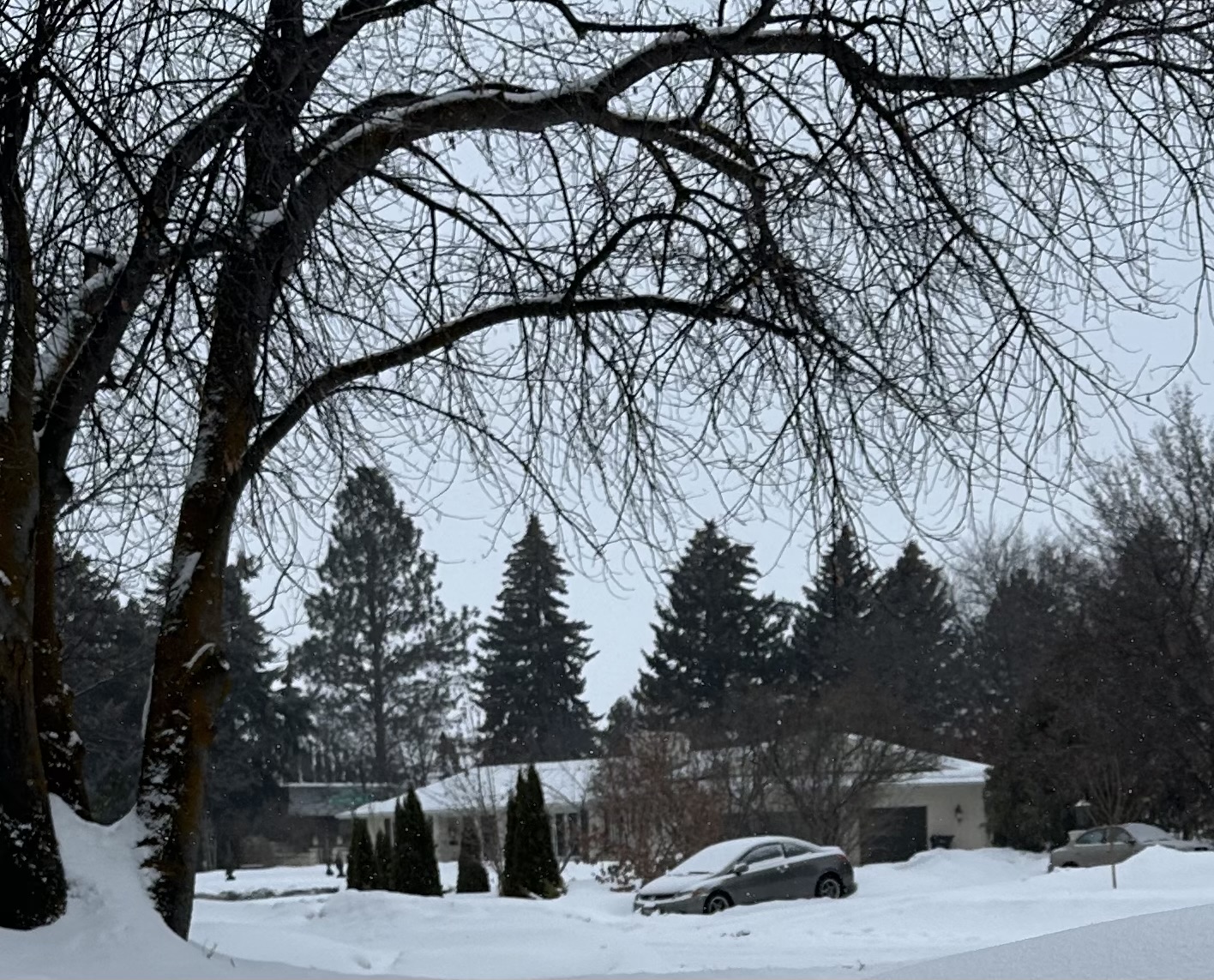
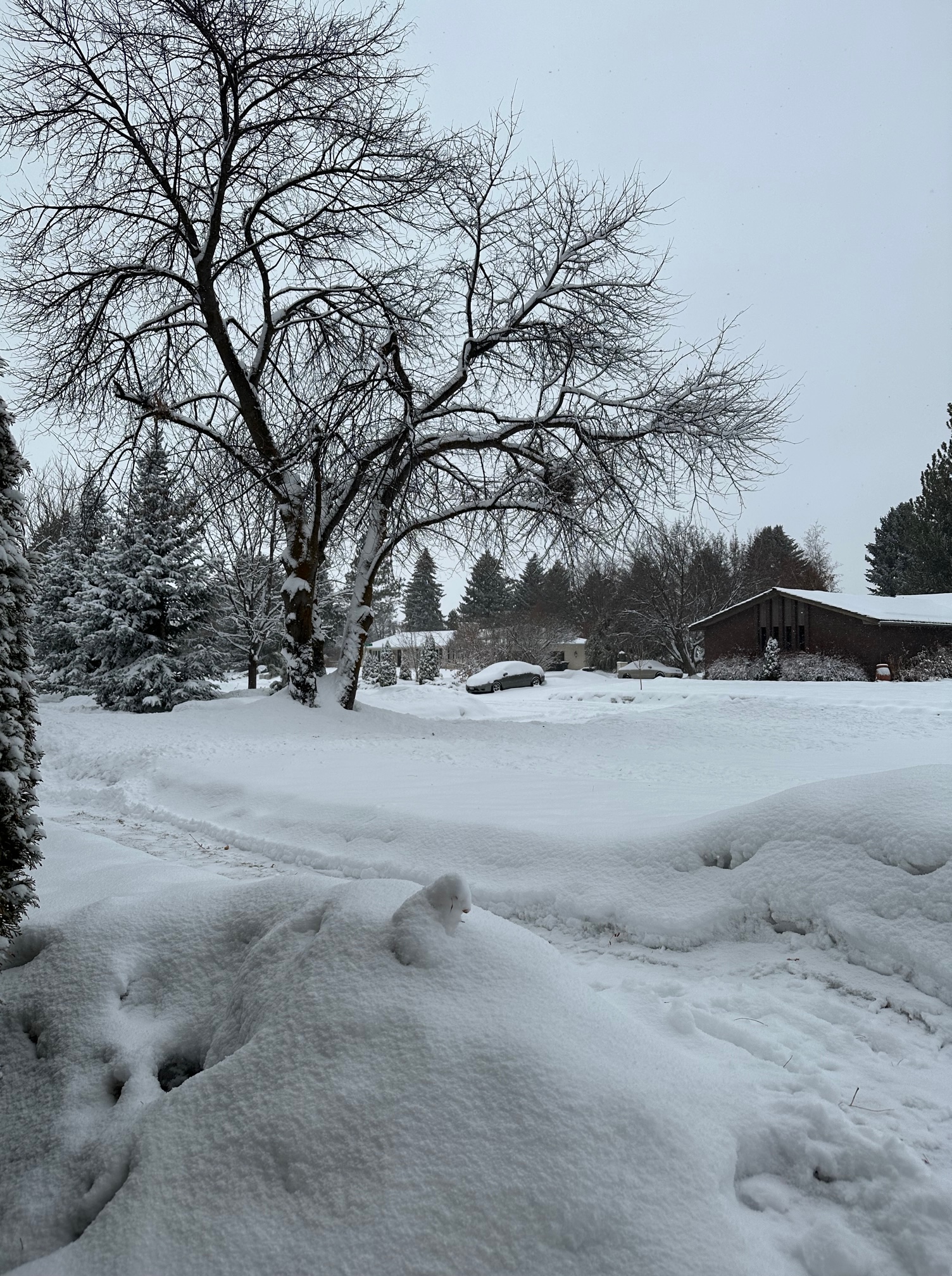
Well of course that magpie was building a nest. And unbeknownst to me, I was capturing photos of it the whole time. My idea of interacting with winter is to hunker in the house and occasionally open the front door to take photos of the latest accumulation of snow. I typically step out on the front stoop, point my i-Phone westward, and capture the view with our front may tree. Well, guess what? Want to see the slide show of a magpie nest being built? It starts on February 20. Nothing going on here, right?
Feb 20, 2023
Then, February 28. Cold, but innocent. Nothing happening here? … perhaps
Then on March 3, huh, a definite thickening of those lower branches hanging down. Gravid. Like the thickening of a womb in preparation for pregnancy.
Two days later – March 5 – definite thickening in those lower branches just above the line of spruce trees
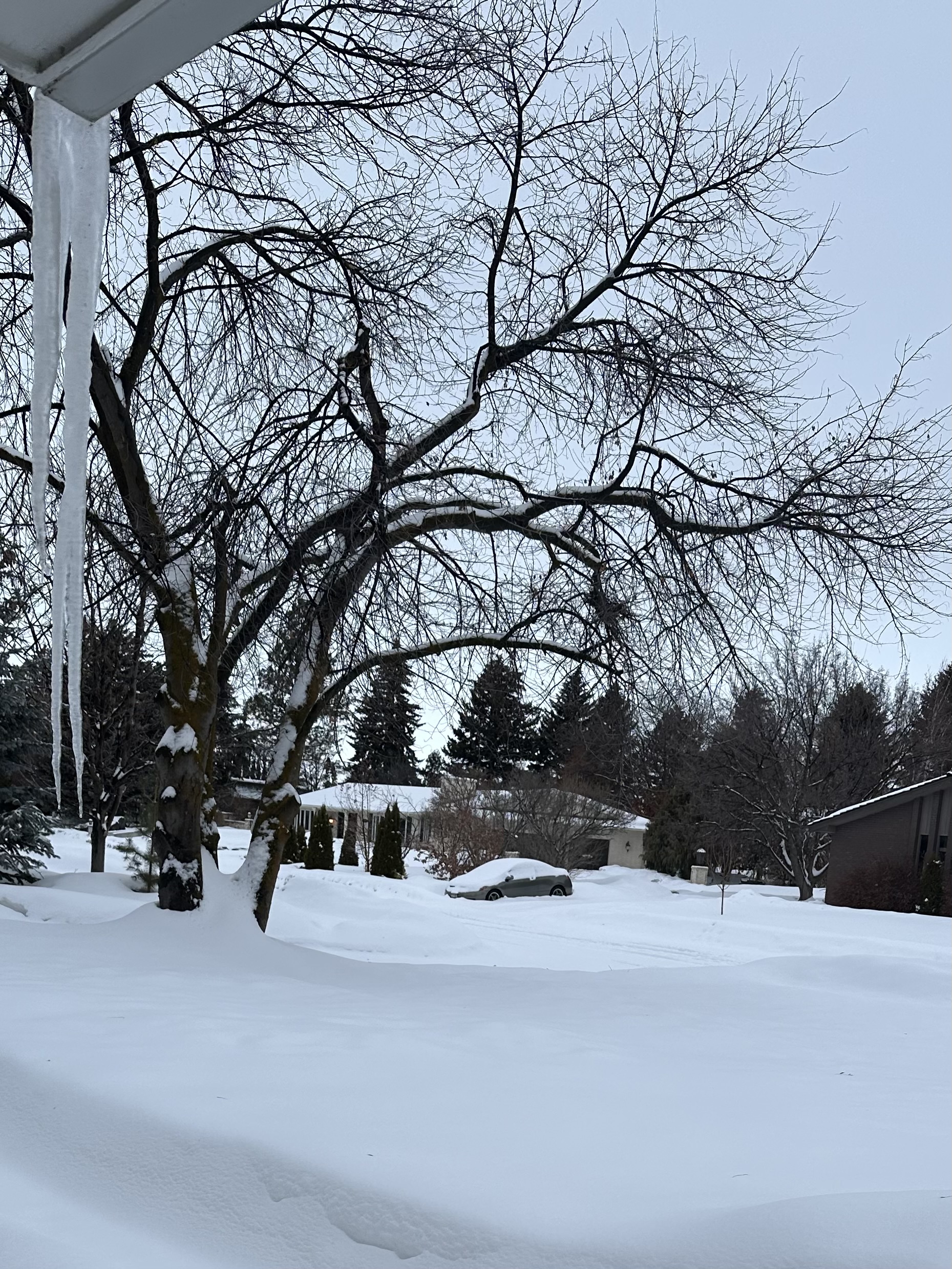
March 10! I had actually used this photo in my Kauai blog, joking that the huge icicle was no spider web, or some such thing, oblivious to the expanding construction project in our May tree.
March 10 – This would have been the moment to intervene. Had I recognized the situation – magpies building a nest right in our front yard. In our ‘Robin tree!’ But no. They kept building, I was capturing it on camera, and we were oblivious.
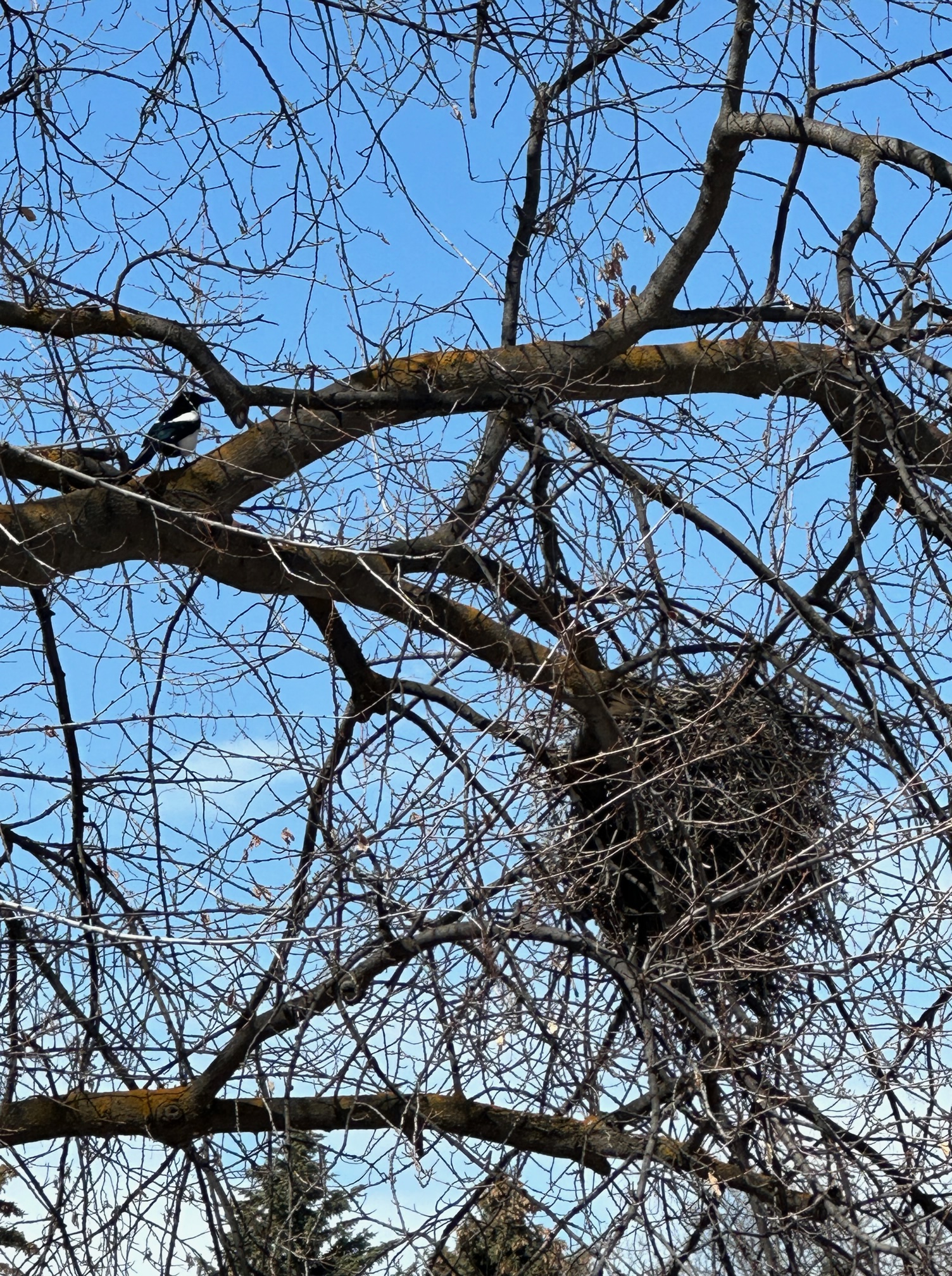
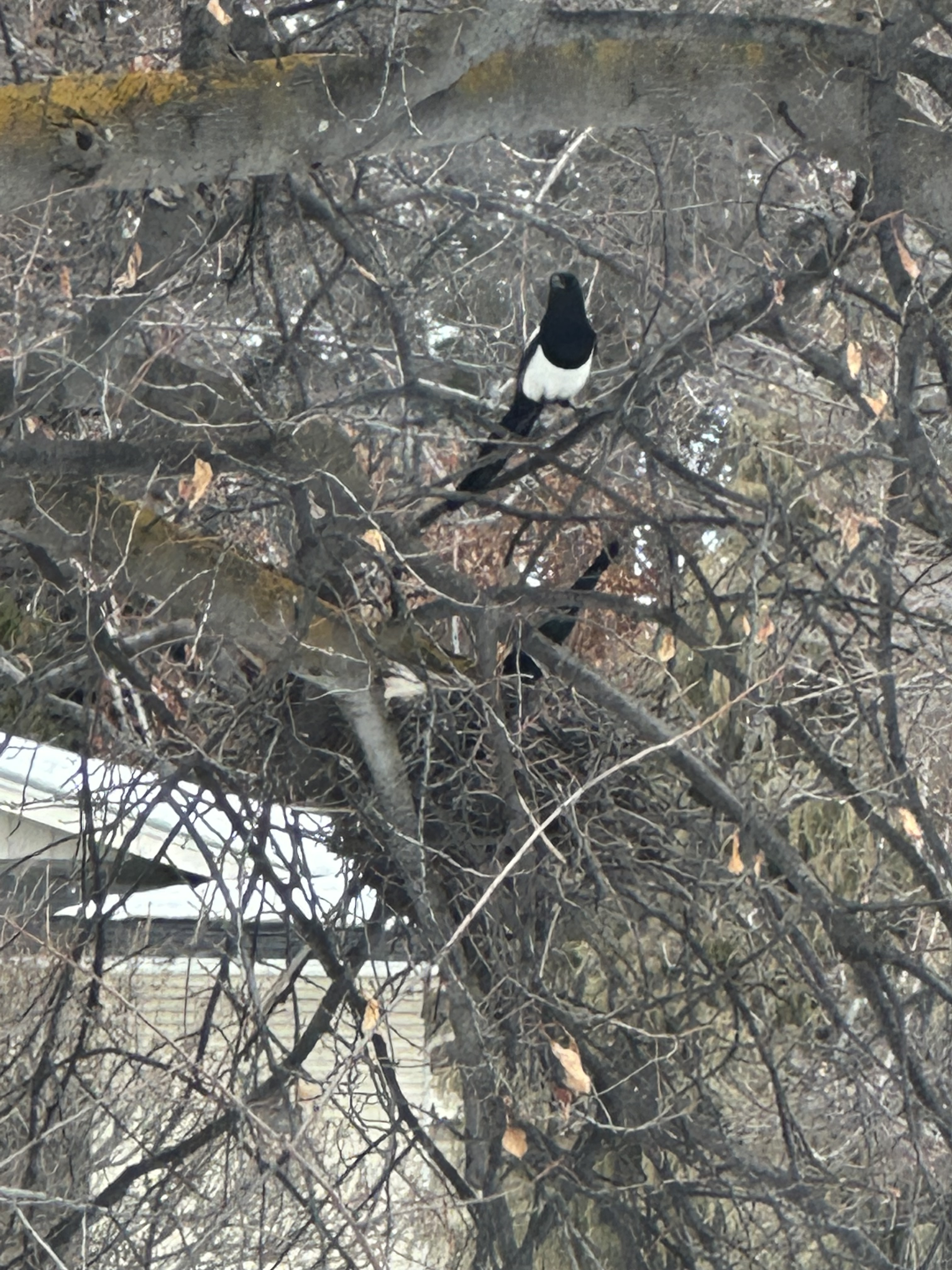
I guess the epiphany came on March 11. There they were! Both of them hard at work on that nest. From what I’ve since read about magpies, the male typically delivers the construction material to the female who builds the nest. You can see the female’s tail in this photo, sicking up out of the nest parallel to the male.
Magpies are building a nest in our front may tree! I just couldn’t grasp the reality of it. I’ve never seen a magpie nest as far as I know. I thought they nested near open fields. Not near humans!
I started doing some research. Here’s a link: https://bonnersferryherald.com/news/2016/nov/10/magpie-the-chatterbox-of-the-bird-world-11/ These black-billed magpies are native to Idaho and the western half of North America. I guess one could argue that they were here before humans and think about how a family of magpies must feel about a big house or a human neighborhood going up next to them! I already knew they don’t migrate in the winter. How does the saying go … “they’re scrappy- when the going gets cold they don’t get going.” They tough out the winter, which tells you how smart and industrious they are.
Magpies are part of the Corvidae family, along with the crows, ravens and blue jays. Indeed, they are highly intelligent, one of the smartest animals in the animal kingdom. Magpies are so noisy because they have communication abilities similar to basic human language, including telling if another magpie is lying!
I wanted to capture closer photos and videos of their industrious nest building, but I was confined to taking them through our dining room window. No matter how busy they were building inside the nest, as soon as I even turned the front door knob to step outside they flew away. So every photo and video you see was taken from inside the house.
Took this video on March 12. Through our dining room window, of course. Turn your sound up so you can hear the proud male announcing his delivery to the female!
Here’s a photo I took a little later on March 12. Look how big that nest is already. Maybe they’re about finished with it.
March 13 – huh, they seem to be adding a canopy or something…
By March 15 it’s clear they are building a two-story condo
March 17 – you work downstairs and I’ll work upstairs!
March 17 – Really shaping up! See the front entrance? There’s a hole there between the two stories.
March 21. Welcome first day of spring! No wonder they build a dome over the nest
Fire up the furnace!
On March 22 I took this video. It’s a little long, 48 seconds, but it’s quite entertaining. One of the magpies drops an 18-inch twig and then flies down, attempts to retrieve it, but maybe decides otherwise (?) Smart move. The other magpie flies in to assist.
They are so industrious and persistent!
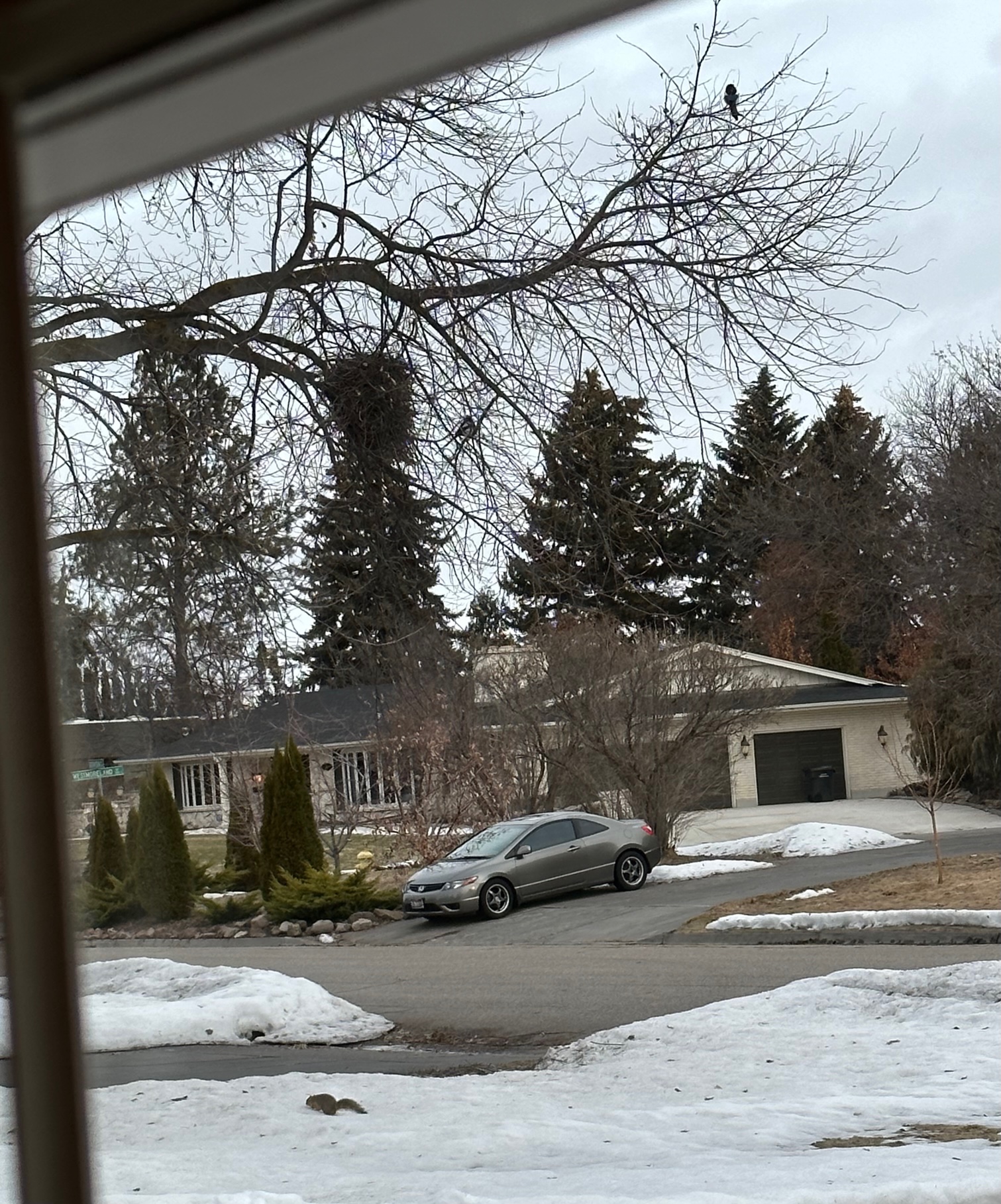
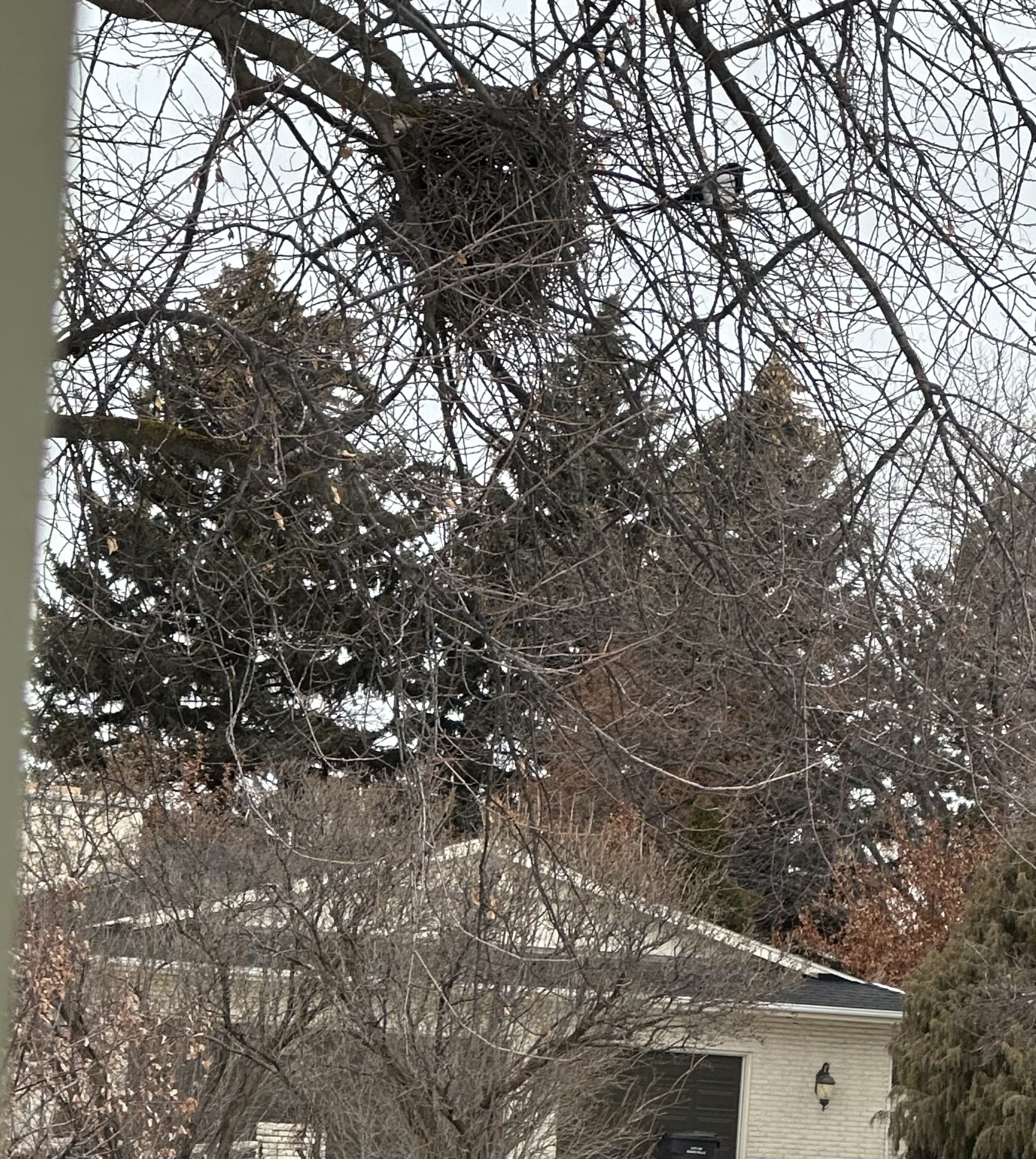
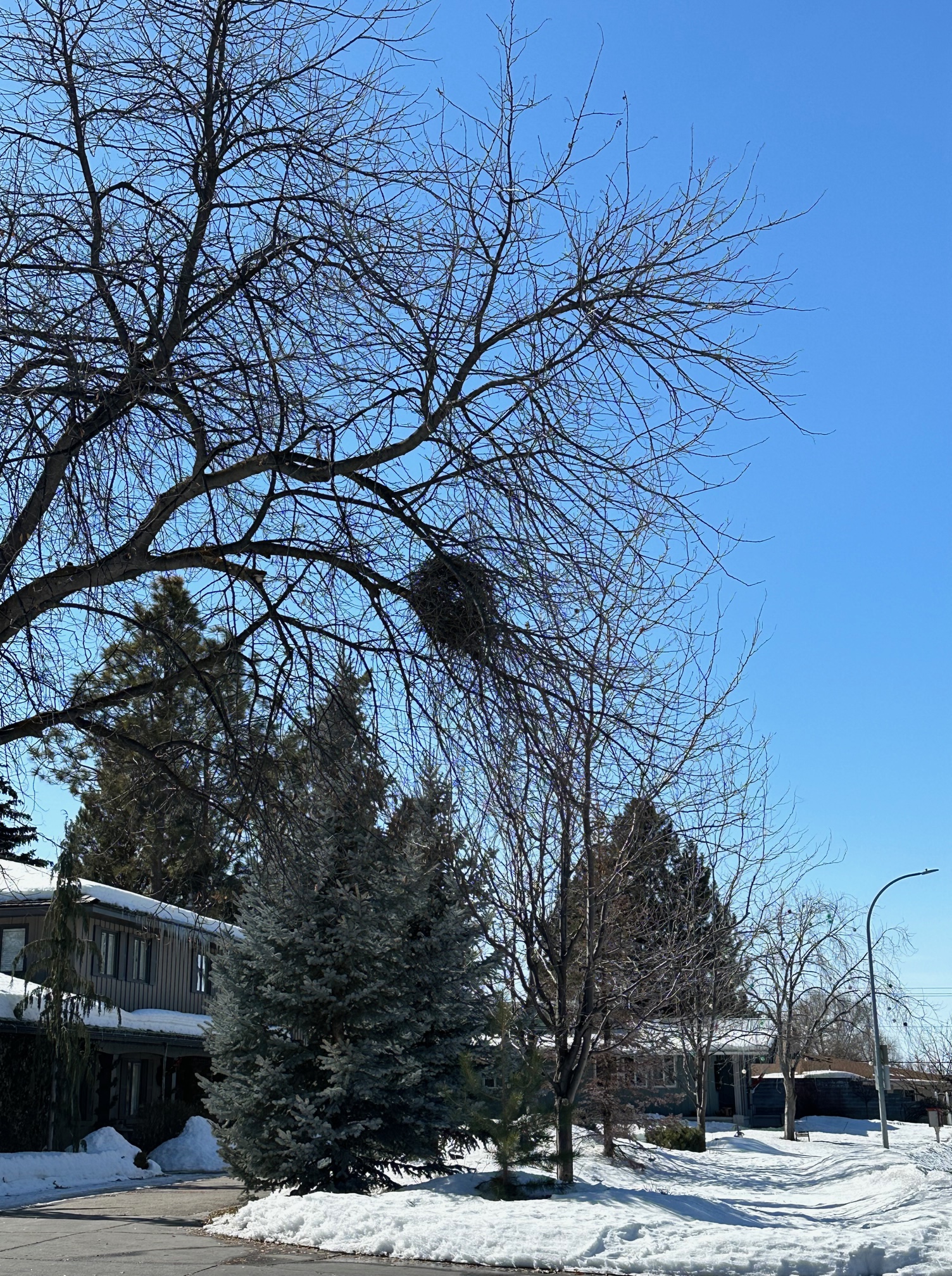
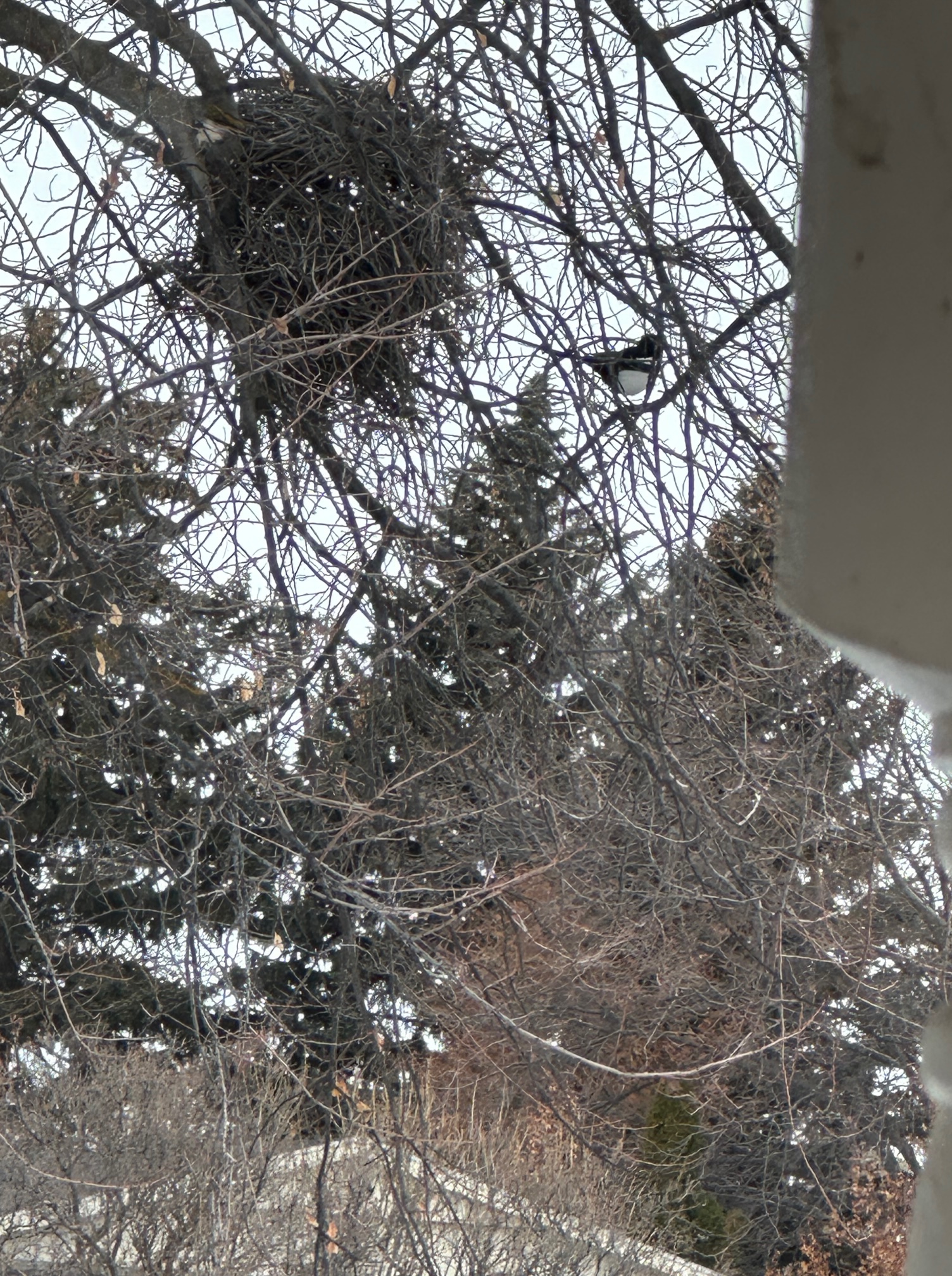
Saturday, March 25. Do you suppose you would notice this nest if you were to walk down our street?
It honestly looks like a giant womb. Which, I suppose it is.
Check out this link to learn more about magpie nesting. https://birdfact.com/articles/magpie-nesting The nesting season is April to July. Egg-laying typically starts in late March or April. Magpies may start building their nests as early as December. It obviously takes several weeks to build them. But they usually finish the nest in March.
I took this photo this morning.
The magpies have been adding finishing touches, likely lining the inside now with moss, animal fur, feathers and other soft materials. When will they lay their eggs?
At some point that may tree will leaf out obstructing the clear view of the comings and goings of this magpie family. May trees typically bloom and leaf out in the first week of May. But this year?? The way ‘spring’ is going, I’m thinking … June?
Watching these magpies is going to be interesting. Especially with all the other activity going on around here. Just last Thursday evening David came in from the back patio, “Hey check out the owl in our back spruce tree.” I did. Except when I went out there the “Whoo-whoo-whoo-ing’ was coming from across the street. So I went out the front door – captured this video. (Turn up your sound!)
Yeah, two great horned owls calling to each other. As I took the video the one roosting in our back spruce tree flew overhead and landed in a spruce tree near the other one.
And since then I’ve been watching carefully and wondering … what does an owl’s nest look like?
Yes, methinks things are going to get interesting around here with those magpies.

















 The Decompression of a Boomer