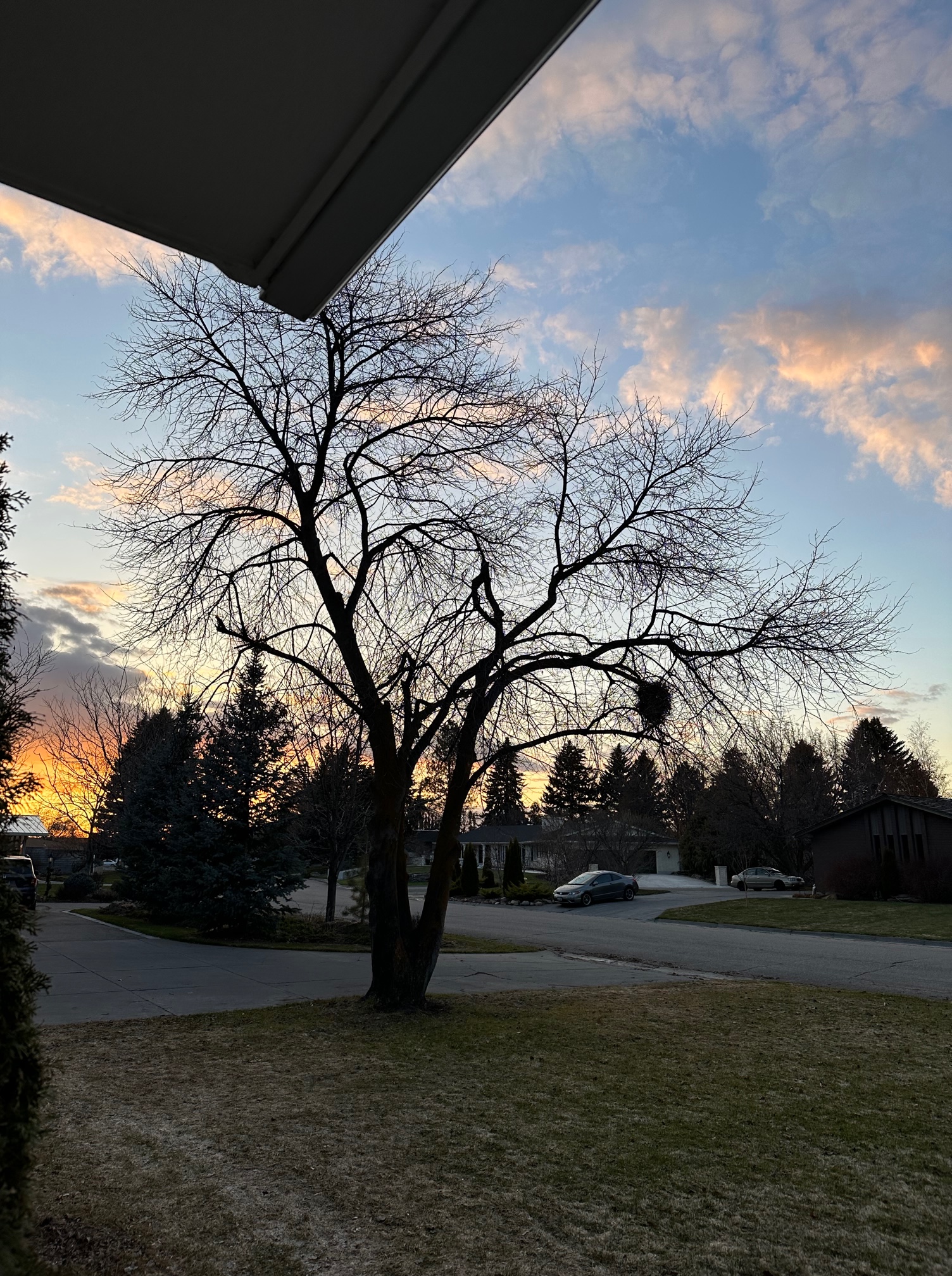
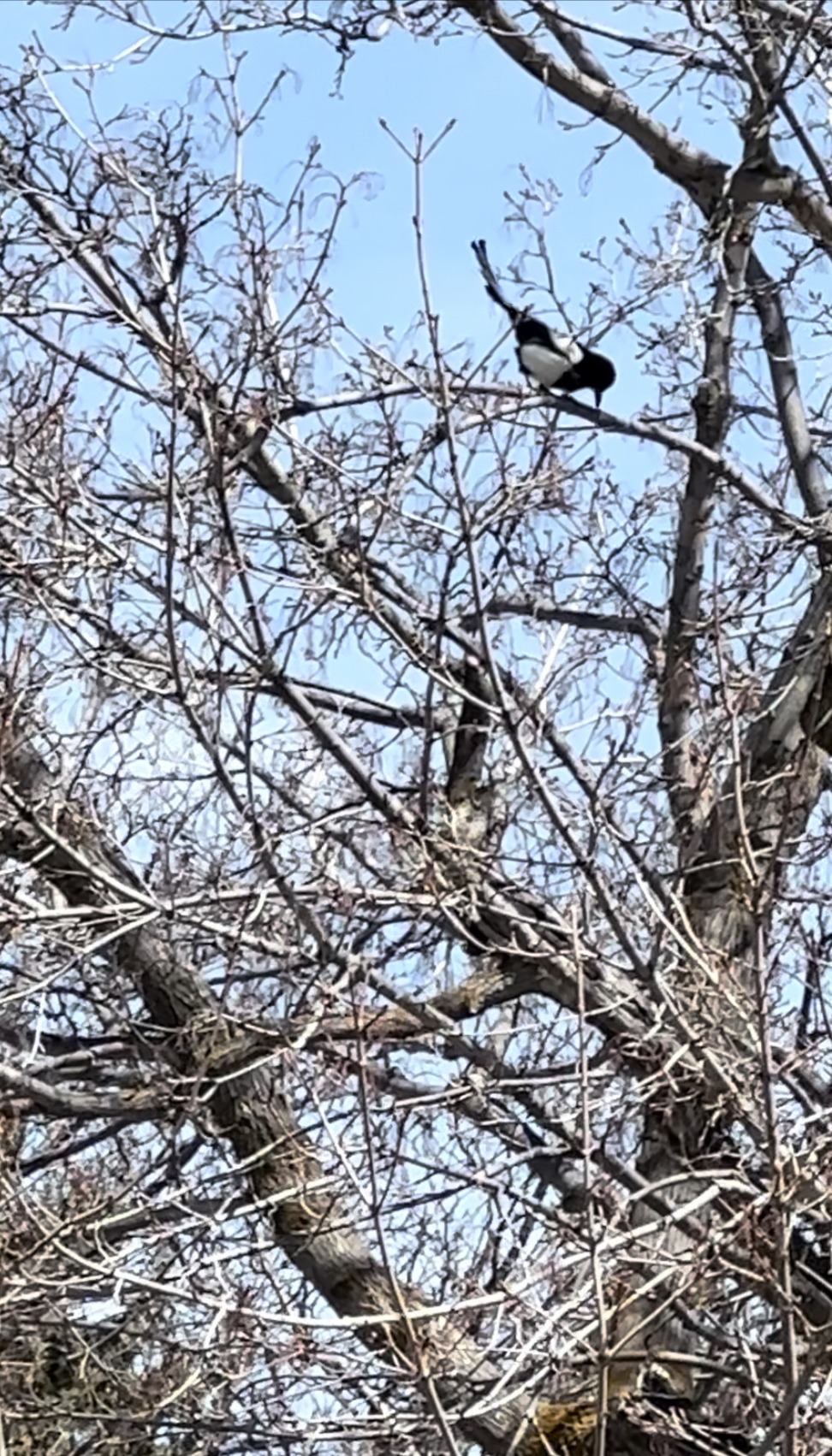
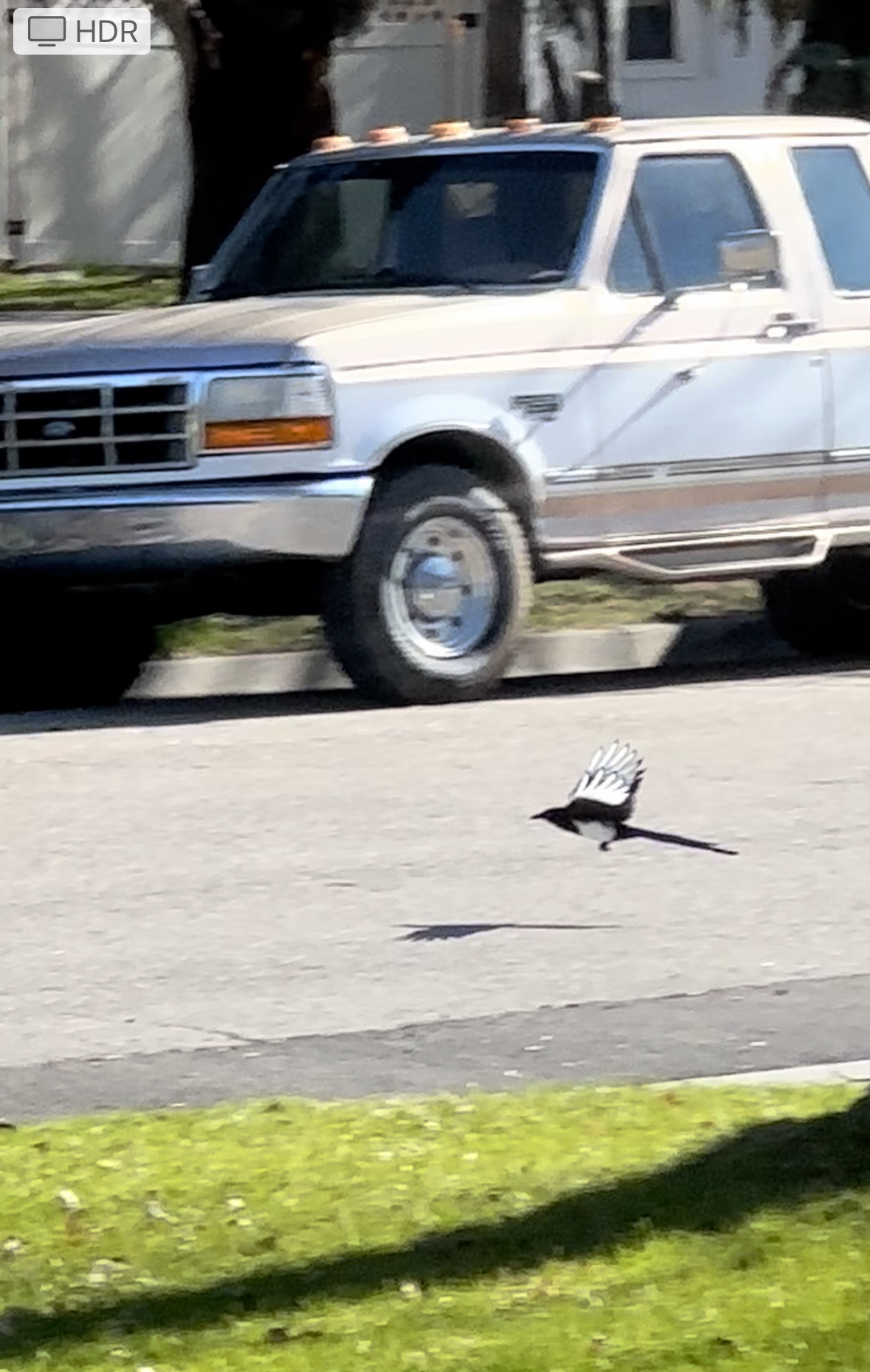
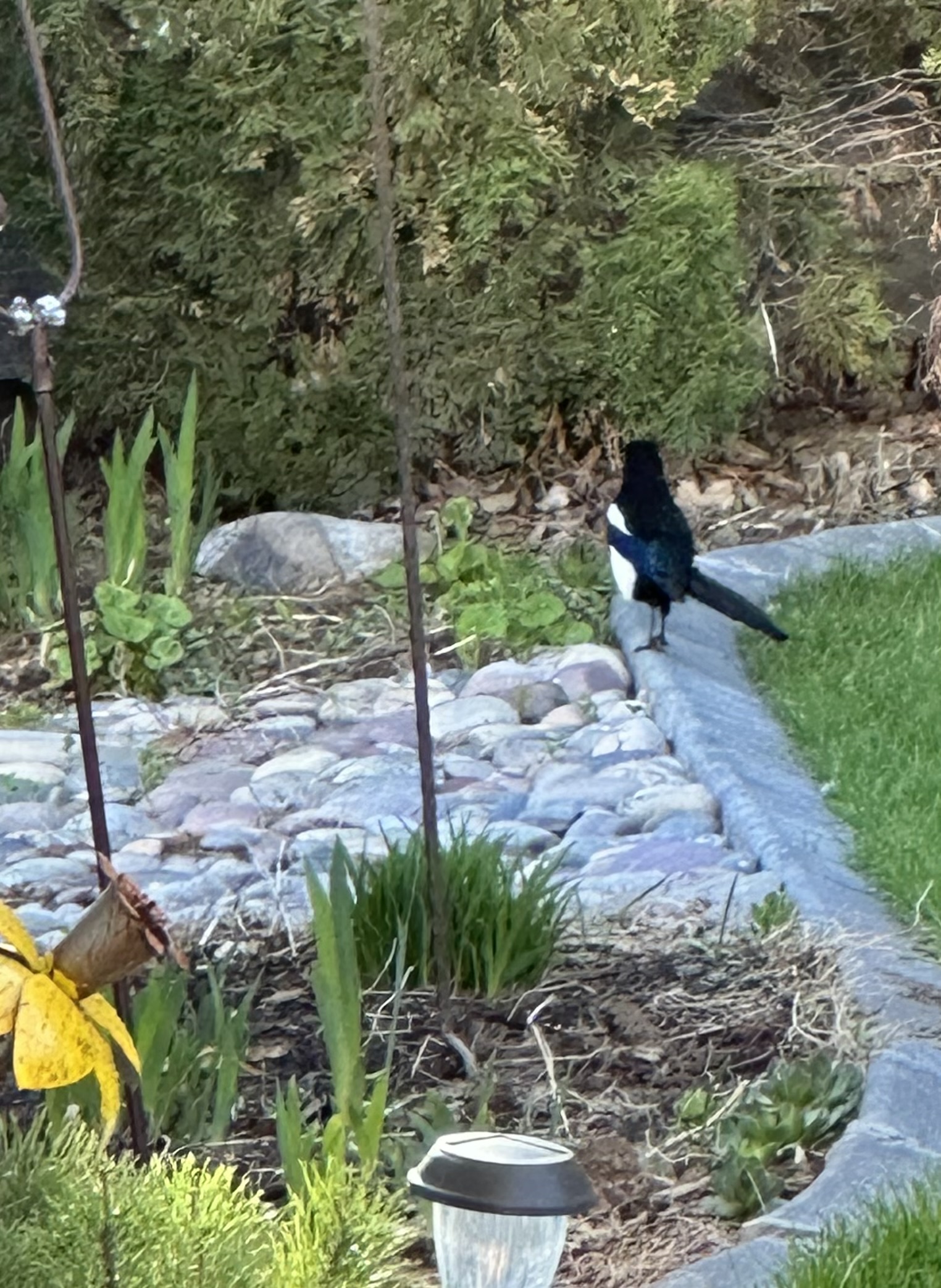
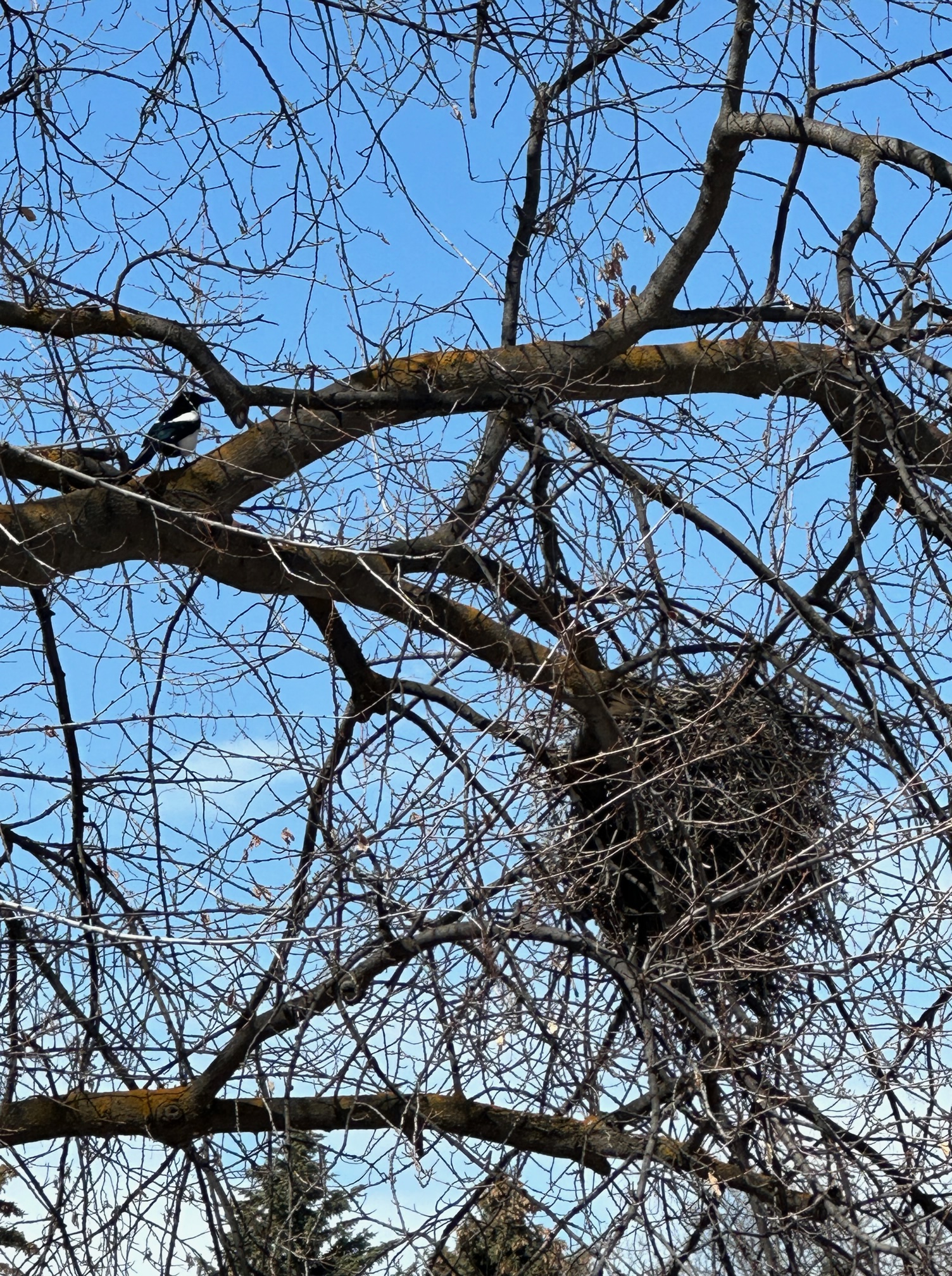
Kauai 2024 – Part 5 – Aloha, Mahalo Kauai!

May 5, 2024

I’ve had writer’s block or something with my blog to where I just can’t move on from our January visit to Kauai. There’s a loose end here. I feel like I’ve left us marooned in Kauai and I need to get us home. Plus, somehow I got sidetracked this year with my blogs, writing about gluttonous invasive bullfrogs, invasive African snails the size of your fist and wild boar hunting with knives and two packs of hunting dogs. Novel idea, how about I wrap up this past January trip with some fun photos from Paradise?

“I agree,” said the rooster …
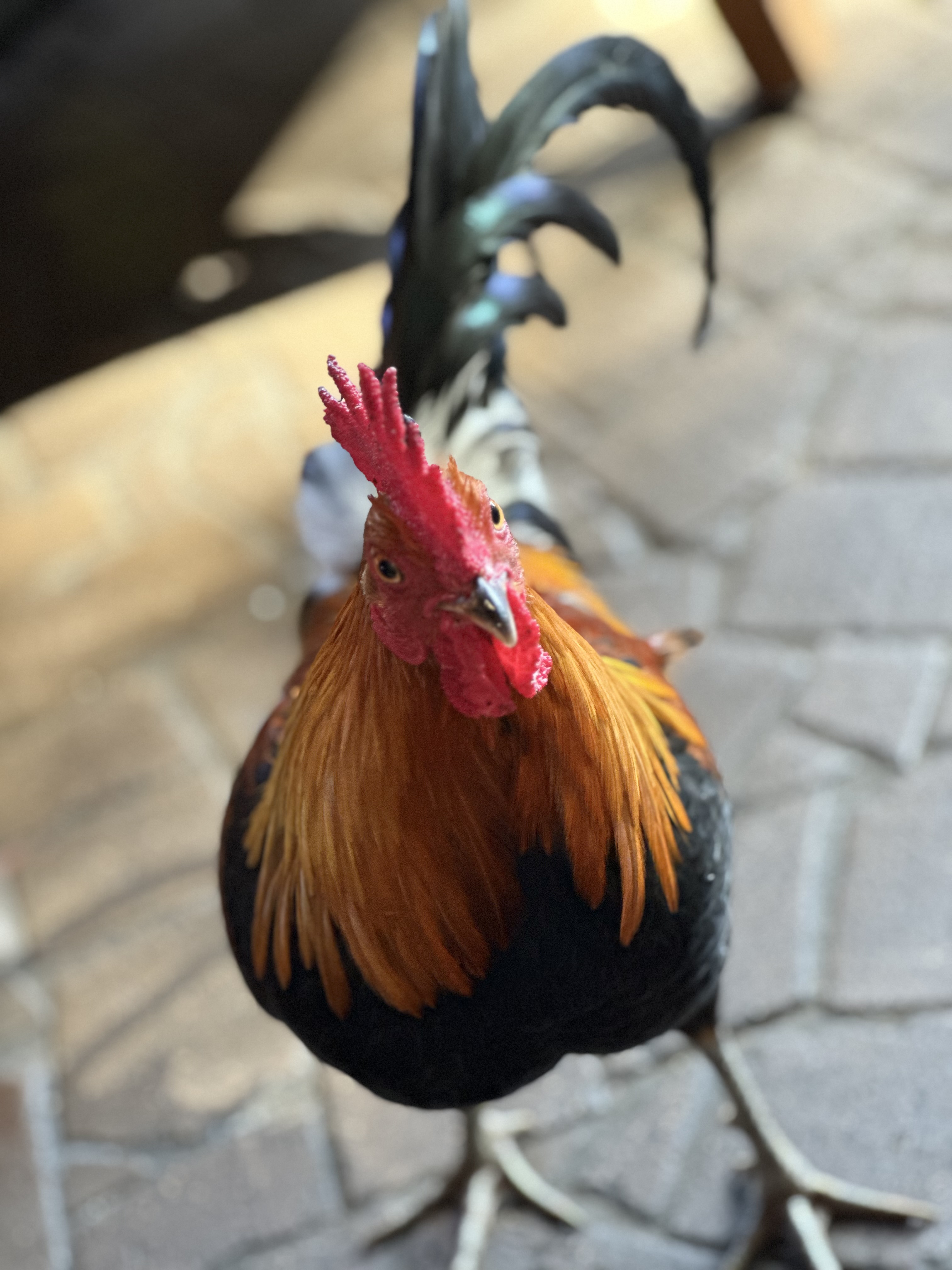
stalking us during lunch on an outdoor patio. A “Please do not feed the birds” sign is posted nearby, but how can we resist that face? Yeah, well, if you don’t resist, the rooster persists. Feral? You bet! Just try to catch that rascal.

We’ve made about ten visits to Kauai, David and I and my brother Eric. Our daughter Megan came with us the last couple of years. I usually write about 6 blogs after each trip, filling you in from beginning to end, getting us safely back home to Idaho. I reminisce and post my favorite tales and photos of Paradise, until spring gets here. Which, well I’m still good this year, time wise, since, here in southeast Idaho, we woke up yesterday to snow.

When we visit Kauai, we stay on the north shore with my sister, Stephanie and husband, Victor, at their home in Princeville. On the north shore of Kauai you absolutely have to visit Hanalei Bay; walk to the end of the dock.

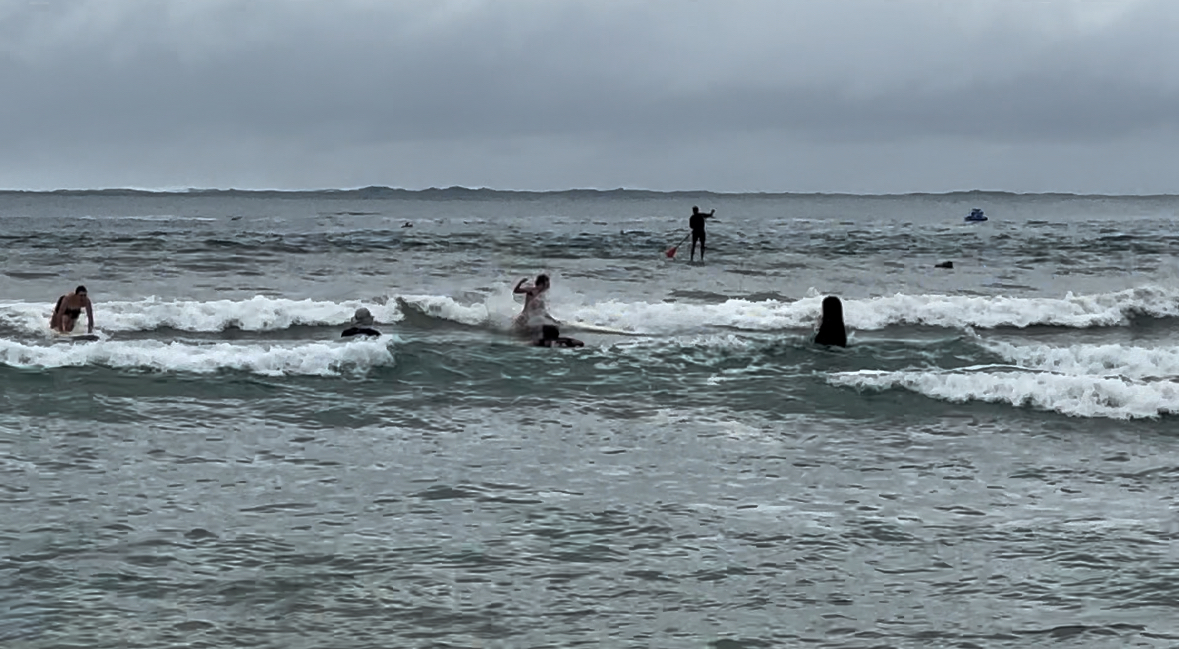
Swim or surf the waves. Or, in my case, swim or surf vicariously through other more enthusiastic water lovers, while you walk the beach. Here, I’ll take you along… you’re wearing your bathing suit, right? Let’s head into the crashing surf!

Or take up the surfboard. Can we catch a wave?
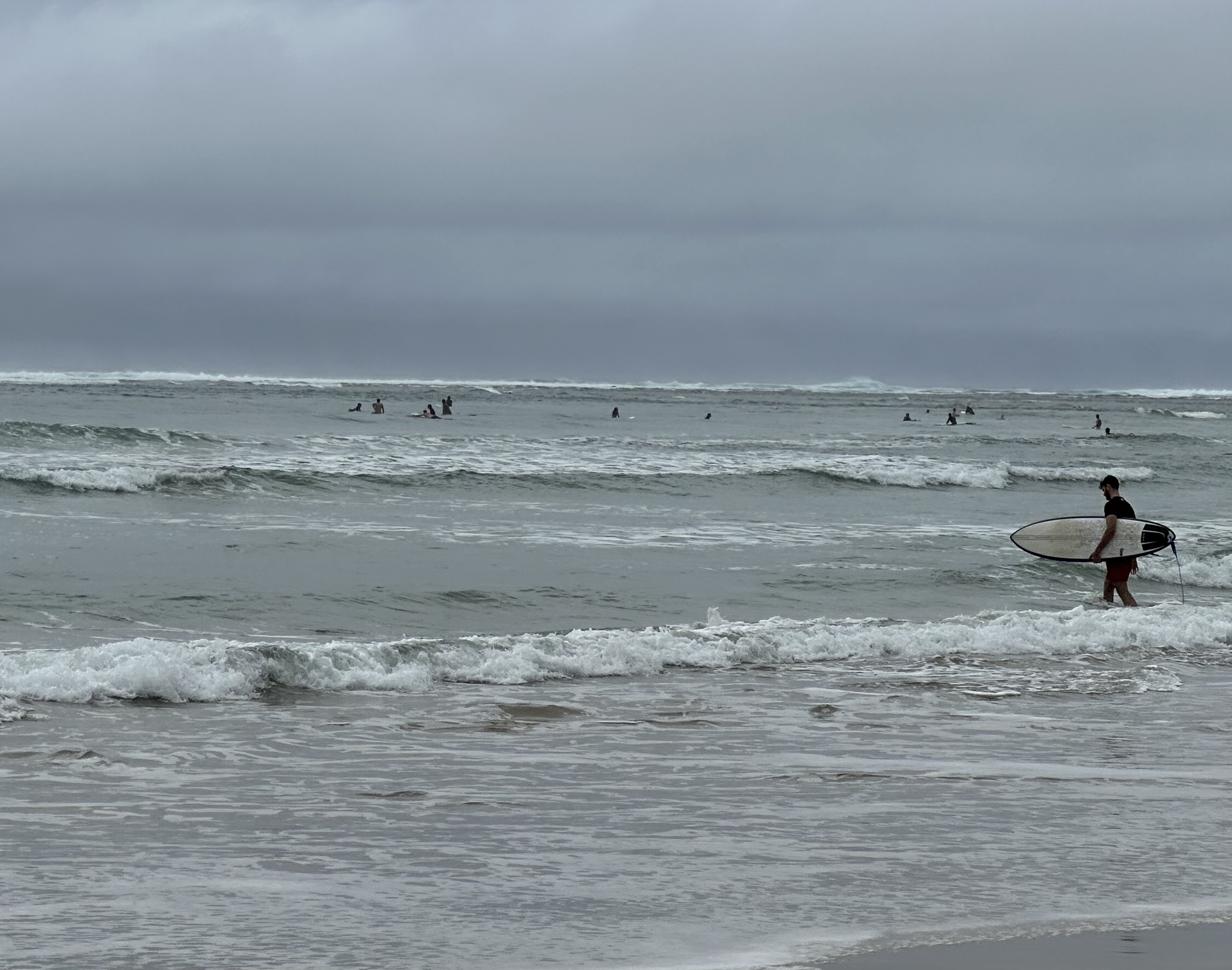
Yes we can! We’re up!… Uh, for about 3 seconds.
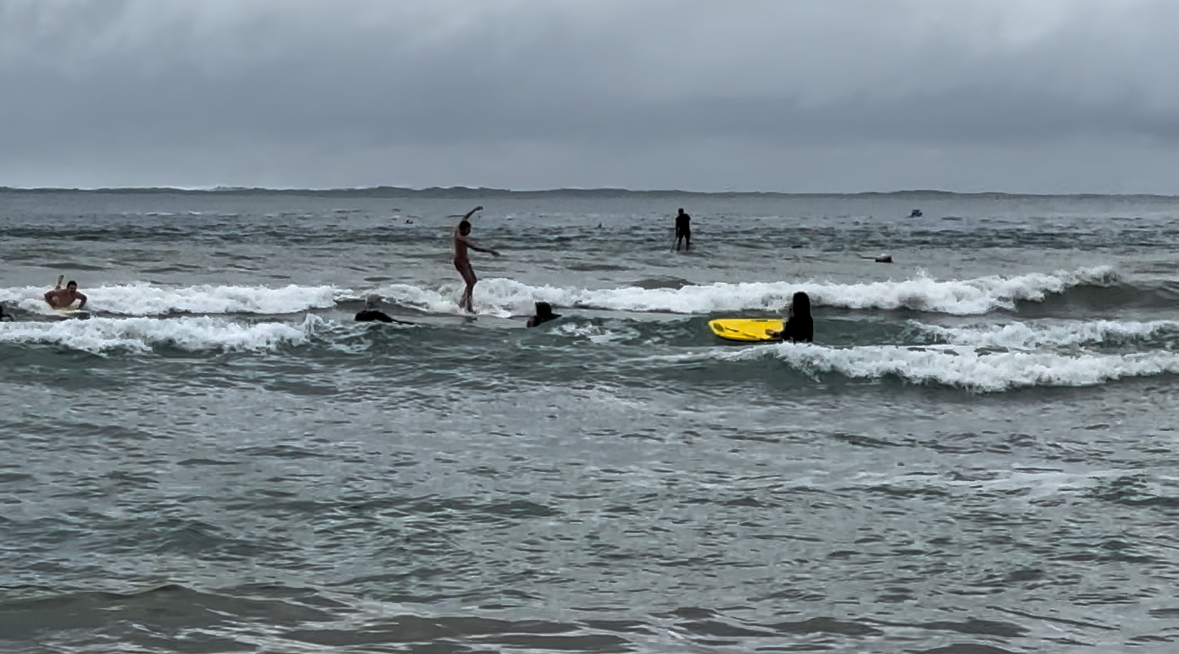
We just have to try surfing again. Like, 500 times. How about paddle boarding?

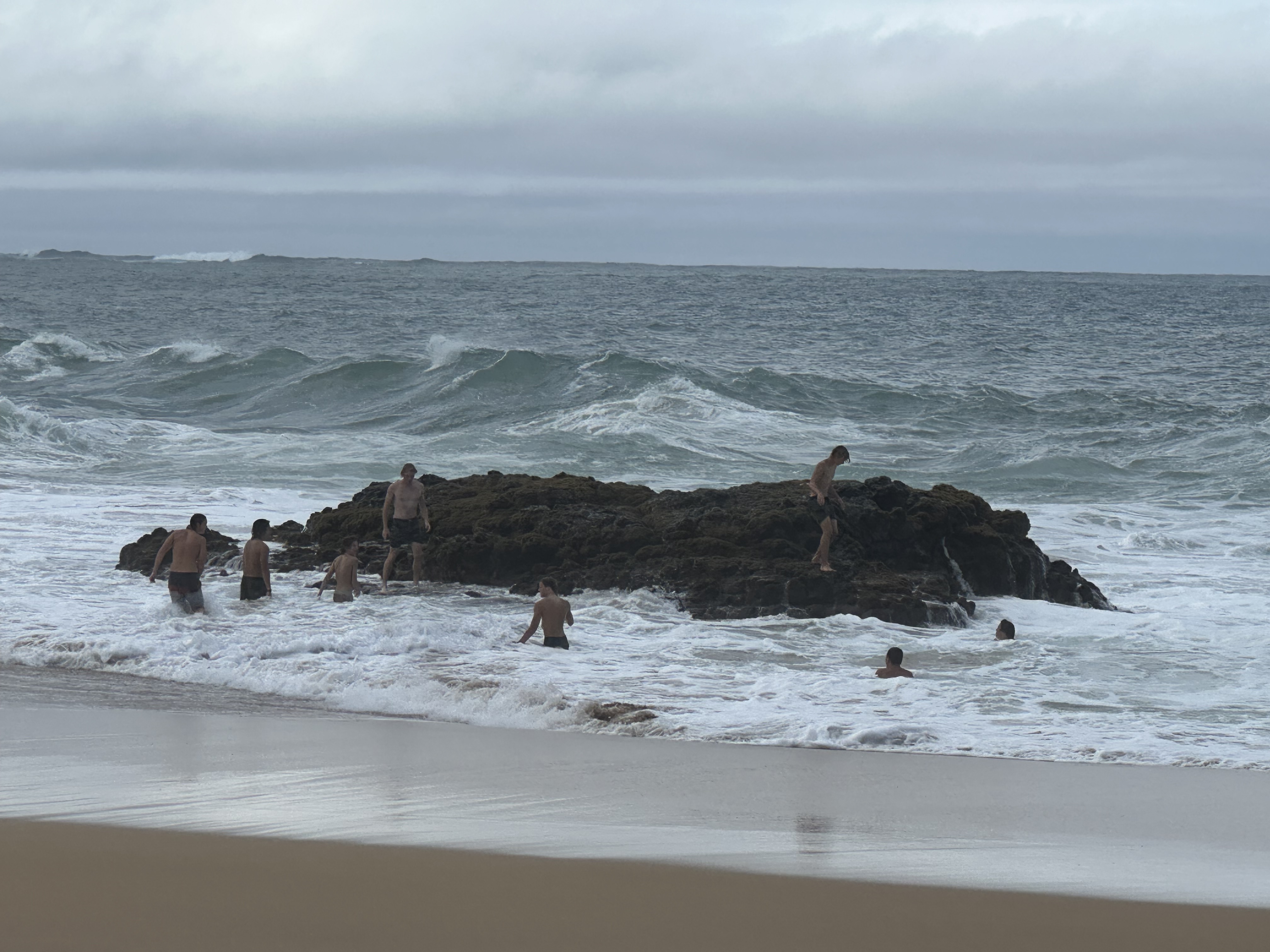
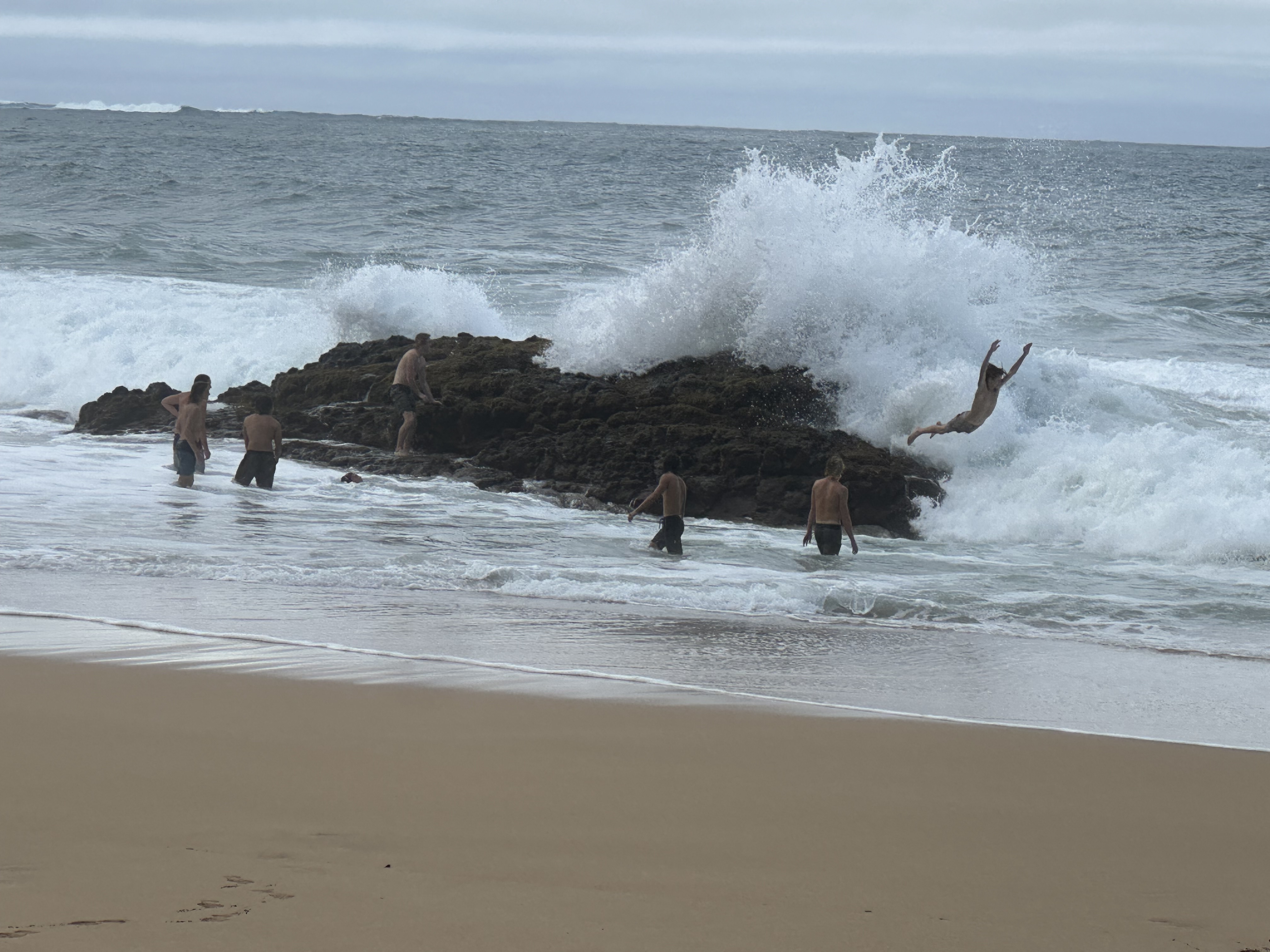
A few miles further north from Hanalei Bay is Lumaha’i Beach, especially thrilling in a high surf. Climb on this rock to play chicken with the roiling surf. Or as a 70-yr-old, do it vicariously through these strapping teenagers (hey, it’s a weekday, aren’t you supposed to be in school? I doubt this is some kind of planned field trip. Do your parents know where you are?)
There are so many beautiful hikes in Kauai. As you explore the lush landscapes, navigating sometimes steep, muddy trails, dodging tree roots, ducking your head under hanging tree limbs, hopping over rocks to forge streams, listening to exotic birds, mesmerized by the tropical scenery, you might miss something. As you gaze at a tree branch, there might be a wonderful little creature staring right at you that you don’t even see. For example, dear reader, we are now on a hike overlooking Larsen’s beach. Do you see anything in the sand below?

At first glance you might just see a shadow. That shadow is an endangered sea turtle!

Do you see the lizard in this photo?
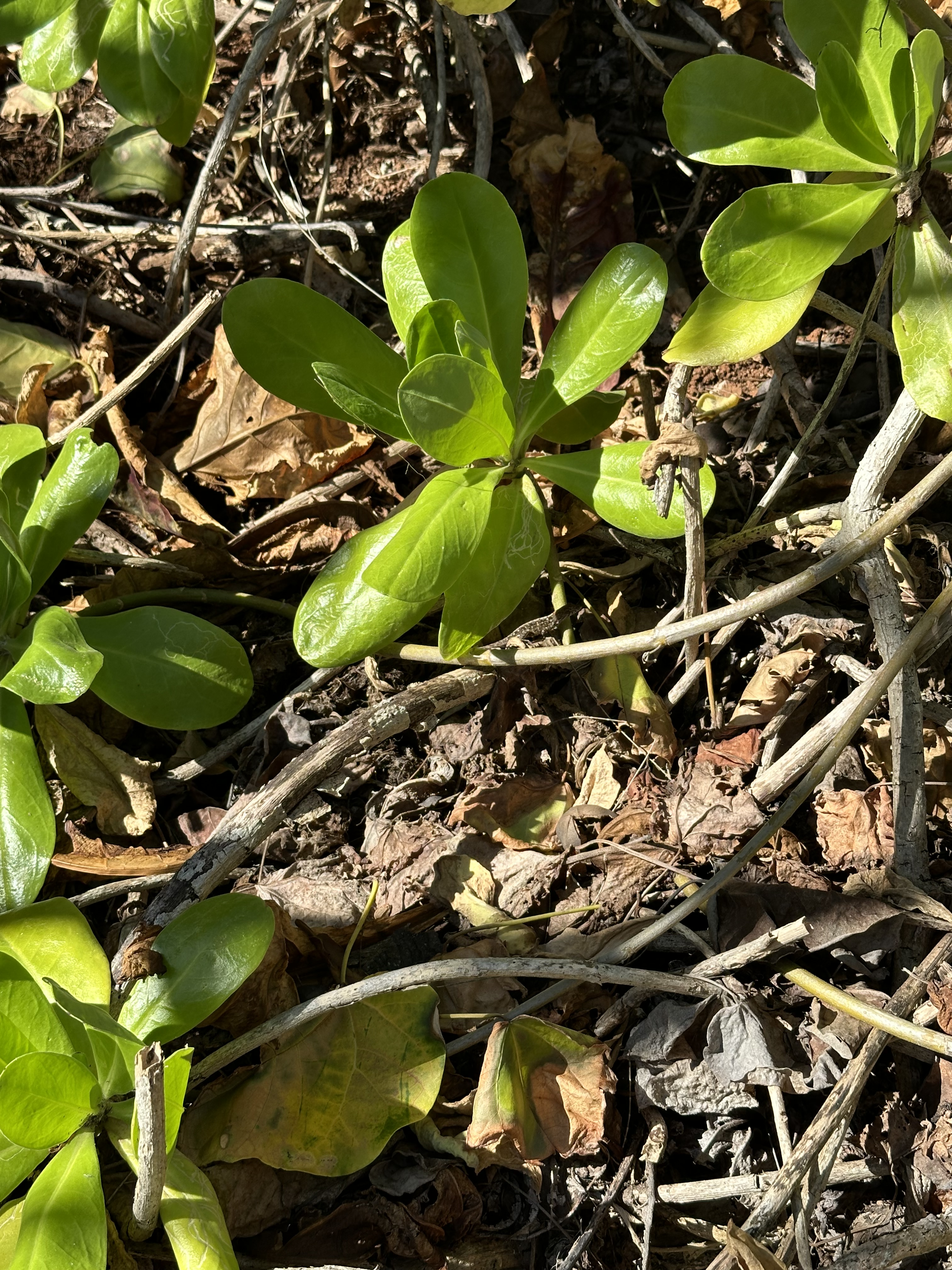
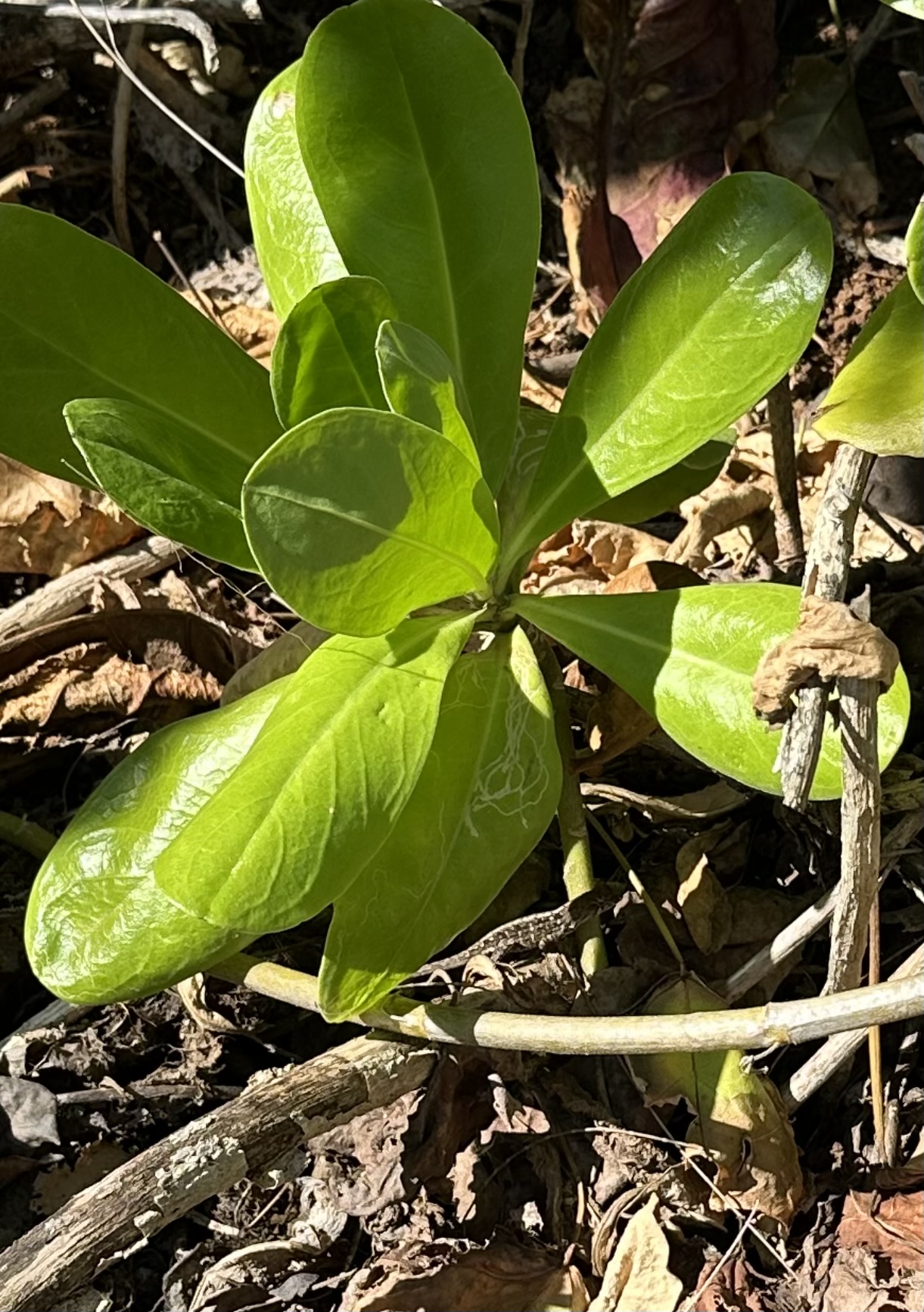
Of course not! you say. Look just above center in the photo right under that middle leaf structure. Still don’t see it? Here I’ve zoomed in:
Find the bee in this photo:

You found it, right? Find the butterfly:
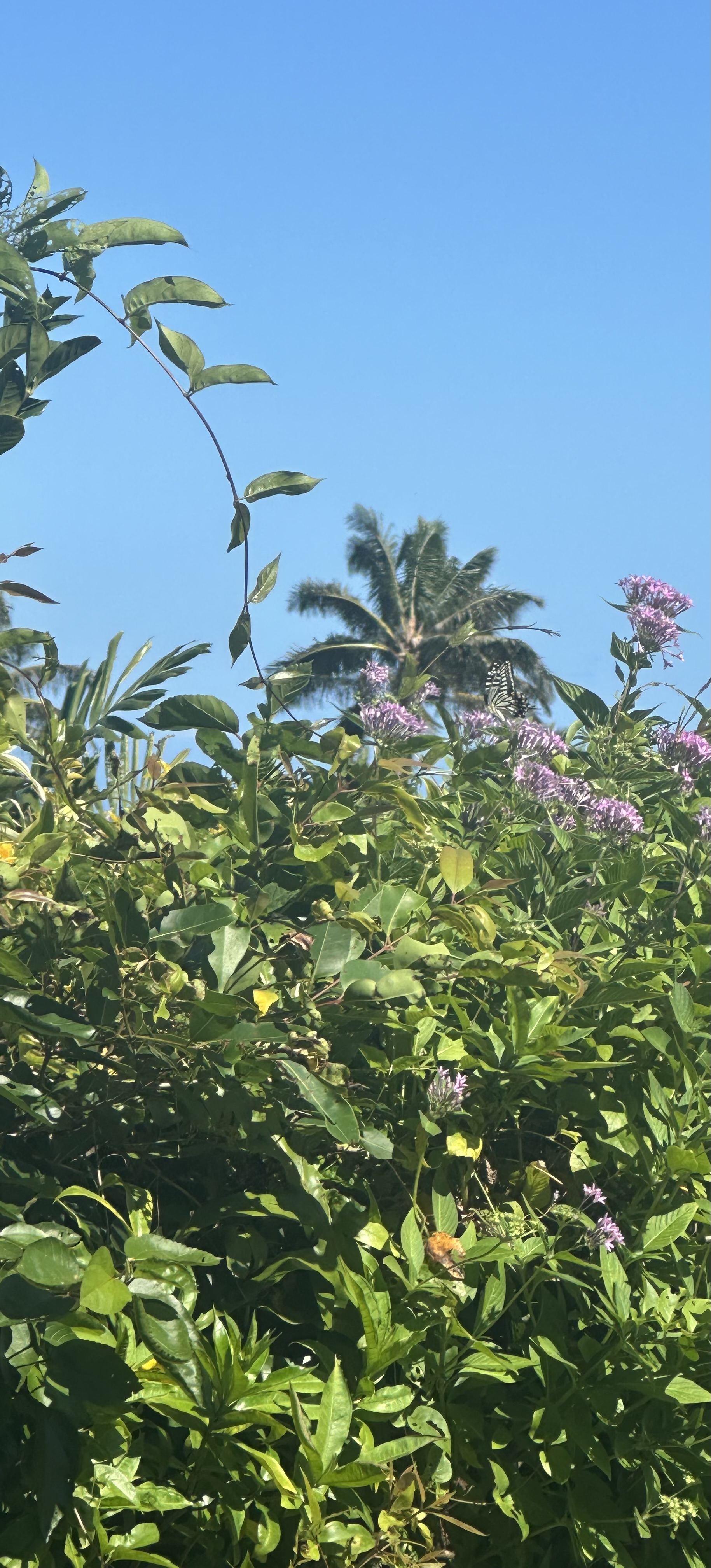
It’s in the middle of all those blossoms.

One more butterfly:

(Upper right side.)

Find Stephanie. (A little small compared to the ancient tree)

Find Eric, literally in the belly of the forest

I have panicked at times on a hike, dilly-dallying, taking photos or something and then look up and everyone has disappeared.

Find Megan:

Thank goodness with me bringing up the rear, someone in our group had the sense to wear bright clothing.

Find the lizard:

Don’t mind him. He’s just a little notch attached to the gutter.

Find this lizard!

Find not one, or two, but three bees (there’s probably more):

Enough already. You’re giving me a headache! You say.

Oh, you need a drink at this juncture? Here you go. A yummy Mai tai!

Oh, but surely you see the fly!

Well, I gotta get us home to Idaho. But not until you enjoy one last breakfast with us at the Hotel 1 in Princeville.

Count the birds. How many do you see? I dunno. As we get up to leave our table by the fireplace, half a dozen birds descend on our leftovers. My review of this very pricey restaurant is that the atmosphere is far more impressive than the breakfast. Even the coffee is hardly drinkable, at least to my standards. (Spoken like a true coffee addict.)

We’ve about come to the end of our visit to Kauai. On our last night we enjoy a fine dinner at the Terrace Restaurant in Hanalei. Here’s the view from our table:
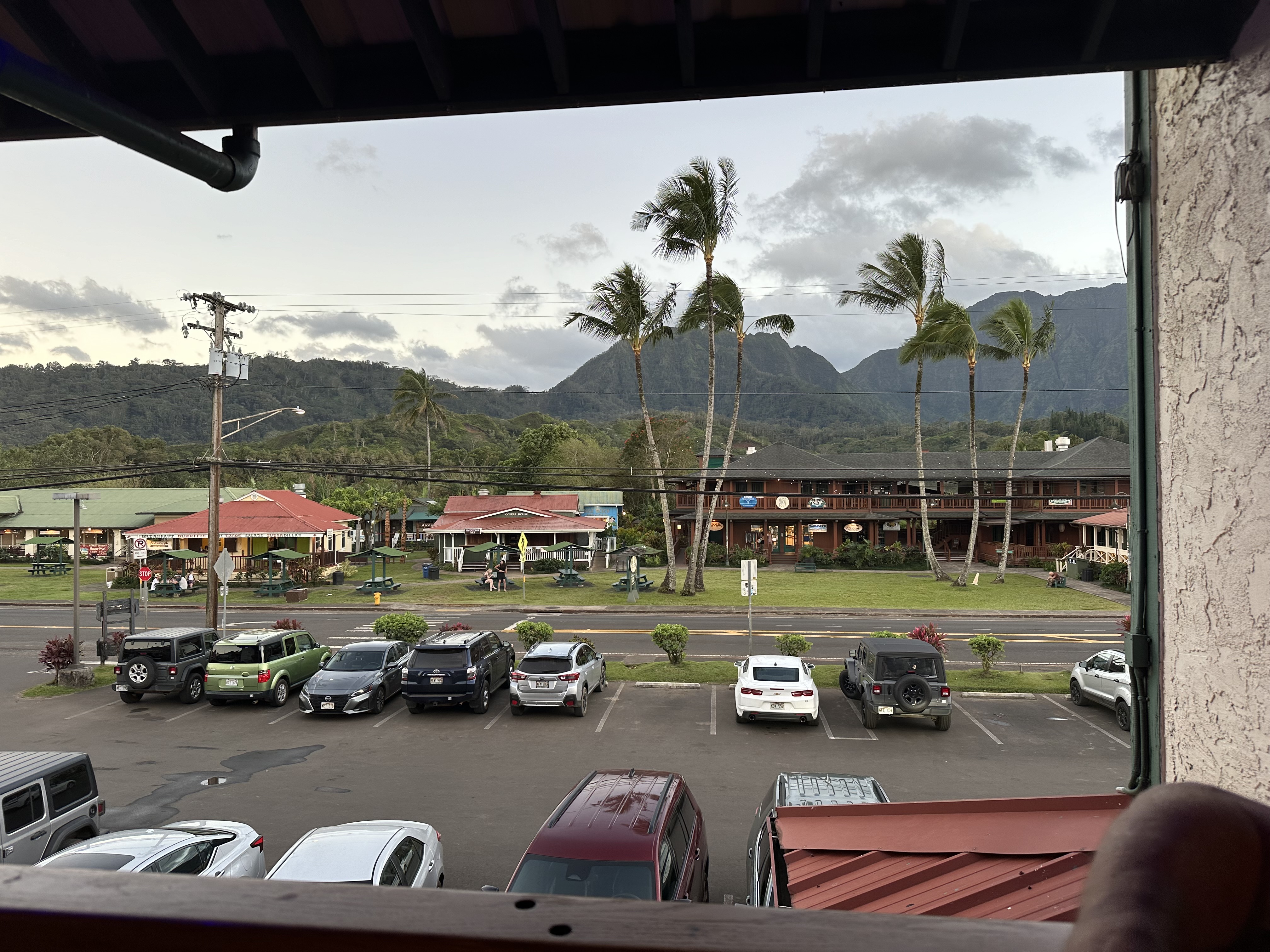
Terrace Restaurant, Hanalei

I take a photo of us after dinner: Victor, Steph, David, Eric and Megan

Mahalo, Kauai!

But before heading to the airport we bid one last farewell to the egret:

The red-crested cardinal

and the magnificent albatross

This pickup pretty much summarizes how you feel after a two-week vacation in Kauai:
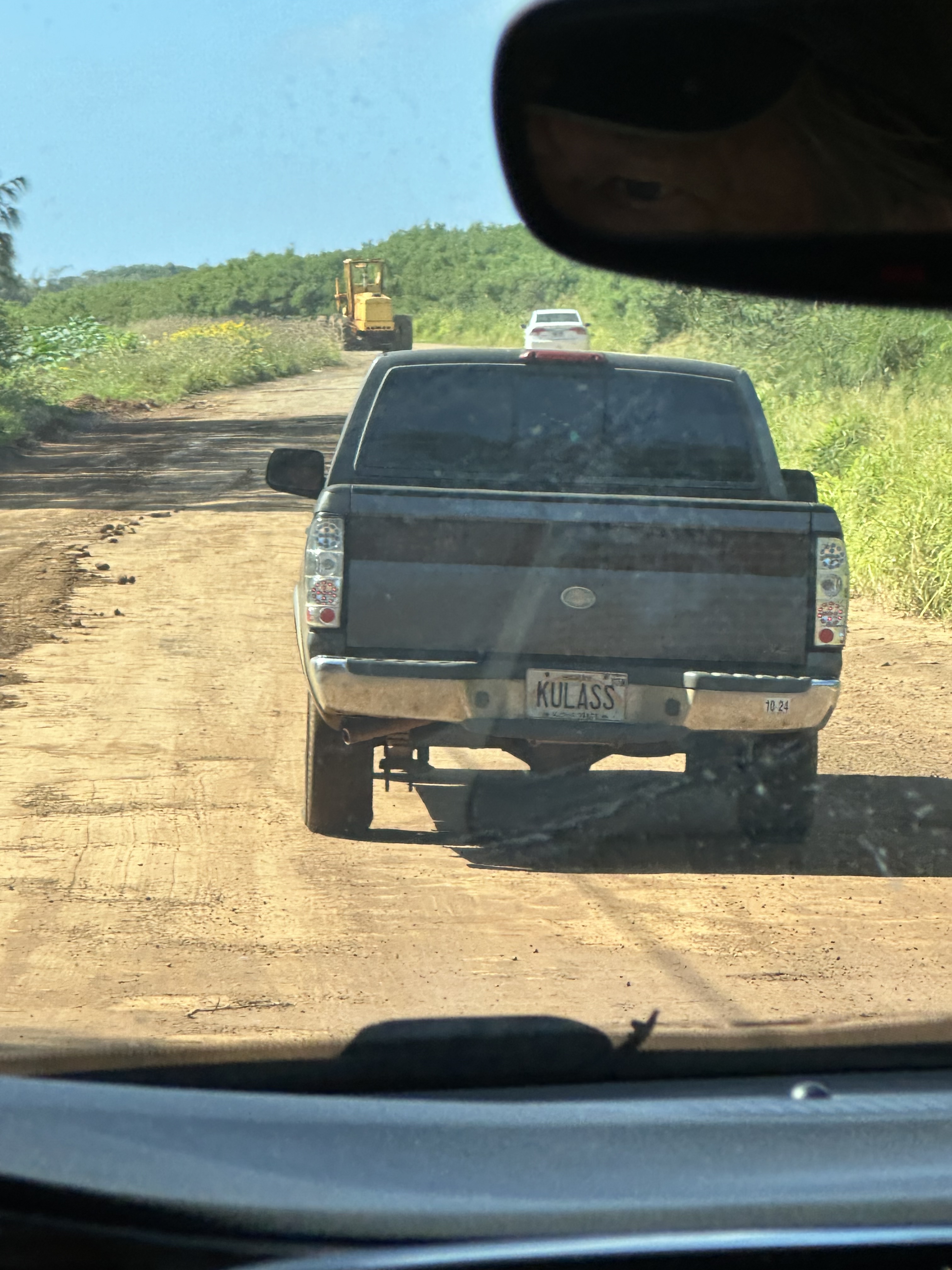
Alas, David is driving us in the rain after dark to the airport in Lihue to catch the 10:30 pm red-eye to Los Angeles.
We’re pretty much silent through the hour drive to the airport, dropping off the rental car, riding the shuttle to the airport entrance, when Megan blurts out, “Hey, look at that rooster!” We all share a laugh over seeing one last feral rooster by the front entrance to the airport terminal.

It takes a while to get through security, and we’re already a bit flagged. We park ourselves down on a bench inside the terminal and hear this strange flapping. We look over and darned if we did’t spot that same rooster inside the terminal.

Who has the job of capturing that wily feral fowl? Maybe the TSA employees who let him get past security? Yeah, good luck with that.

Okay, well, yeah, we’re home. Been back in Idaho Falls since Feb 1st. Here, I’ll share one winter photo with you. It’s our back yard on March 2.

Well at least I finally put a wrap on this year’s Kauai trip. Some pretty kulass memories!

Wild Boar Hunting in Kauai and the Powerline Trail

March 31, 2024

One of our favorite hikes near Princeville is the Powerline Trail. It’s 13 miles long from Princeville to the Arboretum. Here’s a tripadvisor link with reviews: https://www.tripadvisor.com/Attraction_Review-g29218-d208648-Reviews-Powerline_Trail-Kauai_Hawaii.html

From Princeville it’s largely an old rutted road that is a horrible mess after a rain, so you want to go after a long dry spell in the weather. We enter it in Princeville and typically only go 2-3 miles before turning back. It’s 9am on January 26, and we’re on the trail. That’s Eric and David ahead.

About a mile in you come across this view of Hanalei Valley with a waterfall:

Do you see it? It’s just a trickle coming down alongside that sunlit fern on the left.

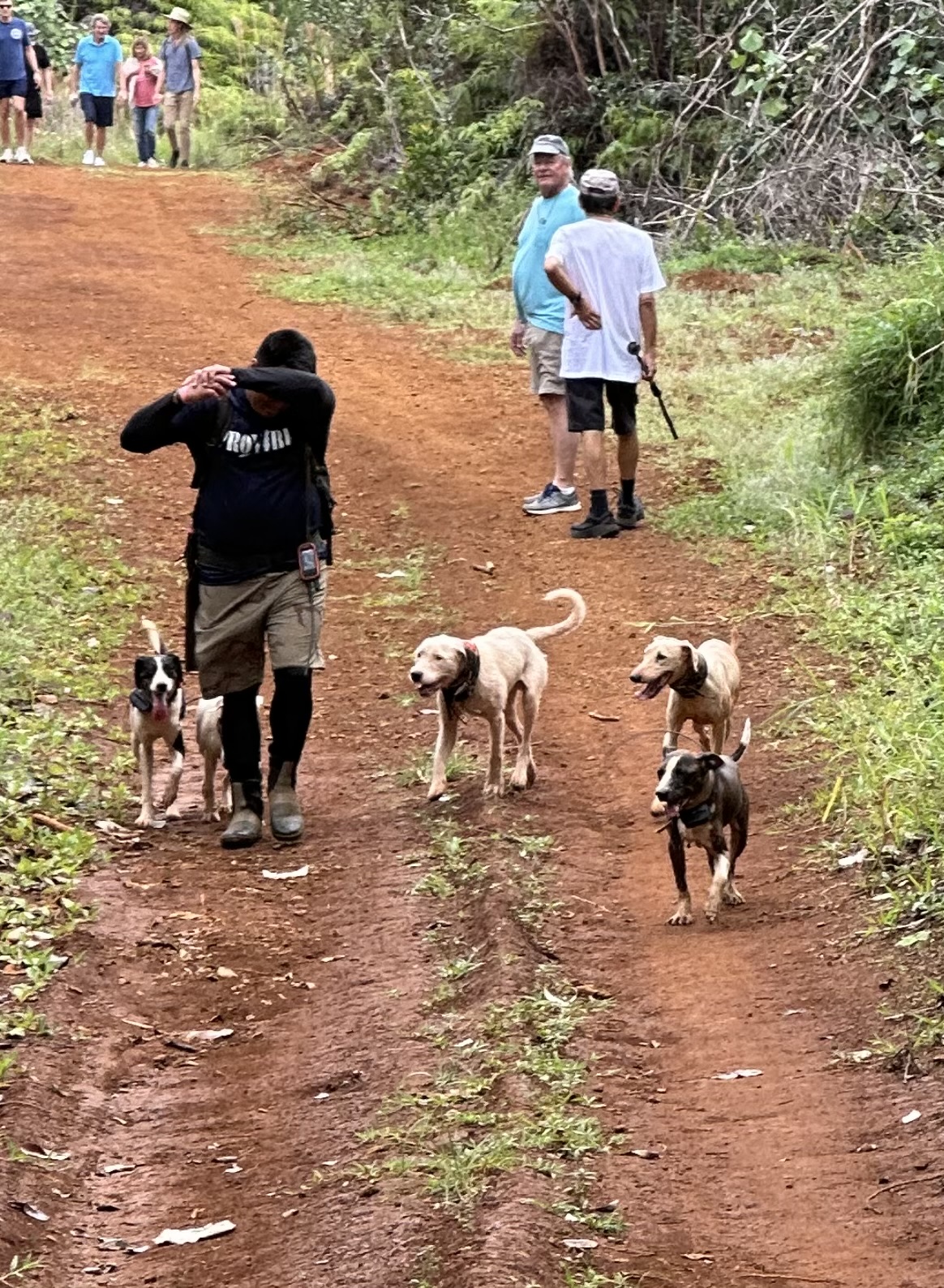
Suddenly we’re approached from behind by three men with, uh, how many dogs?

They stop and visit with us (David and Stephanie). The dogs are just as curious as we are.

This fellow explains that they are participating in a wild hog hunt tournament. (Uh-oh. Is that dog smelling the bacon we had for breakfast? If they mistake us for hogs we are done for.) The rules of the tournament are that you can only hunt and kill the hog using a knife and you have to carry the hog out (on your back, I assume!) whole. I Googled it, but couldn’t find anything about these tournaments per se, but you can certainly sign up for a hog hunt adventure through various companies, if that’s your thing. Here’s a link:

https://outdoors-international.com/hog-hunting-hawaii

Hog hunting in Kauai is a tradition that has been passed down for generations. Traditional hog hunting is with dogs using only a knife or spear. You can also hunt with a bow or rifle.

“A boar hunt is a great add-on to your Hawaiian vacation.” Okay …

They were on their way again – how many dogs?

We counted eight. But that’s not all they needed for this hunt. Because a few minutes later we ran into the brother of the guy in black (and obviously the one in charge)

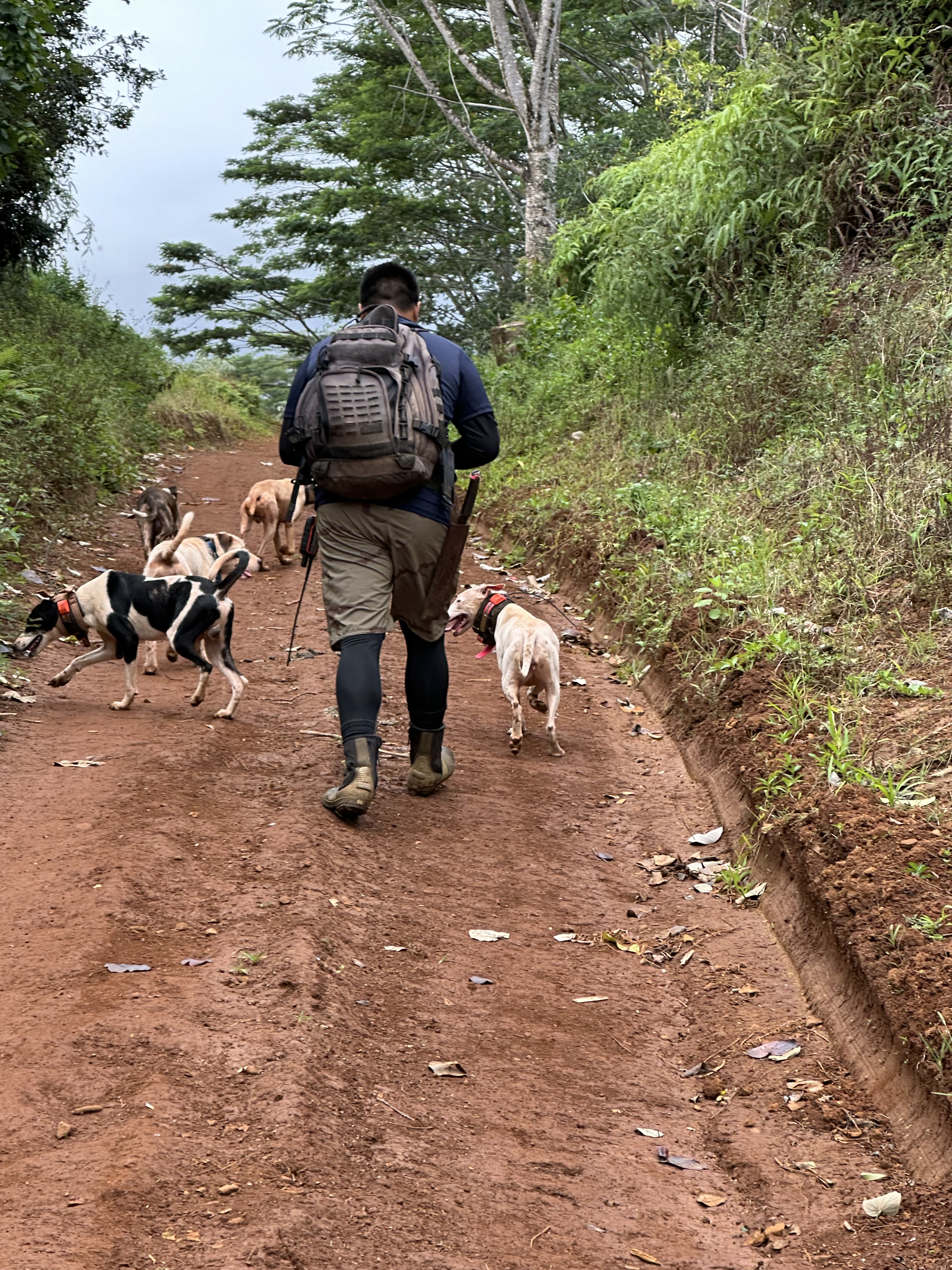
Rushing up behind us. He told David and Victor that he was with the same hunting party, but he had overslept and was trying to catch up with his brother. With, how many dogs??

All tallied, 4 males, 13 dogs on the hunt for a wild boar. In the photo above, you can see the length of the knife from the sheath hanging from his belt. About 12″ long. According to the above link, the dogs will chase the pig until it “bays up.” The humans listen for the barking and try to keep up. Once you get to the pig you finish him off with a large knife. “It isn’t for everybody.” Duh. How much of a rush are you looking for on your Kauai vacation adventures?

Just a brief history of pigs on Kauai, researchers believe pigs were brought to the islands by the Polynesians at least 800 years ago. They were kept as pets and food sources and relied heavily on their families for survival. Pigs were beloved and embedded in the Hawaiian culture and traditions. But then large bearing fruit trees were introduced in Hawaii, such as guava and mangos and pigs were then able to survive in the wild. Other visitors to the Island, like Captain Cook in 1778, brought their own larger pigs who interbred with the more native pigs. Then hurricanes Iwa (1982) and Iniki (1992) set a whole lot more pigs loose and now feral pigs have become a significant problem in Kauai, destroying crops and native plants. Hunting is the only thing keeping wild boar populations in check.

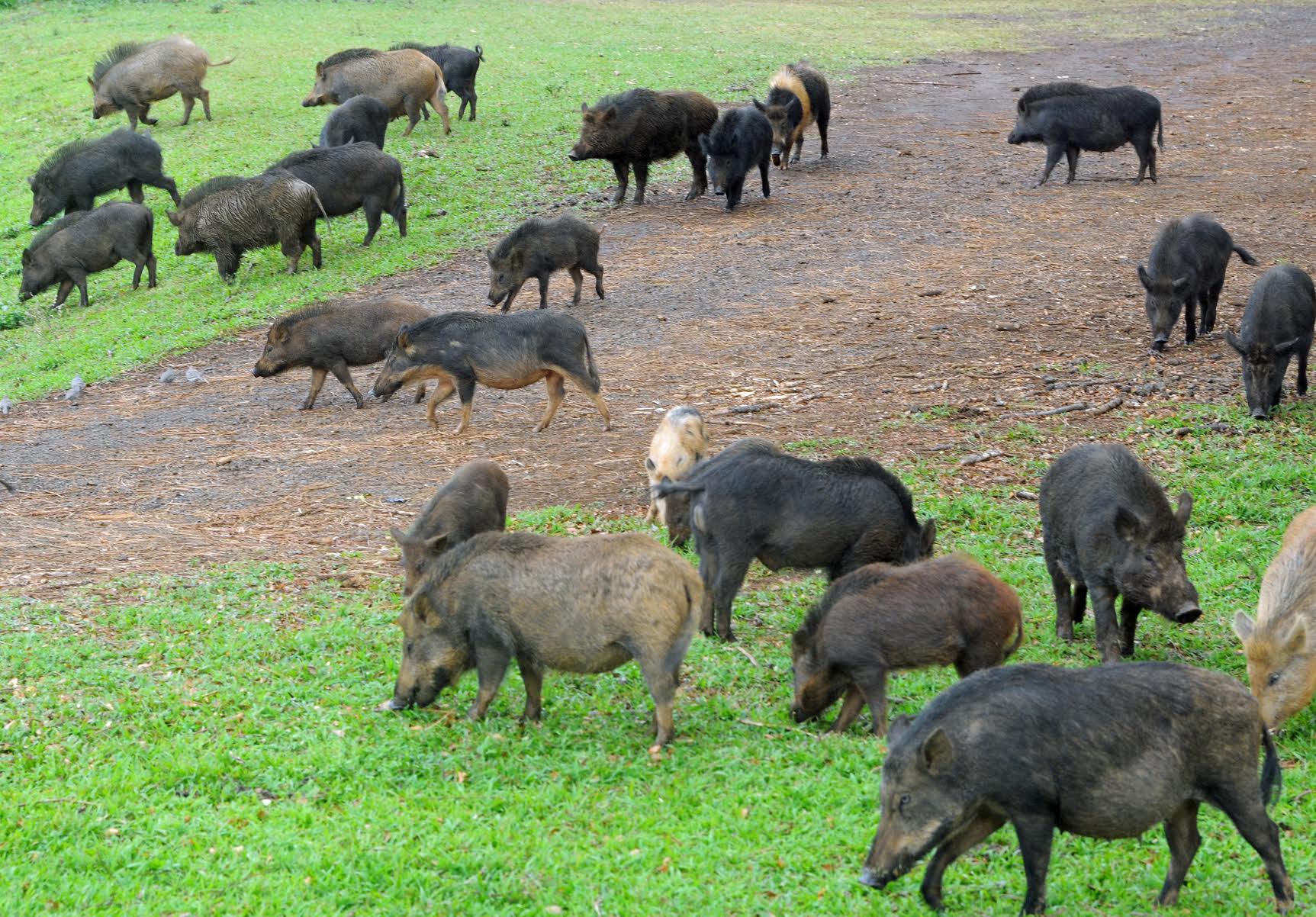
There’s no way of knowing how many feral pigs are on Kauai. Here’s a link to the “Pig Man Of The Garden Isle” Nic Barca https://www.civilbeat.org/2019/03/kauai-the-pig-man-of-the-garden-isle/ who has been studying (and hunting) pigs on Kauai for a while, and he estimates the number at about 11,000. There’s a wildlife refuge near Kilauea we’ve driven past numerous times where we’ve seen a large herd of feral pigs, although we didn’t see the pigs this past January. Here is a photo of the herd (taken from the link above) that captures what we typically see while driving past the refuge.

Photo by Alan Parachuni/Civil Beat – wild pigs gather at a wildlife refuge near Kilauea.

Well I dunno. If after reading this blog you think you want to book an archery hunt for wild boar in Kauai – here’s another link for you. https://www.huntfishkauai.com/wild-boar/ For $1050 per shooter you get a crossbow and ‘all equipment necessary’ and camouflage attire. Plus a “100% shot opportunity guarantee.” Yikes. I’m all over that camouflage attire. I just don’t want any confrontation with a wild boar. On a vacation to Paradise? Well, on the other hand, if you’re looking for a rush …

“Wild boar hunting, not boring.”

Yeah, how about a boat ride?

Kauai 2024 – Part 3 – Froggy, Snail and the Enchanted Forest (What’s Your Spirit Animal?)

March 10, 2024

My last blog was about ‘Froggy,” the bullfrog croaking in the bushes beside Steph and Victor’s pool at their house in Princeville. David, Megan, Eric and I returned home from Kauai over 5 weeks ago and I’ve been wondering about Froggy. Is he still there? I asked Steph last week, and yes, he is, still croaking away. I wonder if Steph and Vic will soon have tadpoles floating in their pool?

I had become totally smitten with the bullfrog over the two weeks in January we stayed with Steph and Victor. He croaked several times a day, and it cracked me up every time. Several of us would be carrying on a conversation in the kitchen when Froggy’s croak would blast from the bushes like a fog horn. It was all I could do to stop myself from raising a palm to pause the conversation with a “Shhhhhh….Froggy is speaking.” He tickled me so much that it even made me seriously wonder for maybe the first time in my life, could I have a spirit animal? Could the bullfrog be my spirit animal? This link might be helpful:

https://www.mindbodygreen.com/articles/how-to-find-your-spirit-animal

In some Indigenous cultures spirit animals are a spirit that helps guide or protect a person on their specific journey. Common spirit animal guides include a Crow, Bear, Butterfly, Cat, Deer, Dove, Dolphin, Elephant, Fox, Horse, Hawk, Lion, Mouse, Owl, Peacock,Turtle, Tiger, Wolf, Frog (“the Frog is often thought to help heal physical and emotional wounds. It speaks to the importance of checking in with oneself and healing from the past in order to live in the present.” Huh…)

Well anyway, I carried my intense froggy love back to Idaho with me and just couldn’t wait to write my blog about ‘Froggy.’ It started off great and wonderful until I started a Google search on American bullfrogs (native to the Eastern and Central United States) only to discover that they are a highly invasive species that prey upon and out-compete native frogs, seabirds, and other aquatic species. They will basically eat anything that walks in front of them that fits in their mouths. But, hey, I covered this sad story in my last blog. Here’s one final link on the subject, an article from the Washington Post about hunting and eating invasive bullfrogs in Utah: https://www.washingtonpost.com/climate-environment/2023/03/05/utah-bullfrogs-catch-eat/ Sigh …

While we’re on the subject of invasive species in Kauai, enter Snail. Uh, that is, the Giant African Land Snail or GALS. While merrily hiking along a grassy path just beyond an enchanted mahogany forest, I nearly choked on my breath with the site of this guy.

Giant African Land Snail

You’ve heard of Nine Inch Nails, but what about Four Inch Snails?https://kealakai.byuh.edu/creature-feature-the-invasive-giant-african-land-snail Giant African Snails can grow as large as 8 inches long with a shell 5 inches across. They are one of the world’s largest and most damaging land snails, eating over 500 different plant species, including peanuts, beans, peas, cucumbers and melons, and many more crops. If fruits and vegetables aren’t available they will gorge on a variety of ornamental plants, tree bark, and even paint and stucco on houses. They are native to coastal east Africa but are now found across Asia, the Pacific, the America’s and Europe. According to invasivespeciesingo.gov, these snails were first introduced to Hawaii in 1936, imported for educational purposes, as pets (really?) or in cargo. Not only has it become an agricultural pest, but it also carries rat lugworm disease from a parasitic worm that can cause meningitis in humans and other animals. Geesh!

The giant African snail I met was truckin’, even if it was at a snail’s pace. By all means, don’t pick it up! Instead I took a video just so you can see what a ‘snail’s pace’ looks like:

The top recorded speed for a snail is 0.002 mph, or about 10 feet/hour. They won’t move on average more than 250 meters (273 yards) in a year. Giant African land snails are hermaphrodites, which means each snail contains both male and female reproductive organs. They don’t need to mate to reproduce and can lay up to 500 eggs at a time, about every 3 months. They are sexually mature after six months. This gives you an idea of how fast even one snail by itself can multiply.

We saw two of these snails on our recent 2-week trip to Kauai. We saw the second one at, I mean on, the restroom at Makauwahi Cave:

Oh yum. Let’s suck the red paint off this building. Makes you wonder. Should you take gloves with you on your hikes and snatch up every one of these you see and dispose of it? (How? In a trash can?) I dunno.

The state of Florida has gone through great lengths to eradicate the invasive giant African snails. According to this article, https://www.npr.org/2023/06/23/1183784344/giant-african-land-snail-florida-problem in 1966, a Miami, Florida boy smuggled three giant African snails into South Florida upon returning from a trip to Hawaii. His grandmother eventually released the snails into her garden. By 1975 the snails were declared eradicated after destroying more than 18,000 adult snails and thousands of eggs. The snails popped up again in 2011, it took ten years, but they were declared eradicated again in 2021. Then this headline from June 20, 2023: https://www.nbcmiami.com/news/local/quarantine-zone-established-after-giant-african-land-snail-spotted-in-broward-county/3056940/, One giant African land snail was spotted in Miramar on June 2, 2023, where they have established a quarantine zone. The snails are sprayed with the pesticide metaldehyde (in snail bait) and also the state uses Labrador retriever dogs trained to sniff out the giant snails.

Since they were introduced in 1936, Hawaii has also tried to eradicate or at least control the giant African land snail population. In the 1950’s rosy wolf snails were deliberately introduced in the hopes they would eat the giant African snails. Except they didn’t eat those snails; they ate endangered native Hawaiian snails instead, driving some to extinction. This is the point in my blog where I can really gross you out. Or maybe offer you some gory entertainment if you’re bored out of your skull. Or if you have a child or grandchild whining at you, “I’m b-o-o-o-r-ed!” – Click on this Google link about the cannibalistic rosy wolf snail. Scroll down and you will see a YouTube video capturing the live action of a rosy wolf snail stalking and then devouring a native Hawaiian snail.

https://www.google.com/search?q=rosy+wolf+snail&ie=UTF-8&oe=UTF-8&hl=en-us&client=safari

Yuck! I can’t end my blog on this note! Here, I will include a link to the fantastic walk we made through the enchanted Mahogany forest near Kilauea on the north shore of Kauai, the same walk where we met that crazy giant African land snail. It’s called the Wai Koa Loop Trail, which ultimately leads you to a beautiful waterfall and a path by a sitting Buddha. Here’s a Tripadvisor link with lots of photos that capture it beautifully.

https://www.tripadvisor.com/Attraction_Review-g60620-d4154204-Reviews-Wai_Koa_Loop-Kilauea_Kauai_Hawaii.html

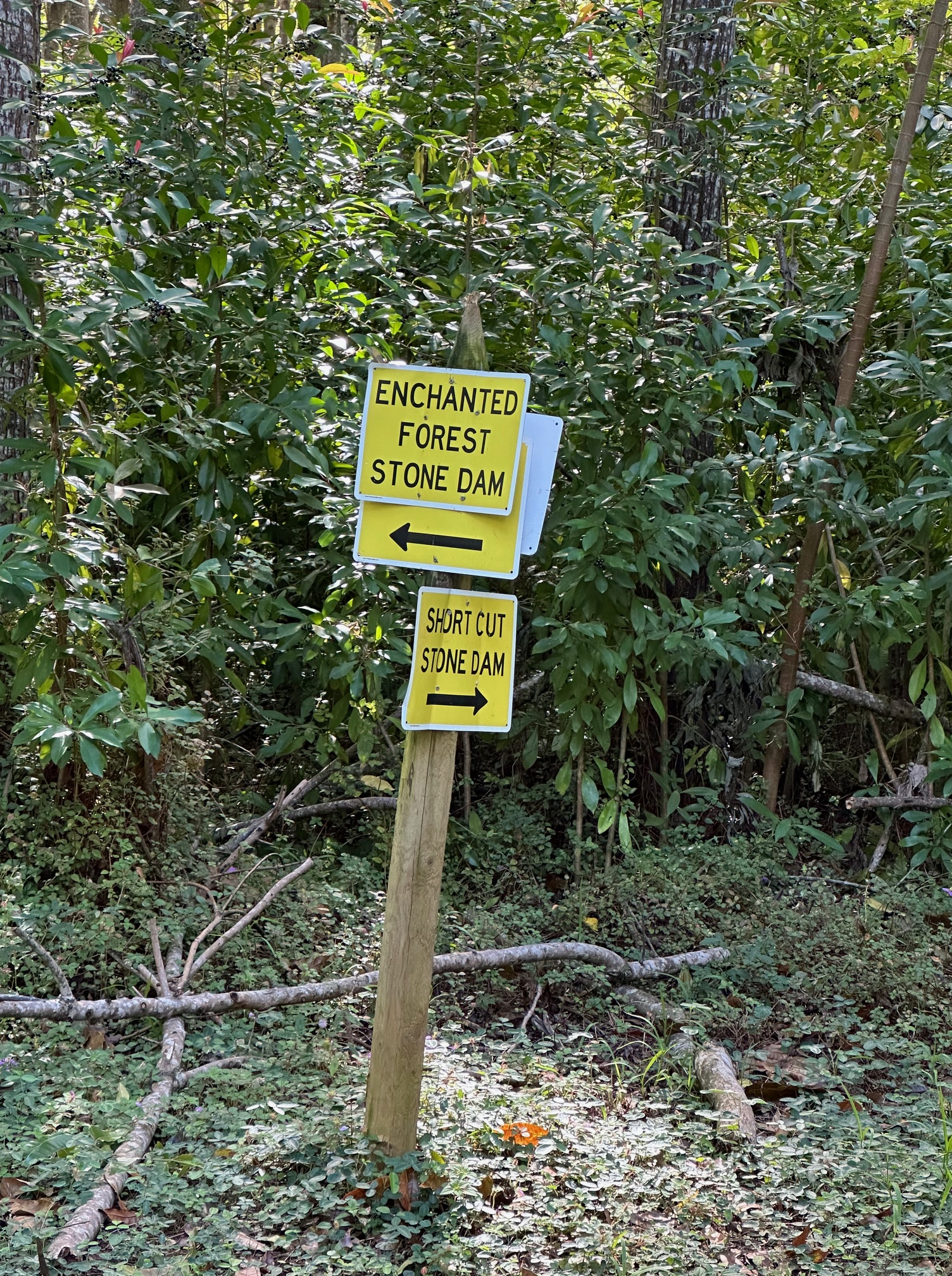
And a few of my own. First we come to a sign:

Wow. Tough decision here. Duh. Is this a research project? 0.002% of humans might go left here.

Here’s the waterfall you come to at the end of the trail:

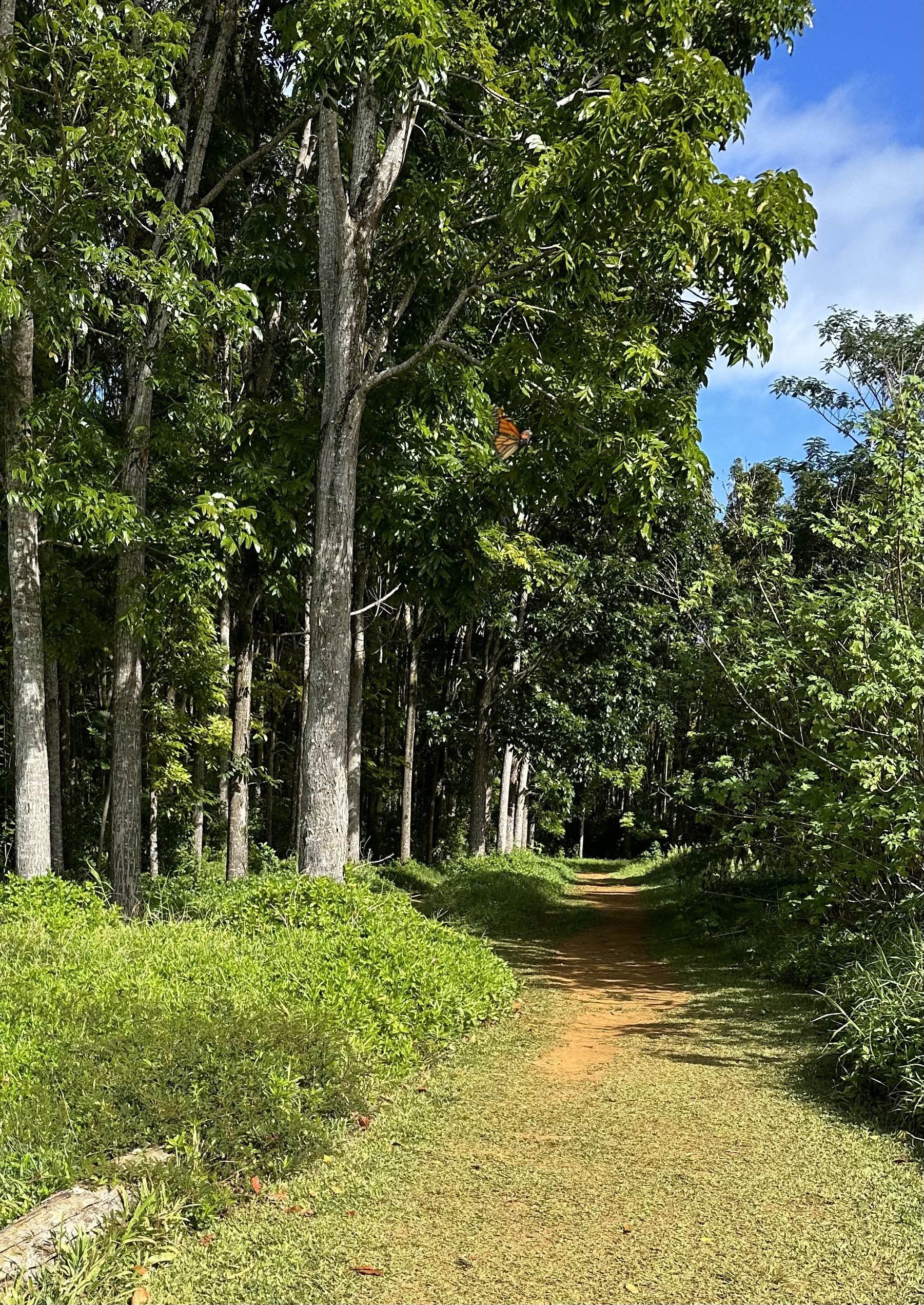
Here we are walking back past the mahogany forest, David, Megan, Victor, Eric and Stephanie.

We saw several monarch butterflies. Here I captured one in flight. Do you see it?

Wonderful.

There now. I feel a little better. After all, I am writing a blog about our two-week trip to Paradise, where you are so close to nature that you might just discover your spirit animal guiding you along your life’s journey. Well, in any case, I’m pretty sure that spirit animal wouldn’t be a giant African land snail.

Kauai 2024 – Part 2 – “The Strange Tale of Bullfrog”

February 18, 2024

I ended my last blog with a video I took of the weird sound coming from Steph and Vic’s back bushes. What in the world?

Here is the video again.

“Oh that’s a bullfrog,” said Steph. We’ve had it for a while. Maybe a year. You haven’t seen it before?”

“No, Steph. In all the visits we’ve had with you over the past 11 years we have never seen a bullfrog.”

Which was true. In all our previous 10 visits to Kauai none of us visiting from Idaho had ever seen or heard a bullfrog in Kauai. They don’t exist in southeast Idaho where we have lived the past 23 years.

Even though we lived in Georgia for 11 years before moving to Idaho, my last memory of encountering a bullfrog was in childhood about 60 years ago in Mystic, Connecticut. We lived near some woods with a path to Pee Pond, a frog haven, where my older brother David loved to catch bullfrogs. We’d see one perched on a rock and he’d stealthily sneak up behind it and grab it. They were quick jumpers though and he missed most of the time. But he’d catch them too. My brother would wrap the captured frog in his hand like a burrito with its head poking out and raise it eye level so we could stare at that adorable frog face. “Gotcha!” Then he’d let the frog go. Except for one prized giant bullfrog he captured and carried home. Named him “Junior.” Sadly, Junior met with a violent end. He quickly escaped from the bucket of water my brother set him in as a temporary habitat. We searched all over for Junior. A couple days later we found him splatted in the neighbor’s yard. Apparently the teenage neighbor kid, Trevor Bogue had run him over with a lawn mower. Bad Trevor! That’s the story I remember about Junior, anyway.

So it was pretty exciting for me to discover that bullfrog in Steph and Vic’s bushes just inches from their pool. I named him ‘Froggy’ and I chuckled every time I heard him croak, which was several times a day. And with this link I’ve definitely confirmed it’s an American bullfrog: https://californiaherps.com/frogs/pages/l.catesbeianus.sounds.html

Open the link and scroll down to the ‘Short videos of the American Bullfrog Advertisement sounds,’ click on the picture of the frog and you will experience what we hear blasting out of Steph and Vic’s bushes in Kauai.

Here’s another informational link: https://www.nps.gov/articles/000/american-bullfrogs-fast-facts.htm#:~:text=Bullfrogs%20are%20the%20largest%20species,and%20live%20around%208%20years Only male bullfrogs croak, ‘advertisement sounds’ to attract mates and to aggressively protect their territory. They also don’t sleep; they stay awake and alert even when they appear to be resting. So they croak during the day and are active through the night.

Stephanie said the neighbors next door got so annoyed with Froggy that they captured him and dropped him off at the other end of the golf course. Two days later the frog was back. Frogs have a strong homing instinct as well. Lol

I happened to be out on the patio when the croaking started up and I captured this video. You can hear another frog echoing him although it’s hard to tell how close the other frog is. A bullfrog can be heard from half a mile away.

I suppose the croaking would get a little tiresome. Like when he interrupts your dinner conversation, which actually happened. We were talking over the frog through the open windows and I had a hard time concentrating on the conversation. Then David got up and stepped out on the patio. “There’s the frog!” he said. We all went out there to see. Froggy had jumped in the pool.

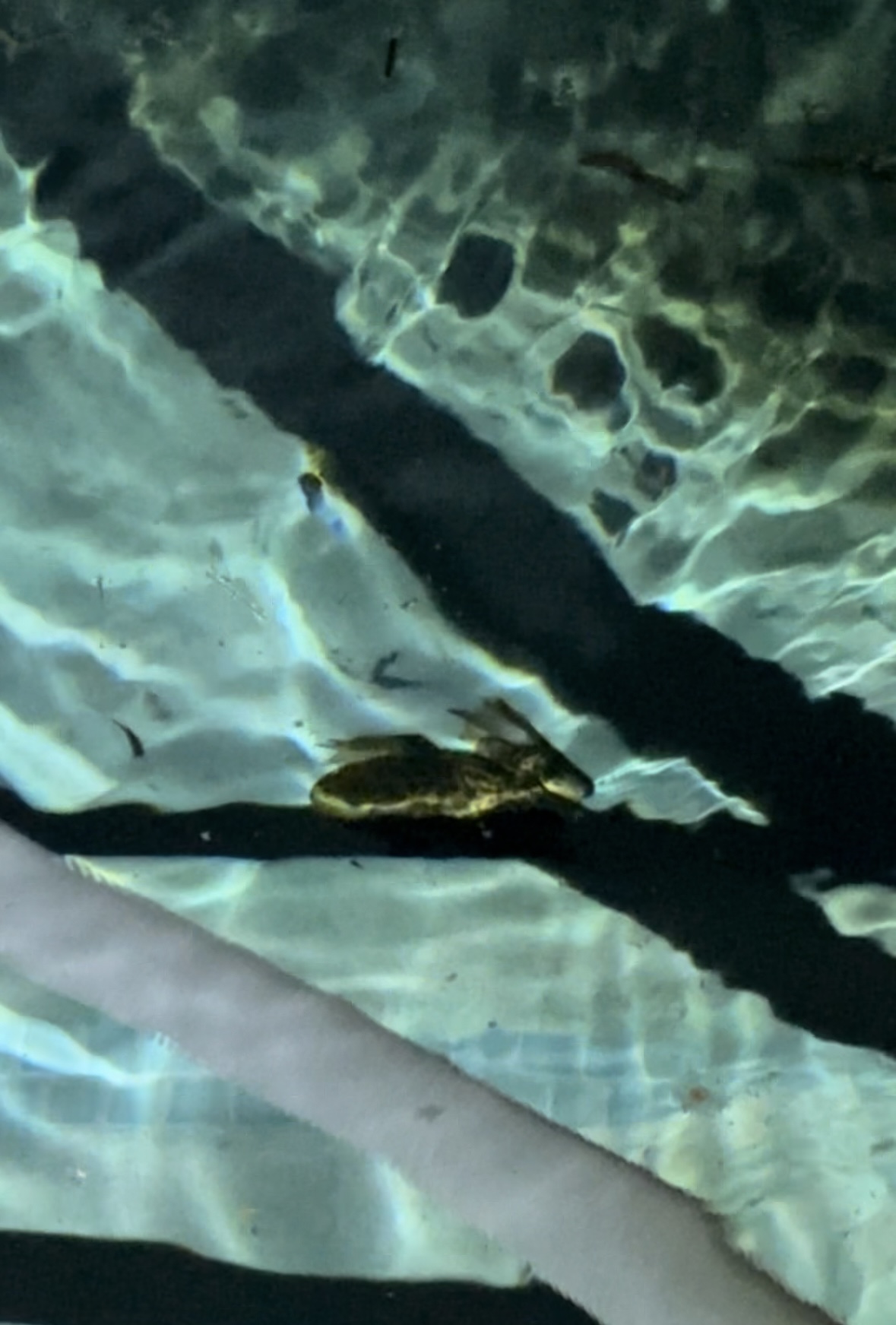
Not easy to capture a photo of a frog in a pool, but he looked to be about 5 inches long. Bullfrogs can grow up to 8 inches long and weigh a pound.

He took off swimming

“Hey, it’s a friggin’ frog!” I know. I seem to have experienced some strange attachment to this fella. Do you suppose I’ve connected with my spirit animal? https://a-z-animals.com/blog/frog-spirit-animal-symbolism-meaning/ “When a frog hops into your life, get ready for a big change!” For starters, they are associated with transformation as they start their lives as tadpoles in the water before morphing into land dwelling frogs.

Speaking of transformation now this blog is morphing into recognizing the dark side of bullfrogs …

I grew up in Connecticut around bullfrogs in their native habitat. And I hadn’t seen one for 60 years until this trip to Kauai. I’ve been rather excited about it until I started doing more research about the proliferation of bullfrogs around the globe and their devastating influence on the native species of the areas they have propagated. The bullfrog’s natural range extends from Nova Scotia to central Florida, from the Atlantic coast to Wisconsin and across the Great Plains to the Rockies. However, they have been introduced around the world by humans because we like to eat their legs (apparently), dissect them in labs, keep them as pets (did you ever keep a pet frog in a fish bowl?) and through other means. They have voracious appetites and will eat about anything they can fit in their mouths – birds, bats, rodents, frogs (yes, they are cannibalistic) newts, lizards, snakes and turtles. They prey on native species and are able to out-compete them for survival.

Bullfrogs are an invasive species even in states like California and Arizona where they were intentionally introduced as a food source but are multiplying at a fast rate with few predators. Check out the you-tube video in this link “Help Stop the Spread of Bullfrogs in Wyoming” (!!) https://www.invasivespeciesinfo.gov/aquatic/fish-and-other-vertebrates/american-bullfrog

So my happy bullfrog love tale has taken a dark turn … I had no idea …

A student, Heidi Beswick Cutia, is researching the invasion ecology of the bullfrog in Hawaii. https://spectrumlocalnews.com/hi/hawaii/environment/2022/02/12/a-researcher-s-quest-to-learn-more-about-hawaii-s-invasive-bullfrogs

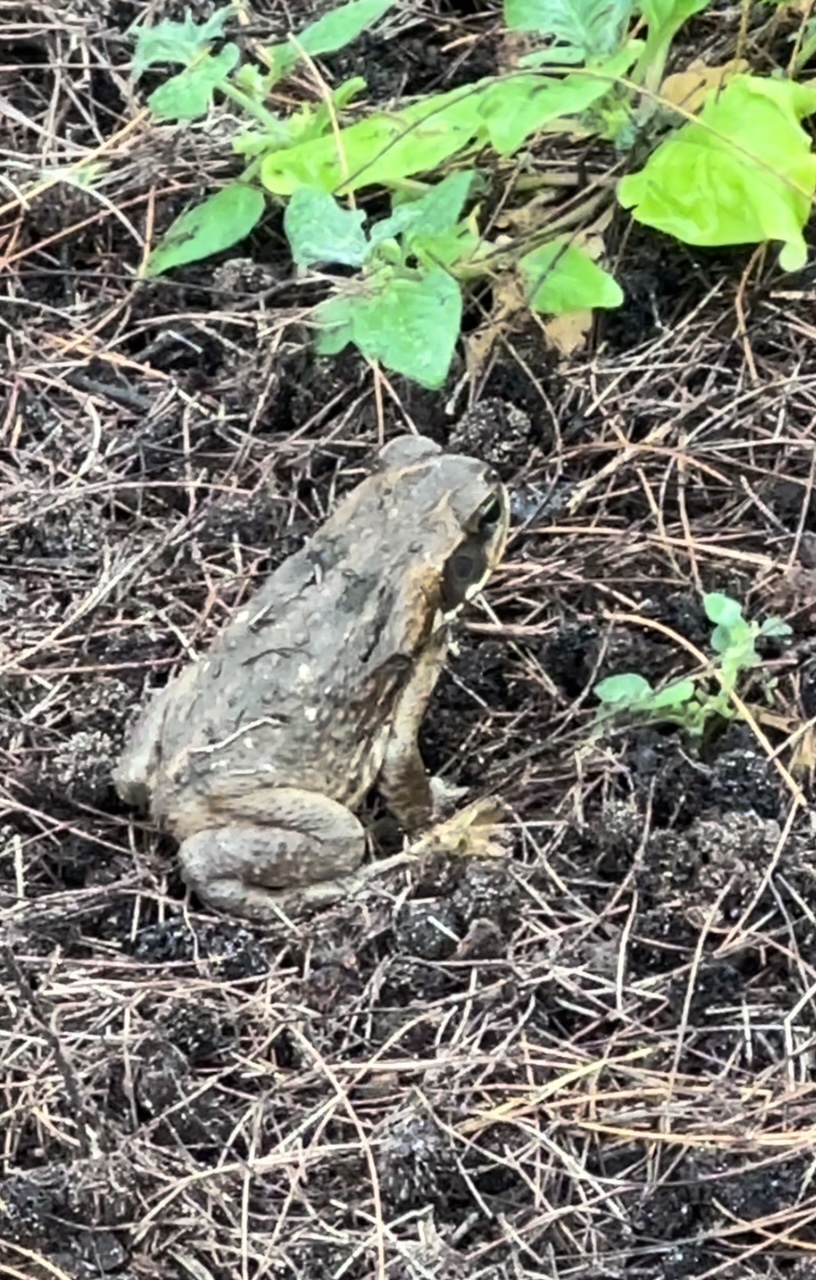
Bullfrogs were brought to Hawaii from eastern North America about 120 years ago so people could eat their legs. They have spread to all the main Hawaiian Islands. Although people haven’t been paying much attention to them. Bullfrogs should not be confused with the more commonly spotted bufo toads. We’ve only spotted this native toad once in all our visits – January of last year near Kahili Beach.

Bufo toad

Little is known about Hawaii’s bullfrogs, except that they are inhabiting the wetlands and eating other native animals such as endangered Hawaiian stilt chicks, snails and native insects. “A U.S. Fish and Wildlife Service study from 2004 put radio collars on endangered stilt chicks at the James Campbell Wildlife Refuge and found that when they could determine the cause of death for the stilts that 77% of them were being eaten by bullfrogs.” Stilt chicks are a long-legged, back and white, slender shorebird with a long thin beak. https://en.wikipedia.org/wiki/Hawaiian_stilt And they are an endangered species.

Along with the harm they cause in the low-lying wetlands, bullfrogs can also scale steep waterfalls into high-elevation streams and wetlands where there are a lot of native species.

So what about that bullfrog in Steph and Vic’s hedge? It might be a great place for it. If it mates with a female and she lays eggs in the pool, then the pool maintenance guy will dispose of them. So even if Froggy thinks he has a cushy spot (which he certainly does) he is not going to produce any offspring.

That fence behind Froggy’s habitat will be coming down after they complete the construction on the adjacent golf course. And if Froggy hops out there he might just get run over by a lawn mower.

Aloha Kauai! January 2024

February 13, 2024

Alright, so I’ve already written 62 blogs on Kauai, about 6 blogs after every trip we’ve made over the past twelve years – invited you along to experience the trip vicariously, if you will. It occurred to me this trip that maybe after 62 blogs I could just let the blogging thing go – go to Kauai, come home and get on with reality and stop with the reminiscing. But don’t you want to go back to Kauai? Let’s go! We fly from Idaho Falls to Salt Lake, to Seattle, then Lihue all in one day. We can do this! Are you packed and ready?

Wednesday, January 16 – Alarms blast off at our house at 4 am and we head to our first flight – leaving Idaho Falls at 6am. Yay! We (David, Megan, me and my brother Eric, who spent the night with us) hop into David’s truck, park at the airport, board on time, arrive in Salt Lake. With a four-hour layover, we have plenty of time to enjoy a leisurely breakfast, get a few extra steps in, before heading to the gate for our flight to Seattle.

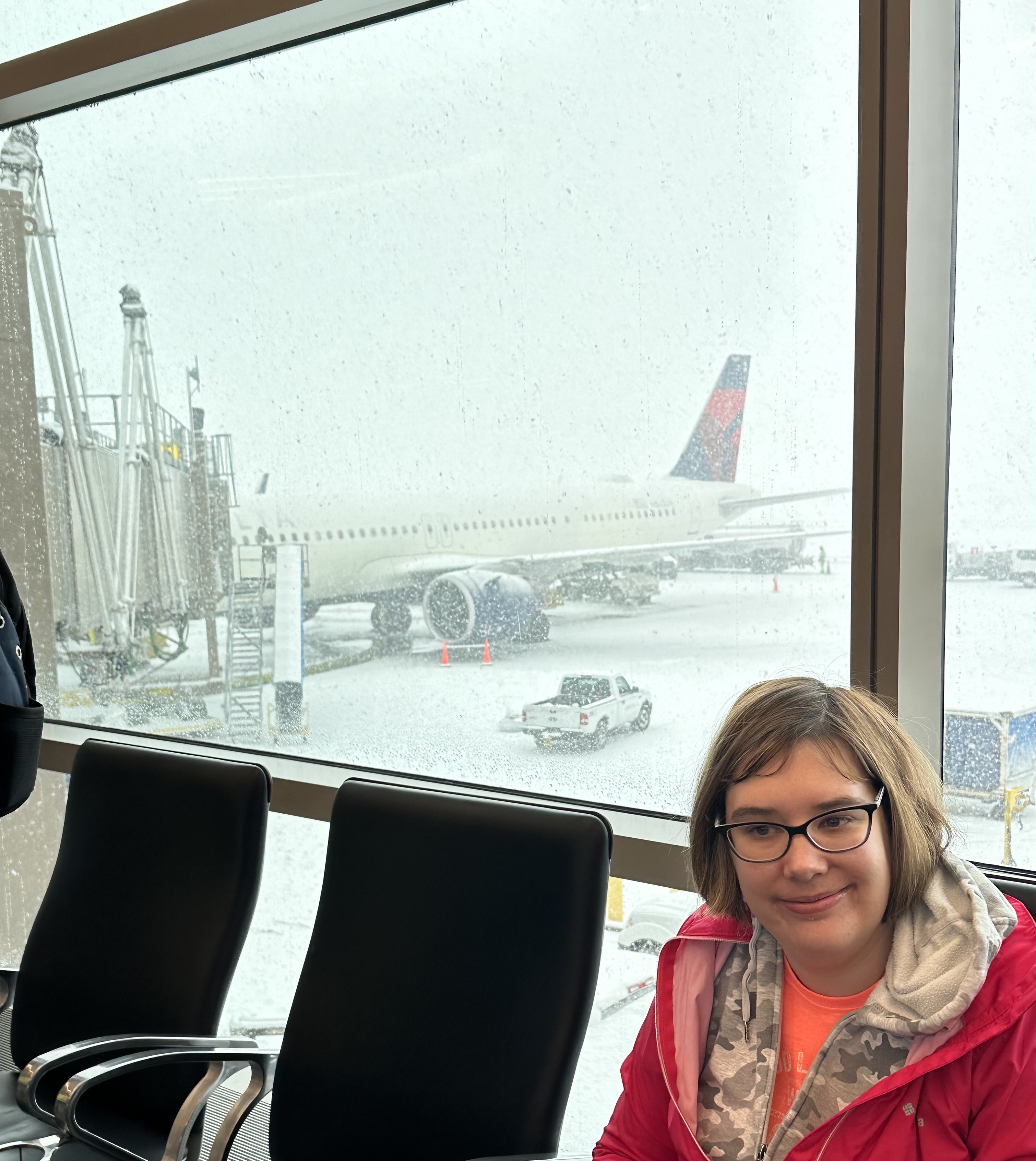
Our plane to Seattle is at the gate. Hey, Megan, pose for a photo! (We’re already flagged from lack of sleep.)

Salt Lake City – 10:40am

We should be boarding now for the 11:15 am flight. Uh, well there is the minor detail of the weather … No worries. We go ahead and board with only a 20-minute delay due to the massive snow collecting on the runways. And luckily we have a 3 1/2 hour layover in Seattle (so smart!) so still plenty of time to enjoy a nice meal in Seattle before boarding our flight to Lihue.

We board the flight and settle in with our noise cancelling headphones and cushy neck pillows and … uh, the plane doesn’t seem to be moving. Of course the plane will need to de-ice. Not a problem. Just pick out a movie on your own personal movie screen in front of you! I’ve got a great book. Relax … We have a 3 1/2 layover in Seattle. The plane pulls out of the gate and moves a bit and we’re stalled again. It’s hard to tell what’s going on outside with that heavy snowfall but there sure are a lot of planes lining up.

Well, long story short, we are asked to stay in our seats as we could prepare for take off at any time. And we sit right there for the next three hours as they plow the runways. Megan finishes her movie. Finally we’re in line to get de-iced, good sign! We do take off. It’s a 2-hour flight to Seattle. By the time we land in Seattle we’ve been strapped in our seats on the plane for 5 1/2 hours.

The 6 1/2 hour flight to Lihue has already boarded by the time we land in Seattle. David and Eric run to the gate to hold the plane while Megan and I race to the nearest ladies room. But we do make the flight to Lihue. Thank goodness for that 3 1/2 hour layover. Of course we’re starving. Well, this trip isn’t as bad as when we booked first class tickets to Kauai two years ago (yeah!) from Salt Lake to Lihue through San Francisco. You can guess how that turned out. We boarded our first flight in Salt Lake which had eliminated first class because they had changed to a smaller plane. Then we ended up landing in Monterey because San Francisco was socked in with fog. Sat on the tarmac in Monterey for three hours waiting for the fog to lift in San Francisco. Re-booked a later flight to Lihue in cattle car. I blogged about it of course. In case you want to read the hot details here’s the link: https://decompressionofaboomer.com/2022/02/06/kauai-2022-do-you-know-the-way-to-monterey/

So now we fly ‘Comfort Plus’ on Delta, which gets you seats at the front of cattle car, with a little extra leg room (maybe?) and free drinks and one extra slightly larger bag of chips beyond the usual snacks from the snack cart. That way, if you get bumped from your flight (which, at this point seems likely) you have a better chance of rebooking similar seats (not at the back of the plane in cattle car when you have a connection to make…)

So now we’re all settled in on our flight to Lihue. Try to cop some ZZZZ’s on the 6 1/2 flight. (Impossible.)

We land in Lihue, Kauai about 8:30 pm. Rent a humongous van and drive in the dark to Steph and Vic’s house on the north of the island. I roll down the window and inhale the ocean breezes. “Hey, Megan, out your window there’s the Pacific Ocean! Can you smell it? Hear it? Maybe we’ll see it tomorrow!” We arrive at Steph and Vic’s about 10 pm – 1 am Idaho time, which, added up to a 21-hour travel day. Steph and Vic had prepared a nice meal for us. We had finally arrived! Boy was it was wonderful.

Thursday, January 17 – It takes a bit to decompress once you arrive in Paradise. I heard the most beautiful bird song our first morning. Wonderful, and I wanted to know what kind of bird it was. I had downloaded a free app called “Merlin Bird ID” where you press ‘record’ and capture a bird song and it will identify the bird. Steph and Vic had a western meadowlark singing away in their back yard. So, imagine yourself, waking up in Paradise that first morning, walking toward the kitchen, bare feet over cool tiles, looking out at the brilliant sun, when you hear the sound of a meadowlark – check it out on this you tube video: https://www.youtube.com/watch?v=fRgU4xS06sM

We took a morning walk around the Princeville golf course and heard a lot of Myna bird song – (identified by Merlin) – here you can hear it too (skip the add…) https://www.youtube.com/watch?v=3Ix1hugefpo

A major golf course in Princeville (behind Steph and Vic’s house) is being refurbished and is enclosed in a tall green mesh fence. You see a lot of that fence in my photos. Hopefully the golf course will be reopened in the next year. But on our first walk we also saw a nesting Albatross – right up against the fence about three houses down the street from Steph and Vic.

I wonder how the nest even survives. They nest on the ground right in people’s yards. It might be because they are imprinted to return from the sea to nest in the place they were born, and maybe these albatross were here before the houses were? Albatross don’t find a mate and start breeding until they are at least 7 years old. https://ypte.org.uk/factsheets/albatross-wandering/breeding-5e050f07-1dc7-477a-adcd-dfe1fbc0b194

Here we are on our walk through the wooded path along that same golf course near the Westin resort.

Eric, David and Megan

You will always come across feral chickens on this path. Likely with clutches of newly-hatched chicks. Here’s a photo I took and a video (I hope you can open the videos!).

Back home at Steph and Vics I recorded this really strange sound coming from their back bushes. Is it a bird? Merlin did not recognize it. Do you?

Well that about wraps up our first full day in Paradise. We’ll have to solve the mystery …

Neuschwanstein Castle, Linderhof Palace, and Fairy Tale King Ludwig II of Bavaria

October 28, 2023

This story begins with the wooden puzzle above that arrived at our house from Liberty Puzzles a few weeks back. I discovered Liberty Puzzles during COVID and over the past two years have amassed a broad collection of these intricate, wildly creative wooden puzzles. When I spotted Castle Neuschwanstein on the website recently I just had to have it. We have visited Neuschwanstein, the castle that inspired Walt Disney’s fantasy castle.

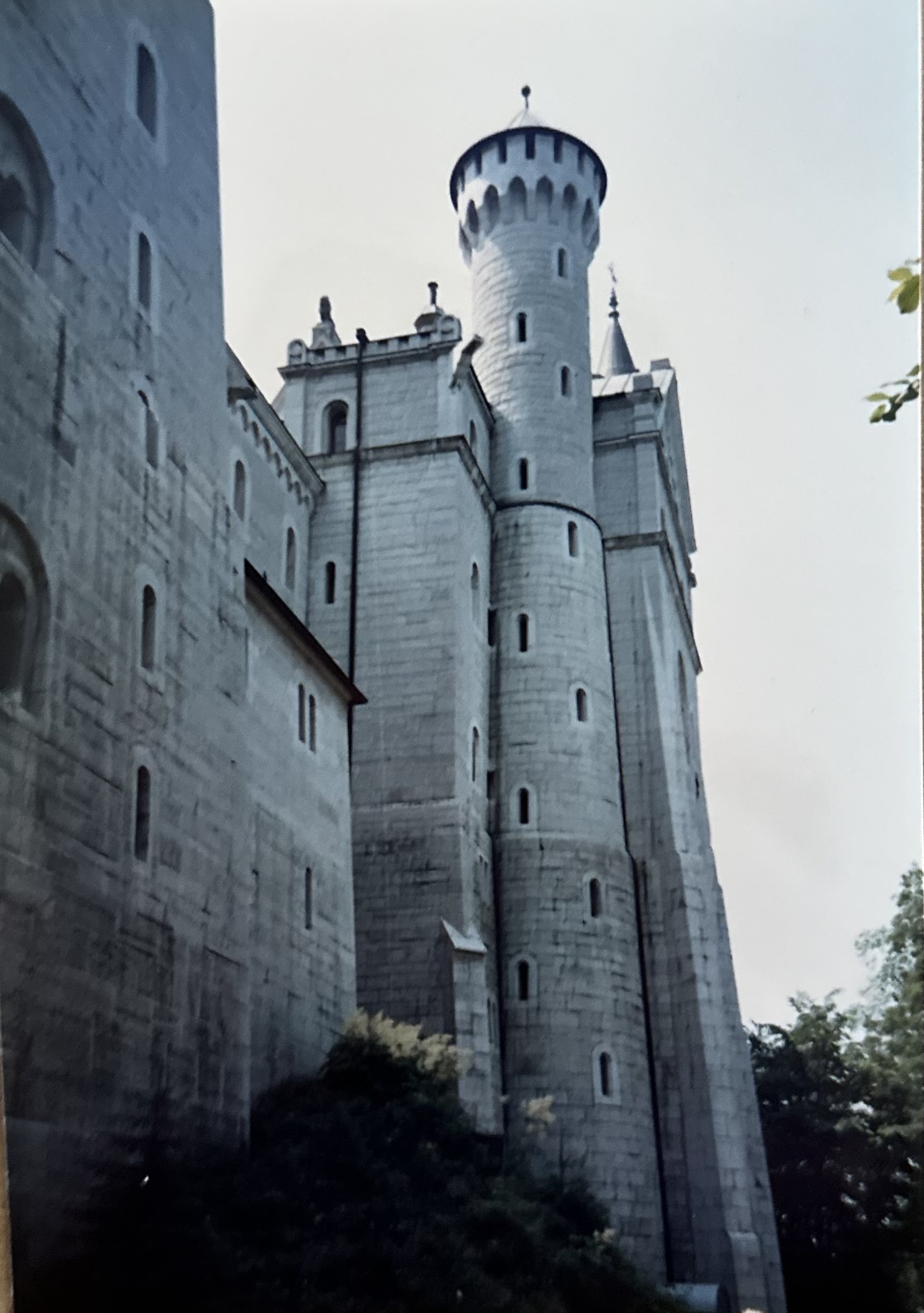
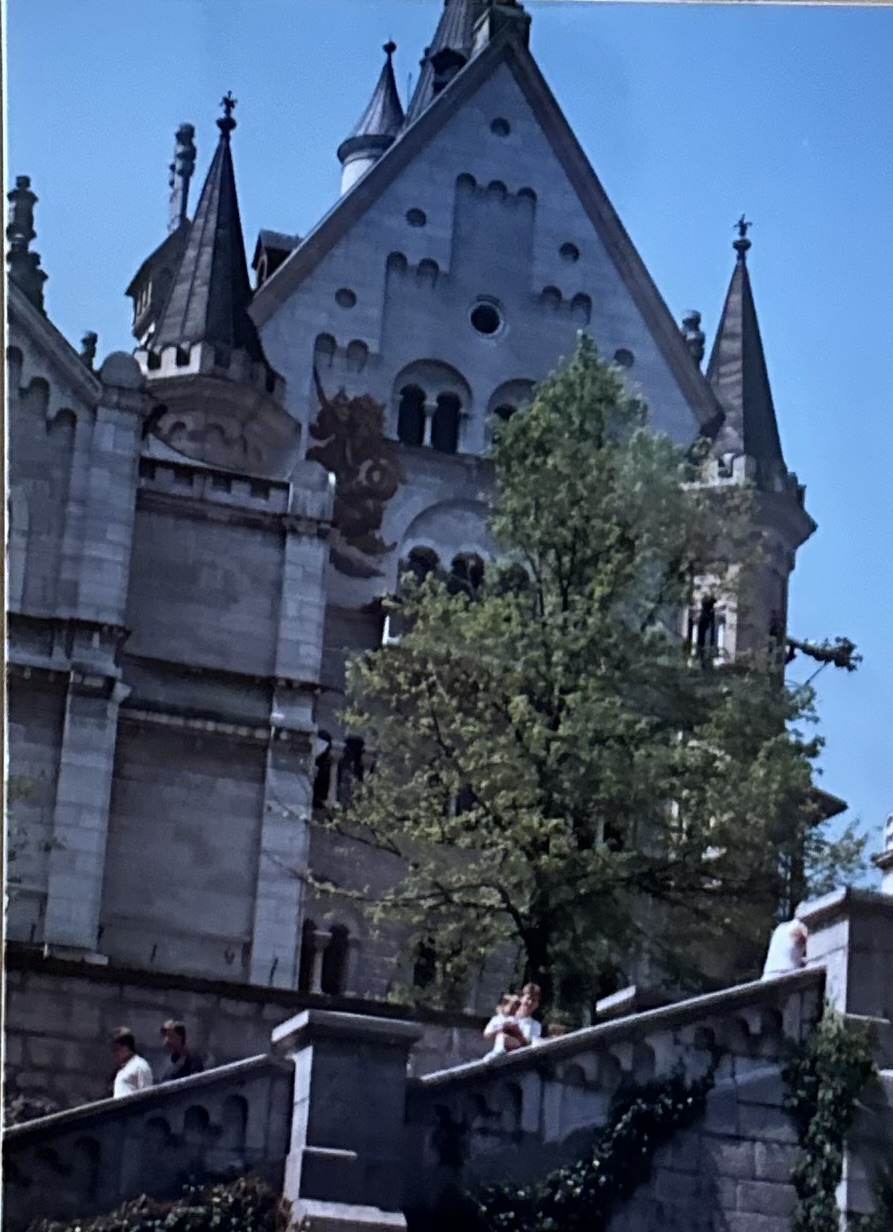
Granted, we visited Neuschwanstein Castle in Germany during the spring of 1987, more than half my lifetime ago. I was 33. Dang, that was a long time ago. David and I and our two young sons, Aaron and Ben, traveled to Bavaria in Germany. I captured a few photos of the trip with my trusty point-and-shoot camera. You know, you buy the 110 film with 24 exposures, load it in the camera, shoot, wind, repeat to the end of the roll, with no clue as to what you have until you get the film developed. (If you understand this or have ever even seen a roll of film, it belies your age.)

I put the photos in an album that has been sitting on a shelf for 36 years. And we know where they’ll likely end up (dumpster). In the meantime, they just seemed destined for my blog. So I pulled them out and took photos of them with my i-Phone. Are you ready for the trip to Bavaria, Germany to visit two of the Fairy Tale King Ludwig II Castles? Here we go. (How could you be so lucky?)

We’re at the train station now. The Hauptbahnhof. (I promise this is the worst photo – I just wanted to make sure I knew how to spell Hauptbahnhof).

Hauptbahnhof means “Central Station.” Like in Berlin, or Hamburg, or in this case, maybe Munich? Not sure which central station it is. Or why we were even at the train station. We were living in Sweden at the time of this trip and I assume we drove to Germany. Those blurry figures on the left are David with Ben (almost 3) and Aaron (almost 5). Are we having fun yet?

Descending the escalator! (??)

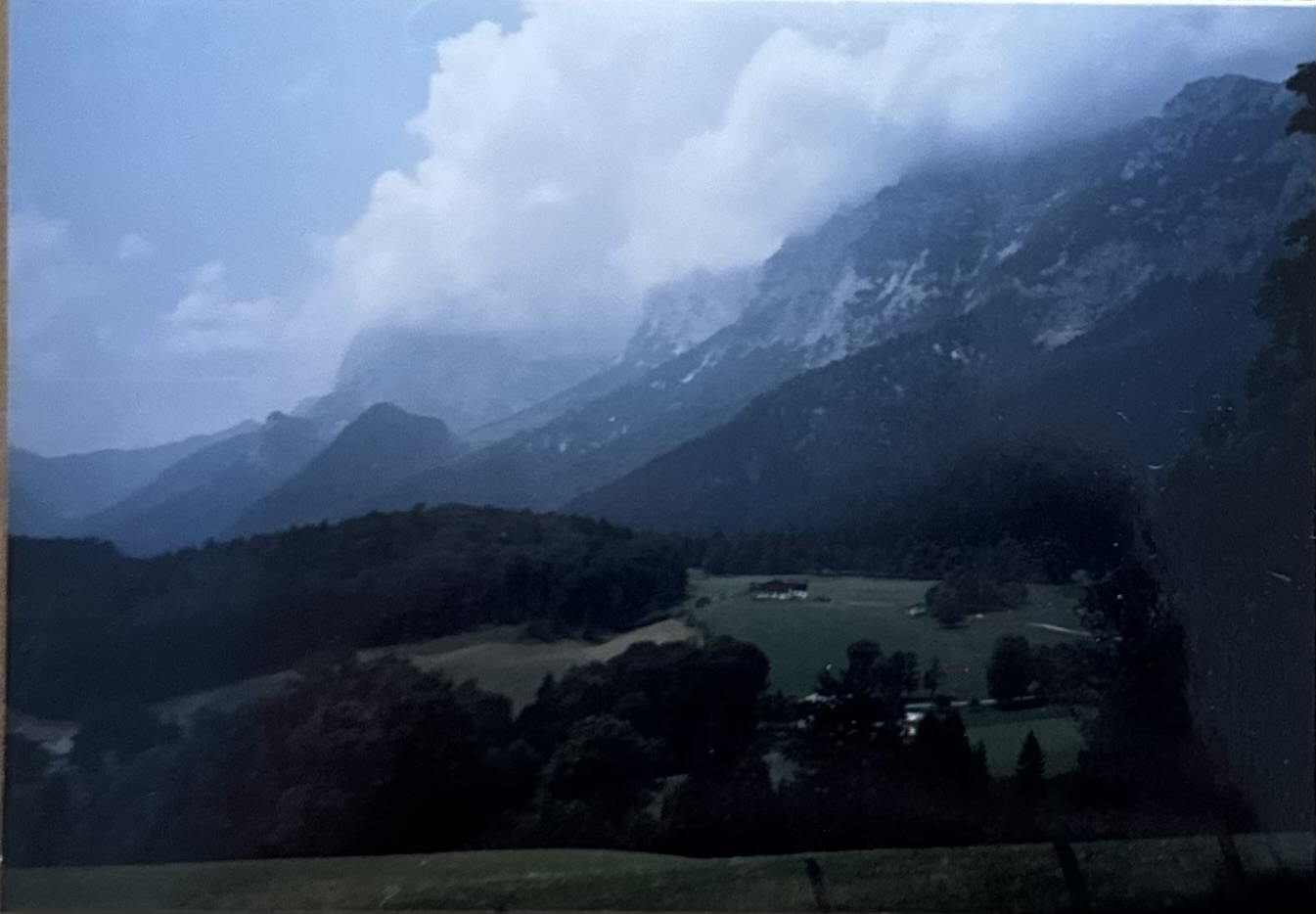
If we were taking photos with a smart phone it would tell us exactly where we are. But with these photos I have to guess the exact locations. We are definitely in Bavaria in the south of Germany, just one or two kilometers from Austria. The foothills of the Alps!

Our destination today is to visit Neuschwanstein, King Ludwig II’s 19th Century fantasy castle, which sits in the hills above the incorporated village of Hohenschwangau near Füssen. Check out this link: https://en.wikipedia.org/wiki/Neuschwanstein_Castle King Ludwig II commissioned Neuschwanstein Castle as his own personal retreat but also in honor of composer Richard Wagner whom he greatly admired.

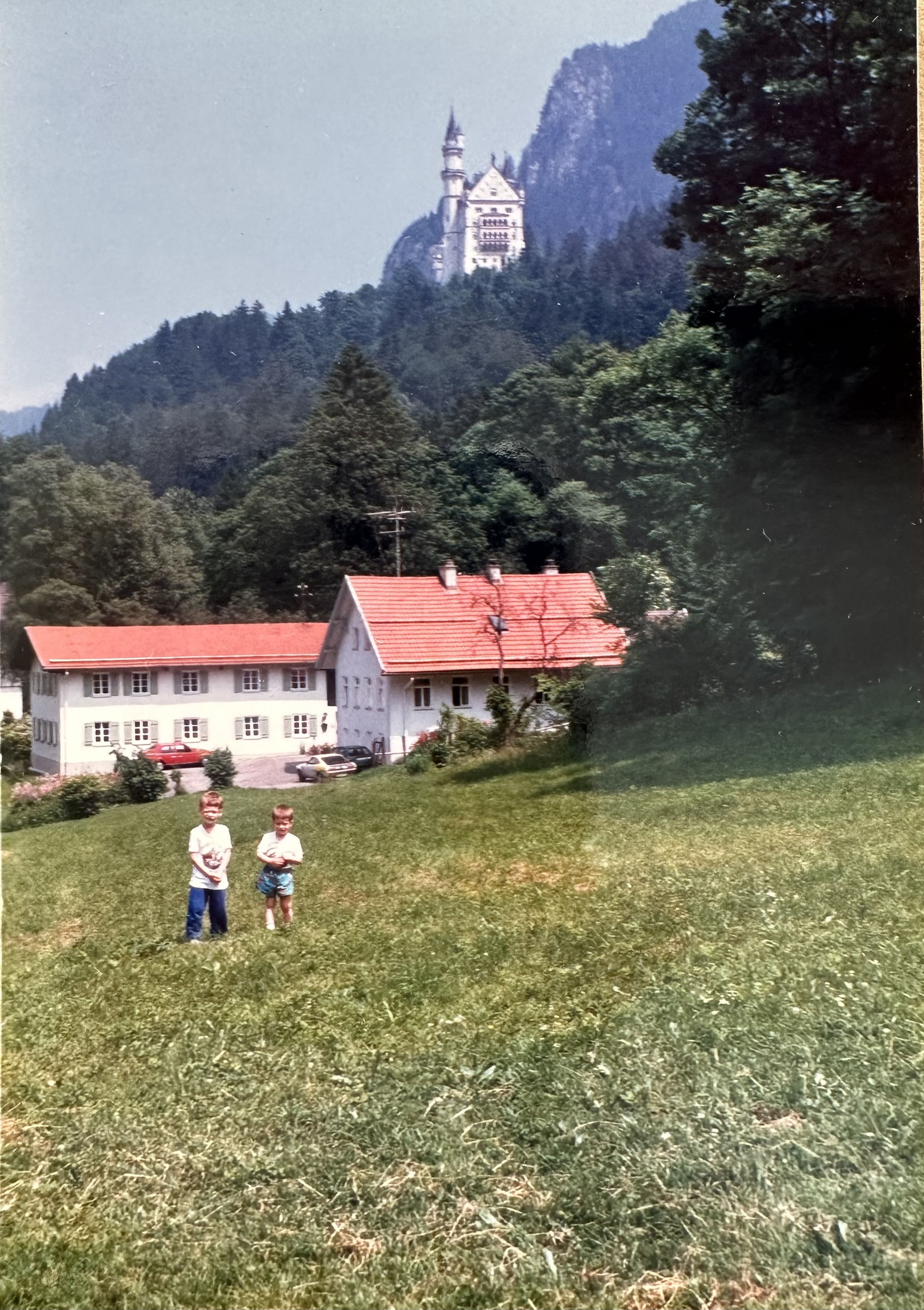
There it is! (With Aaron and Ben in the foreground)

How do we get to it? From the small village of Hohenschwangau just below the castle? Here we are, I believe, in the nearby town of Füssen. https://en.wikipedia.org/wiki/Füssen David, take a picture of us with that castle in the background! (Okay not too thrilled with my hair, which I had to cut off due to it being completely fried by a recent perm. Remember those 80’s perms? Disco on, baby!) Anyway,

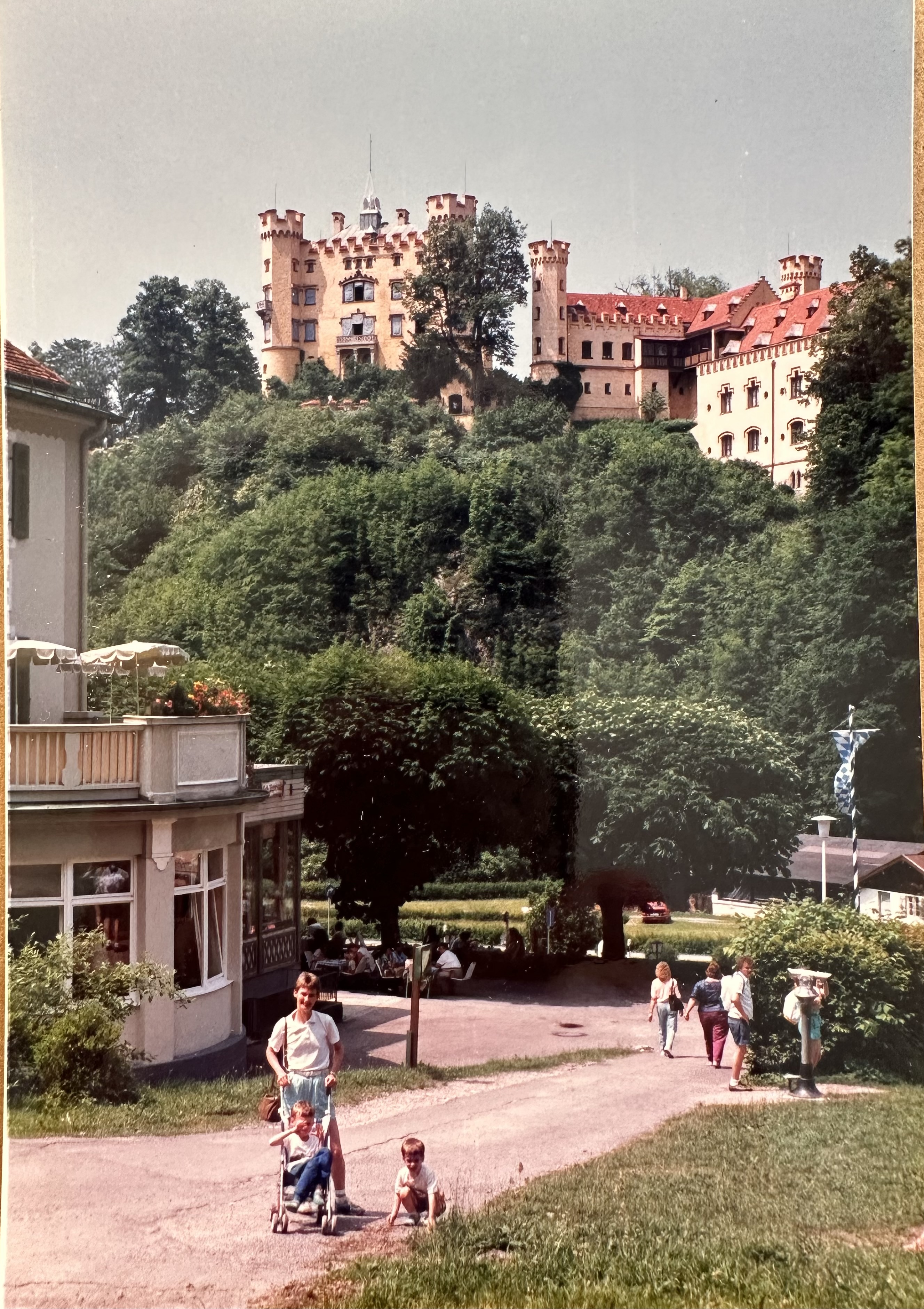
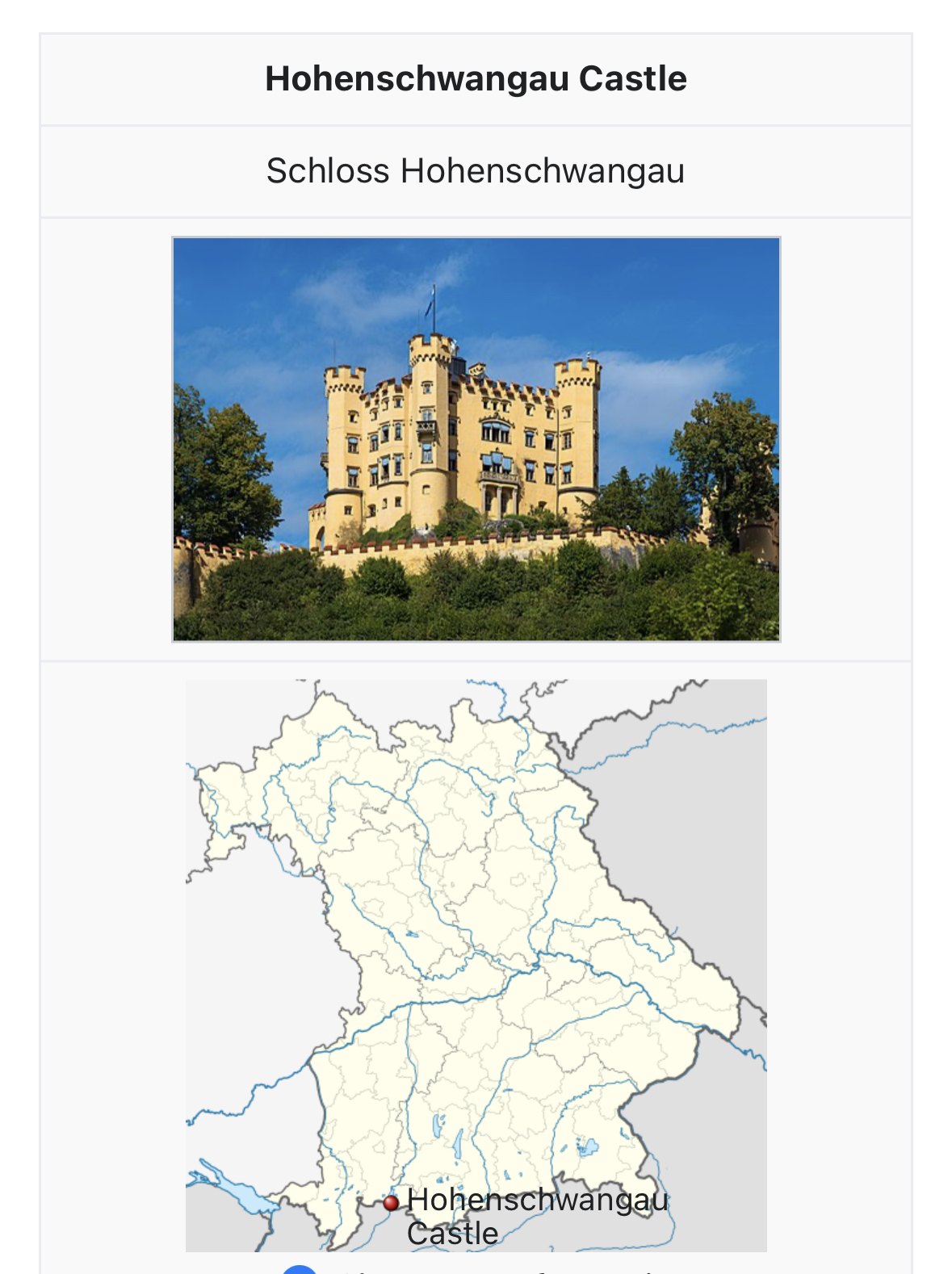
That castle behind us must be the Hohenschwangau Castle, the childhood residence of King Ludvig II? Maybe, or it could just be one of Germany’s 20,000-plus castles https://germanyinusa.com/2019/05/02/germany-home-to-more-than-20000-castles/

Here is a screenshot of the Hohenschwangau castle from this Wiki link: https://en.wikipedia.org/wiki/Hohenschwangau_Castle

Which does look remarkably similar to the castle behind us in the photo. So, maybe?

In any case, King Ludwig II, https://en.wikipedia.org/wiki/Ludwig_II_of_Bavaria was born in 1845 and spent much of his childhood in the Hohenschwangau fantasy castle (above) built by his father Maximilian II near Füssen in Bavaria (where we are now). Ludwig was continually reminded as a child that he would ascend to the throne one day. From an early age he was both extremely indulged and severely controlled by his tutors and subjected to a strict regimen of study and exercise. According to his mother, he was an extremely introverted and creative child who spent much time day-dreaming. You can imagine him as a child peering out the windows of the Hohenschwangau Castle to the foothills of the Alps, imagining the huge fairy tale castle he would build for himself one day. Which is exactly what he did.

Crown Prince Ludwig was 18 years old in 1863 when his father died after a 3-day illness, and he ascended to the throne. Although ill-prepared for office, his youth and good looks made him popular in Bavaria and elsewhere. Except his real interests lay in art, music and architecture. His extreme shyness caused him to avoid large public functions and social events whenever possible. He increasingly withdrew from day-to-day affairs of state and spent much of his time absorbed in his own fantasy world. He commissioned the construction of three fantasy palaces/castles: Neuschwanstein Castle, Linderhof Palace, and Herrenchiemsee. The construction of Neuschwanstein began in 1869. https://www.neuschwansteincastle-tours.com/neuschwanstein-castle-history/ The castle’s construction was King Ludwig’s passion project, and he was involved in every aspect of the planning and design. Christian Jank made the castle’s overall design, and King Ludwig hired theater artists to design the castle’s interiors. Intricate murals and decorations cover almost every surface of the palace. King Ludwig spent his own private money from the royal family and borrowed extensively to build his castles, defying all attempts by his ministers to reign in his spending. When his castle building threatened to bankrupt the Bavarian state, his ministers accused him of insanity. In 1886, they deposed him on the grounds of mental illness and had him committed to the custody of Lake Starnberg castle. This accusation has since come under scrutiny.

The day after his imprisonment, Ludwig II was found dead in Lake Starnberg. He had gone out for a walk after dinner with his physician Dr. Gudden and they were both found dead, head and shoulders above the shallow water near the shore. Gudden’s body showed signs of strangulation and blows to the head and neck. Ludwig’s death was ruled a drowning but the official autopsy report indicated that no water was found in his lungs. Ludwig was a very strong swimmer in his youth and the water was about waist deep where he was found. Speculation exists that Ludwig was murdered by his enemies while attempting to escape from his imprisonment. A Memorial Cross has been placed at the site where the body of Ludwig II was found in Lake Starnberg. https://commons.wikimedia.org/wiki/File:Ludwig_II_Memorial_Cross_Lake_Starnberg.jpg He was forty years old at the time of his death.

Neuschwanstein Castle was intended to serve as King Ludwig II’s private residence but it was never completed before his death. It had been under construction for 17 years. Seven weeks after his death, in 1886, Neuschwanstein was opened to the public and since then, more than 61 million people have visited the castle. More than 1.3 million people visit annually, with as many as 6,000 per day in the summer.

Back to our visit to Neuschwanstein in the spring of 1987, 36 years ago, 101 years after it opened.

This might be a view of Neuschwanstein from Füssen?

We have made it up to the castle!

There I am holding Ben. Aaron might be totally out of sorts, being too small to see over the stair rail.

This link on Neuschwanstein is fabulous – all you need to know of the history and King Ludwig II, plus a complete tour of every room of the interior: https://www.neuschwanstein.de/englisch/ludwig/biography.htm

Great views of Füssen from the Castle

This experience might have been a bit lost on the kids.

Oh, but wait, there’s more. Next we will visit Linderhof Palace, the smallest of the three palaces built by King Ludwig II and the only large palace he lived to see completed. https://en.wikipedia.org/wiki/Linderhof_Palace

King Ludwig actually lived here. Linderhof, in comparison to other palaces, has a rather private atmosphere with only four rooms that have a real function. The Hall of Mirrors was used by the king as a drawing room. Because Ludwig II used to sleep in the daytime and stay awake through the night, “the mirrors created an unimaginable effect for him when they reflected the light of the candles a thousand times. The parallel placement of some mirrors evoke the illusion of a never ending avenue.” Huh. Somehow that all-night activity doesn’t sound like it would mesh well with his assigned administrative duties.

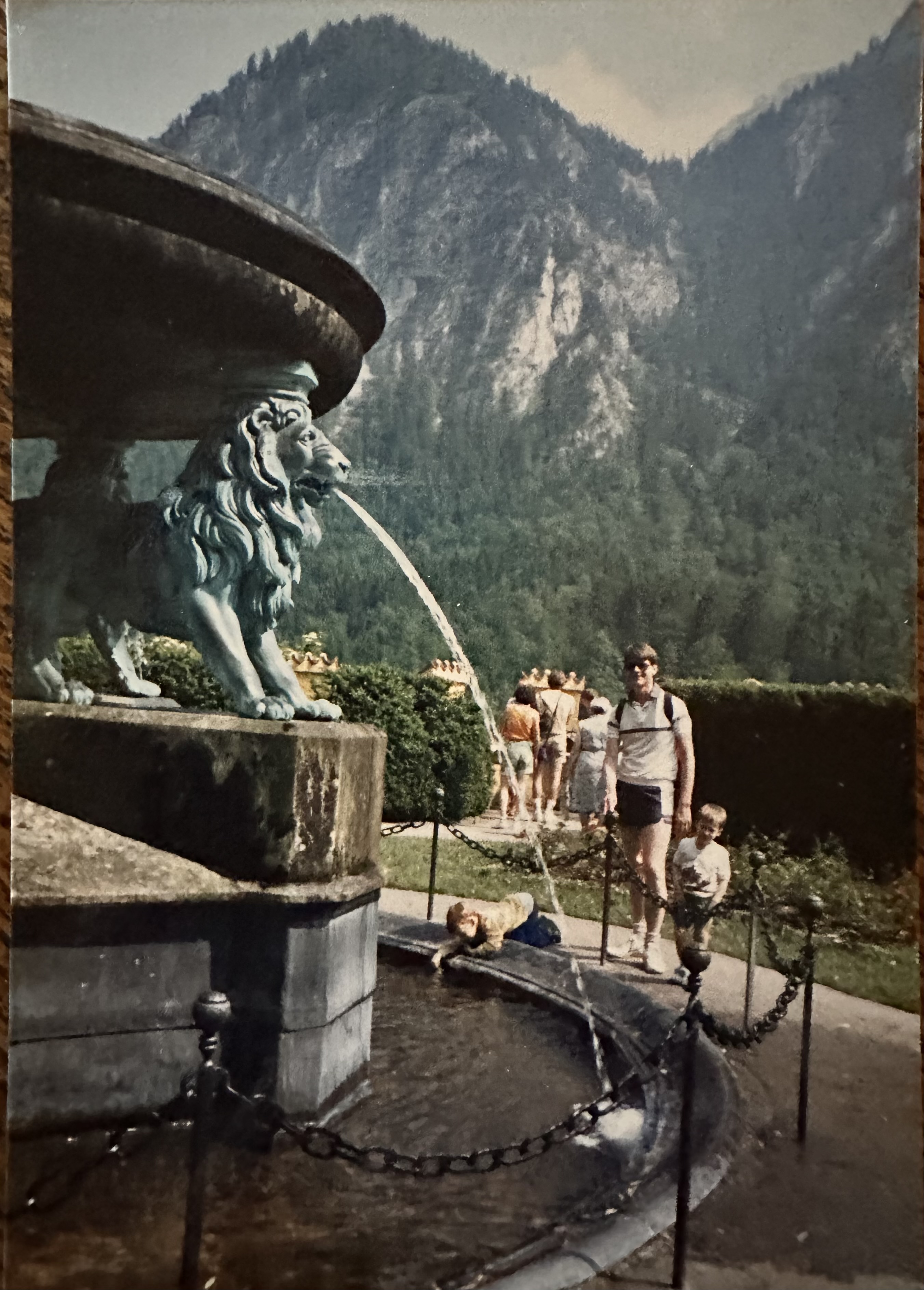
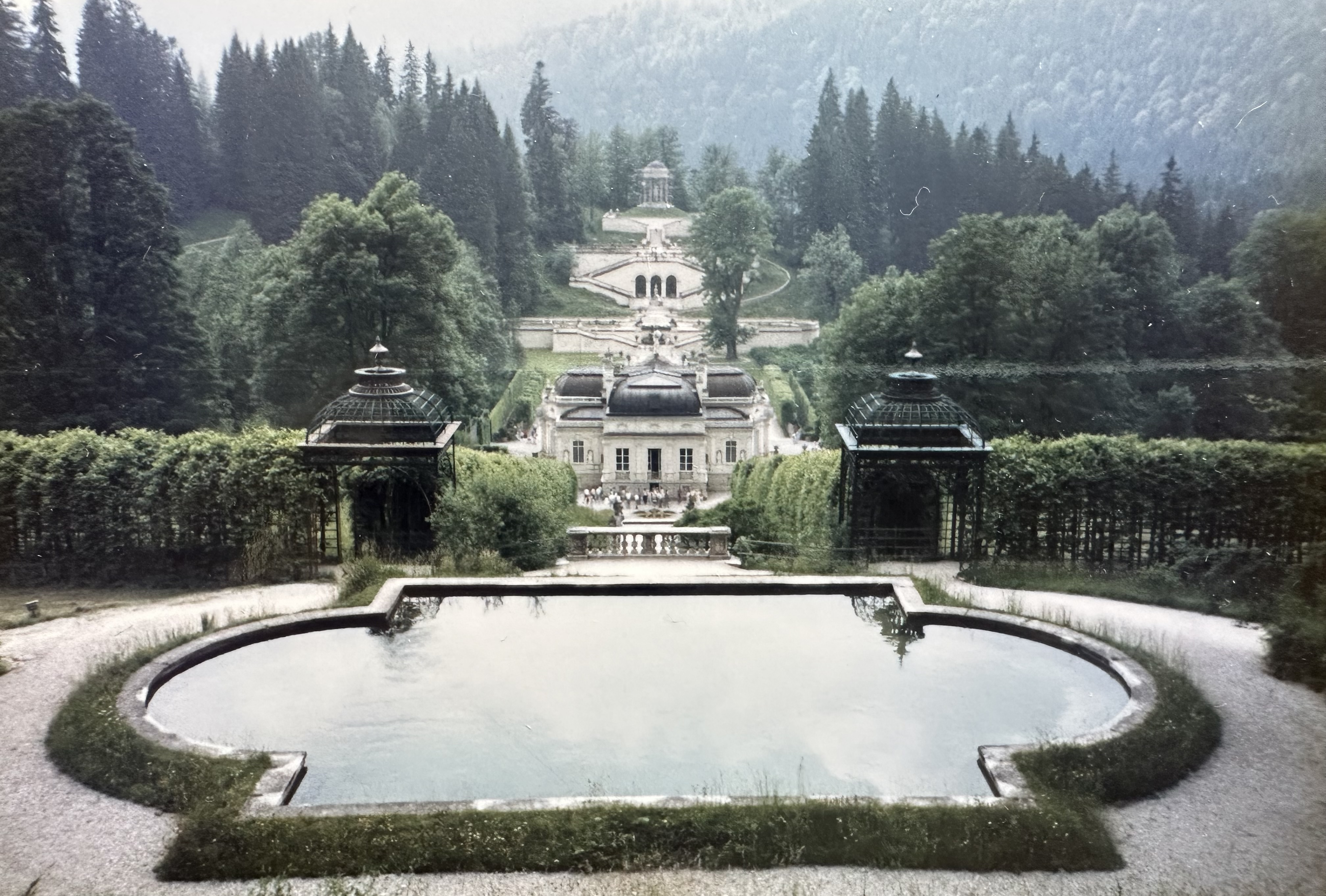
What I remember most from Linderhof is the magnificent terraced gardens surrounding the Palace. Apparently among them was a 300-yr-old Linden tree with a seat in it where Ludwig would take his ‘breakfast’ at sunset hidden from view (of his adult supervision?) amongst the branches. Here are the photos we took of our visit 36 years ago:

A few more photos from our trip to Bavaria…

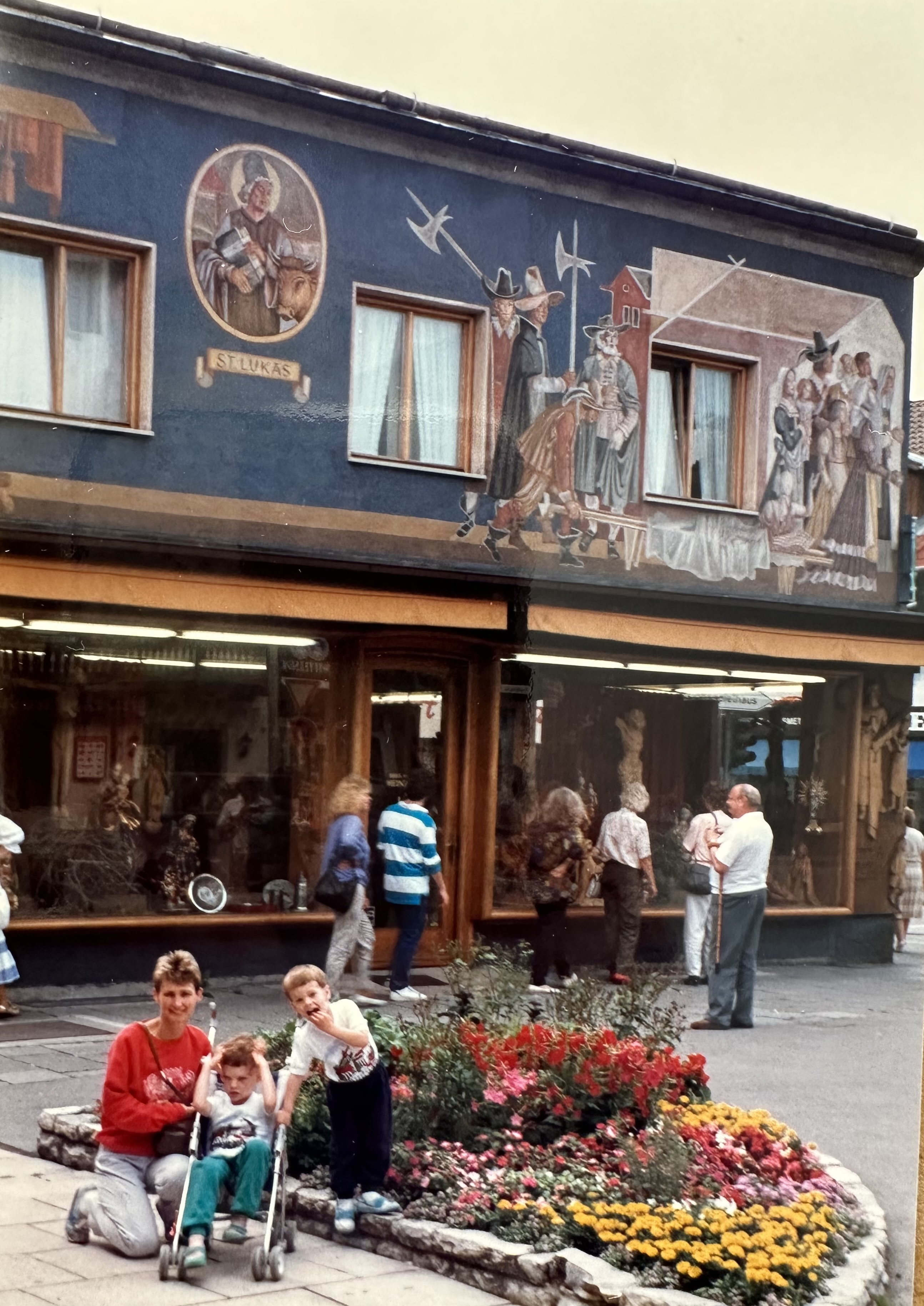
Here I am with Aaron and Ben – love the murals on the buildings!

And the gardens. I can’t believe we did all that walking with two small children and one little ‘ol banana stroller. You see here that Ben has relenquished the stroller to Aaron. I wonder if they’ve been keeping score this whole trip on who’s turn it is to ride.

David with the kiddos:

Take a play break at the fountain!

It was great to sit outside by a Jagerhaus (hunting lodge?) and enjoy the Bavarian spring weather.

Oh no! Who could have predicted that a bee would land on the rim of Aaron’s coke and sting him right on the lip as he lifted his can to take that oh-so-innocent sip? When you ask Aaron about this trip he will say that he does remember that cruel bee sting to his lip! We all do.

Yeah, well, the kiddos are 40 now. Dang. What does that make us? David and I. How did we find ourselves at this (ahem) stage of our lives so quickly?

That about wraps up our trip to Bavaria, Germany, 36 years ago where we visited two of King Ludwig’s fantasy castles. I dunno, I may have to lock myself overnight in a hall of mirrors reflecting the light of the candles a thousand times, creating an unimaginable effect on my brain to tackle that intricate wooden 641-piece Liberty puzzle of Castle Neuschwanstein.

Magpies – Part 6 -The Funeral

June 11, 2023

What? You still blogging about the magpies? The nest is empty! Yes, just before Memorial Day, an adult magpie was killed in front of our living room window. I was hoping it wasn’t one of our mating pair, but of course it was, as soon after we discovered two dead babies on the ground near where the adult had been killed. Then the nest and even our yard turned quiet. Where had the widowed mate gone?

It was a bit of a challenge letting go of that magpie family we had been watching for 8 weeks from every front window of our house, building the nest, the male feeding the female as she nested, and finally both of them taking care of the babies. I had been expecting the babies to fledge about the time one of the adults was killed.

I was surprised at how sad I was. How could I have become so attached to that pair of nesting magpies? I did a lot of research on magpies, (hence five blogs!) and discovered how they are one of the smartest animals on the planet, how they mate for life. Here’s an informative link: https://www.nature-anywhere.com/blogs/bird-feeding-academy/bird-card-the-black-billed-magpie

In captivity a Black-billed magpie can live up to 20 years but the average life-span in the wild is 2-4 years. They don’t even start breeding until they are a couple years old. Only about 14% of magpies ever succeed in breeding. They may successfully raise only 7-11 chicks to adulthood in a lifetime.

One of the most fascinating facts about magpies is that they grieve for their dead and gather for funerals. https://www.dailymail.co.uk/sciencetech/article-1221754/Magpies-grieve-dead-turn-funerals.html

When a magpie discovers the body of a dead magpie he will call out as loud as he can to attract other magpies to the area. Together they will squawk loudly for up to 15 minutes, leave grass ‘wreaths’ and then silently leave the scene. Some funerals have had up to 40 mourners.

Here’s a youtube link to a video of a funeral – (you might want to turn down your sound!)

Now you need to turn up your sound (!!) to fully experience the event that happened early Saturday morning, June 3. At 7am David and I simultaneously bolted upright from deep slumber. (Hey, we’re retired.) What’s going on? It took me a bit to realize what we were hearing through our open upstairs bedroom windows. What in the world? I scrambled to find my i-Phone to capture a video from our bedroom of the loud screaming magpie fracas around the nest in our front may tree.

As it turned out, I needn’t have rushed to find my phone to take a video. Play my 47-second video over and over again about 17 times and you will have experienced what could only have been the funeral for the deceased magpies. After about 15 minutes the magpies all flew off and the tree fell silent. The funeral helped me grieve and find closure as well.

Lastly, here’s a sweet parting song on Youtube called “Magpie” by Ian Tyson. A few lyrics:

“Always wakin’ up my wife and I,

You ol’ coyote in the sky.

The west ain’t never gonna die,

Just as long as you can fly…”

.

The sun has set on the magpies.

And, I guess I could focus now on putting out the hummingbird feeders.

Magpies – Part 5 – Magpie Mania

June 5, 2023

It’s been 50 days since I last blogged about the magpies nesting in our front may tree. What an interesting experience it has been, witnessing this pair of black-billed magpies build their nest just 20 feet from our front door. They built an elaborate domed nest over several weeks, which I describe in my first blog written on March 29. I had been stepping out our front door to take photos of the worst southeast Idaho winter we’ve had in over 30 years (ahem), and inadvertently also photographed the building of the nest. I was confounded by its discovery and my first impulse was to devise ways to run the magpies off, those noisy, smart, pesky, bully birds whom nobody seems fond of. My only previous history with magpies was to chase them off our property for the past 22 years and hold them to blame for the disappearance of baby songbirds.

But I was suddenly fascinated with them, and discovered lots of interesting facts and history about magpies, which I blogged about while watching and waiting for the pair to lay eggs. I wrote my last blog on April 16, when I was pretty sure the female was beginning to nest. Magpies mate for life and raise one brood per year. They typically lay 3-6 eggs, which hatch in 16-20 days. The male feeds the female throughout incubation. The babies fledge after 3-4 weeks.

The lucky thing was, I could view the nest from our front dining room window. And our kitchen window. And our upstairs bedroom and office windows. I found myself looking for them constantly, I’d hear a squawk and race to the window. I loved watching this pair. And taking photos and videos. It made me so happy to see them together.

Winter seemed like it would never end. We had another snow storm on April 21. I worried a bit about how the female would keep the eggs warm and the male would find enough food under a new blanket of snow to feed them both.

April 21, 2023

The nesting female would hop out of the nest and shake herself off, fly to a nearby tree or lawn to exercise her wings, but then head right back to the nest. Her long tail was a bit bent from roosting.

I’ve captured lots of photos and videos of the magpies. (Surprise, surprise)

Magpies in flight, magpies in our back garden.

To say I was obsessed with the magpies would be a gross understatement. One Sunday I came down with the blues. I had flats of annuals to plant but just couldn’t get myself motivated. But I knew the cure. The magpies saved me. Seeing both magpies hop out of the nest buoyed my spirits.

Of course, I’ve yet to plant the flowers in the gardens. I don’t want to miss anything with the magpies.

Both parents were feeding the babies now. Such a happy time. I captured a video of them canoodling on the roof across the street. So sweet!

I planted the flower pots on the deck on May 20. Three days later, on the evening of May 23rd, we got hammered with a huge rain/hail storm, dumping 1-3 inches of rain and hail over a couple of hours. I took a short video of the storm through our dining room window, capturing the edge of the may tree with the magpie nest.

The magpies survived in their domed and roofed nest. I wonder about the robins and other songbirds? Our flower pots were completely hammered.

I expected the babies to fledge around Memorial Day. The may tree had leafed out and the babies were very quiet. Although you could hear tiny sqawks when one of the parents arrived in the nest.

Yes, the magpies had survived the hail storm, but on Saturday morning, May 27, I heard a magpie squawking like mad in our front bushes by our fountain up next to the house. I opened the front door and it flew off. Huh. Maybe an intruder? David came to me later that afternoon. “I don’t know if you saw it, but there are magpie feathers scattered in an area by the front fountain.” What?? I ran out there. Sure enough. A scattering of feathers – a magpie had been killed. Did a cat get it? Magpies are relatively slow flyers. Was it an owl or hawk? Oh, surely it’s not one of our magpies! But how could it not be? Although we have seen other magpies around. I clung to the hope…please, please, let it not be one of ours!

That afternoon about 4 PM I spotted one of the parents feeding the babies. I quick! captured a video

Yes! Such a hopeful sign.
But that would be the last time. On Memorial Day, two days later, I found a dead baby magpie in the same spot where I had discovered its … father? mother? With only one parent it would have either died of hypothermia or starved to death. I took a photo of the dead baby. It had feathers and I bet it was about ready to fledge. I came in the house and told David. Do you want to see the photo of the dead baby? I asked. Why would I want to see that?? he said. I dunno. Dang it! I was so sad.
Two days later David was out digging up dandelions in our front yard and found another baby in the grass just 10 feet away from where I had seen the other one. Maybe the remaining magpie had kicked the babies out of the nest so they would die quickly and wouldn’t have to suffer starvation.

The nest was empty now and our whole place was quiet. I could hear magpies chattering in neighbors’ yards but honestly didn’t spot a one in our yard for several days.

Then this past Saturday, just two mornings ago, the most amazing thing happened. I’m a heavy sleeper in the early morning hours and I nearly always miss the chirping of the birds. But I was awakened by a huge racket in our front may tree. It was really something. I jumped up and scrambled to find a phone to take a video.But I needn’t have hurried. The racket in our front may tree, coming from what must have been about 20-30 magpies, went on for nearly 15 minutes. It was a funeral for our little family.

Which brings me to the topic of my next blog.

In the meantime, I hope to finally get our flowers and tomatoes planted. I’m sure they’re all rootbound as hell.

Magpies- Part 4 – Tales and Superstitions

April 16, 2023

Whenever I tell someone about the magpies nesting in our front yard they almost always react with an “Oh no!” or an expression of, ‘oh, you poor thing.’ Over the 22 years we have lived in this house the only interaction I’ve had with magpies was to run them off, because I don’t want them messing with the robins and other pretty sounding songbirds. Which is easy. You just open the front door and the magpies fly off. I’ve even run them off the the neighbor’s yard across the street, to protect the nesting duck in their front marigold patch. I’d open our front door and clap. Off they flew. They have very sharp senses. I’ve never seen a magpie nest, or even imagined magpies nesting near us during the past 22 years we’ve lived at this address. Until now.

It is still a surprise to look out at our front may tree.

Friday, April 14, 2023

I don’t see no nest, do you? Yeah, it’s like the elephant in the room, or in this case, the elephant in the tree. I’ve been closely watching them and I’m about positive the female laid her first eggs this past Tuesday, April 11. I told a friend that, she said, no way. There is no way those eggs will survive the weather. I wonder too. We had about 3 days of spring, when she appeared to be nesting and perhaps laid her first eggs, then winter was back.

Thursday, April 13

The female would hop out of the nest, shake herself off, then hop back in. Good thing the nest is domed. Although not leak proof! The male is close-by. And sure enough he is feeding the female.

And look! The robin is back! Assuring us, everything is fine.

Magpies have such a horrible reputation, the yakkity, garbage eating bullies of the bird world that will destroy your gardens and decimate the populations of nearby nesting, more sweet sounding songbirds. But how much of that is true? I did a little research. The Romans believed magpies were highly intelligent with excellent reasoning abilities. In ancient Greece, magpies were sacred to the God of wine, Bacchus. Native Americans considered magpies to be sacred messengers of the creator or even a guardian with shamanic properties. They wore magpie feathers to signify fearlessness.

In Korea the magpie is celebrated as a “bird of great good fortune, of sturdy spirit and a provider of prosperity and development.” Korean children were taught that “when you lose a tooth, throw it on the roof singing a song for the magpie. The bird will hear your song and bring you a new tooth.” https://en.wikipedia.org/wiki/Oriental_magpie. Similarly, in China magpies are seen as an omen of good fortune and killing one would bring the reverse. The Manchu Dynasty (the Great Qing Dynasty and last dynasty that governed China from 1636-1912) adopted the magpie as a symbol of its imperial rule, declaring it the official ‘bird of joy.’ Mongolians believed magpies controlled the weather.

The magpie was seen as a very important, positive mythological bird in history, until the Christians arrived on the scene. https://www.birdspot.co.uk/culture/magpies-and-superstition The story was told that when Jesus was crucified, two birds came to perch on his cross, a dove and a magpie. The dove grieved for Jesus and caught his tears but the magpie did not. Thus, magpies were eternally damned in the eyes of Christianity because they supposedly did not grieve the death of Christ. In the 19th century a vicar reported one of his servants explaining that the magpie is the only bird not to enter Noah’s ark, preferring to sit outside chattering and swearing in the pouring rain. The church also started the rumor that magpies carry a drop of the devil’s blood in their tongues. If you were to cut the tongue to release the blood then the magpie would be capable of human speech. BTW, the magpie is already capable of mimicking human speech, how in the world would a human cut its tongue? So who is smarter, (guns and opposable thumbs aside) humans or magpies? One could wonder…

In Britain there is probably no other bird more associated with superstition than the magpie. It is generally considered bad luck to come across a lone magpie. Not entirely sure why, but magpies often mate for life, so seeing a single magpie may mean it has lost its mate and therefore, the chance of it bringing bad luck is higher. Coming across a larger group of magpies could actually bring you good fortune and wealth. To help ward off the bad luck that might come your way when meeting a single magpie you might want to either salute the magpie, or say “Good morning general” or “Good morning captain!’ or say “Good morning Mr. Magpie, how is your lady wife today?” or “Good morning Mr. Magpie, how are Mrs. Magpie and all the little magpies?” or say, “Hello Jack, how’s your brother?” or Doff your hat, spit three times over your shoulder, or lastly, blink rapidly to fool yourself into thinking you’ve seen two magpies. You know, to ward off back luck, just in case.

It’s Sunday, April 16, and we checked on the magpies, first thing. Sure enough they were both out there. I started writing my blog and noticed things started to seem more quiet than usual. I kept glancing out the window, especially when I heard magpie calls. For some reason for the past few hours I’ve only seen one. I’ve seen the female emerge from the nest, alight on a limb and call. And then return to the nest. I’ve glanced out to see a magpie fly out of the nest, was it the male, flying off after feeding the female inside the nest? I hope so. I have to admit that I’m a bit worried. I hope they are fine; I’m just missing the signs. Why is it so quiet and why have I only seen one over the past several hours? Could something have happened to the male? You know their reputation around here. Oh man. I shared my concern with David, had he seen the two of them? No, not since 7:30 this morning. “But hey” David reminded me, “You’ve been running them off for the past 22 years, all worried about the robins, and now you’re heartbroken with worry that something might have happened to the magpies?”

Yep, pretty much. If I see even one magpie I’m going to salute it, “Good morning Mr. Magpie, how is Mrs. Magpie and all the little magpies?” And hope with all my heart that they are fine.

Magpies – Part 3 – Our Noisy Lovable Neighbors

April 11, 2023

A pair of magpies has built a nest right in our front yard in a huge may tree that hasn’t leafed out yet. I’ve been mostly photographing them through our front dining room window. They used to fly off as soon as I opened the front door. But they’ve become more comfortable and bold of late, or maybe undeterred in their quest to raise a family. This morning I walked out on the front stoop and took this video. They don’t appear to be nesting yet. You will see the mate fly across the view in this video.

You could play that video in a continuous loop and that’s pretty much what it sounds like around here. Even as I write this blog that magpie has alighted somewhere on another end of the property going ‘yaak’ ‘yaak’ ‘yaak’. It’s a different sound than the “yak-yak-yak-yak’ we were hearing, until about a week ago. Is it some huge announcement to the the animal world, “This is our territory and we’re raising a family!” I hope they have only claimed as territory the west end of our front yard surrounding the tree.

They are never far apart from each other.

Magpies mate for life. They are usually at least two years old when they choose a mate and they stay together year-round. If one of them dies then the other may find a new mate. They will even try to find a surrogate parent to help with raising the young if a mate dies while they are nesting. Although I did wonder if they also divorce, and sure enough, according to this Wiki link, https://en.wikipedia.org/wiki/Black-billed_magpie – divorces are possible: one South Dakota study found about an 8% rate of divorce, but another 7-year study in Alberta found divorce rates up to 63% (hey, so they’re smart and complicated, like humans).

Black-billed magpies, also known as the American magpie, are native to the northwestern half of the the US and Canada. Here’s a screenshot of the map in the Wiki article showing their habitat.

Magpies (and other corvids like crows, ravens and jays) are considered to be the smartest non-mammal animals. Of course we humans are much smarter, the smartest of all animals and mammals, with our guns and opposing thumbs, the species at the top of the food chain. When Lewis and Clark first encountered black-billed magpies in South Dakota in September of 1804, they reported the birds as being very bold, hopping into the tents of Plains Indians in search of meat, some which were tame enough to take food from the hand. Magpies followed the buffalo herds, picking insects and ticks off their backs but when the white man came along and decimated the buffalo herds in the 1870’s, magpies switched to cattle, horses and mules. By the 1960’s they had also moved into the emerging towns and cities of the west.

During the first half of the 20th century magpies developed a bad reputation because they stole game bird eggs and also because they picked at the sores on the backs of cattle, for example, their fresh wounds from being branded, and saddle sores on horses and other unhealed wounds. So humans systematically trapped and shot magpies. Bounties of one cent per egg or two cents per head were offered in many states. In Idaho the death toll eventually amounted to an estimated 150,000. In 1933, 1033 magpies were shot in an exterminating contest in Washington’s Okanogan Lakes Region, by two 6-person teams of bounty hunters. Many magpies also died from eating poison set out for coyotes and other predators.

Luckily magpies survived human’s extermination efforts in the early part of the 20th century, and they are common and widespread today. Their main natural predators are owls, crows, raptors, dogs and cats. They can have eggs stolen out of their nests by raccoons, hawks, weasels and minks. Most males appear to begin breeding in their second year. Mean life expectancy in the wild is 3.5 years for males and 2.0 years for females. Although, in captivity magpies can possibly live up to 20 years. It’s a hard scrabble life for magpies.

I’ve been watching the magpies closely today. One of them is chirping constantly.

I saw the two of them together on a limb near the nest and then one of them hopped into the nest and stayed there until I got tired of watching, a good ten minutes. The female incubates and the male feeds the female throughout incubation and guards the nest. I’m wondering … is the female laying eggs now? The female lays up to 13 eggs, but the usual clutch size is 6 or 7. Incubation period is 16-21 days.

One magpie, (the male?) is still talking constantly. I just now stepped out the front door and captured this video:

Tuesday, April 11, 2:26 PM. Did we possibly just witness the male deliver food into the nest for the incubating female? Has she started laying and incubating eggs!? It’s admittedly a good day to lay eggs. We’ve had a two-day sunny warm spell here with temps soaring into the mid-sixties. Of course, the weather forecast calls for a 25-degree drop in temperature over the next 48 hours.

I have to admit – I’ve become quite attached to these magpies. Ol’ grandma here will keep a close watch and do my best to scare off predators and any unwanted visitors, like their wily close cousins the crows.

At this point, I just don’t want anything seriously bad to happen to this budding little magpie family. Is that just too much to ask of Mother Nature and the Universe? Yes?