My last blog was about ‘Froggy,” the bullfrog croaking in the bushes beside Steph and Victor’s pool at their house in Princeville. David, Megan, Eric and I returned home from Kauai over 5 weeks ago and I’ve been wondering about Froggy. Is he still there? I asked Steph last week, and yes, he is, still croaking away. I wonder if Steph and Vic will soon have tadpoles floating in their pool?
I had become totally smitten with the bullfrog over the two weeks in January we stayed with Steph and Victor. He croaked several times a day, and it cracked me up every time. Several of us would be carrying on a conversation in the kitchen when Froggy’s croak would blast from the bushes like a fog horn. It was all I could do to stop myself from raising a palm to pause the conversation with a “Shhhhhh….Froggy is speaking.” He tickled me so much that it even made me seriously wonder for maybe the first time in my life, could I have a spirit animal? Could the bullfrog be my spirit animal? This link might be helpful:
https://www.mindbodygreen.com/articles/how-to-find-your-spirit-animal
In some Indigenous cultures spirit animals are a spirit that helps guide or protect a person on their specific journey. Common spirit animal guides include a Crow, Bear, Butterfly, Cat, Deer, Dove, Dolphin, Elephant, Fox, Horse, Hawk, Lion, Mouse, Owl, Peacock,Turtle, Tiger, Wolf, Frog (“the Frog is often thought to help heal physical and emotional wounds. It speaks to the importance of checking in with oneself and healing from the past in order to live in the present.” Huh…)
Well anyway, I carried my intense froggy love back to Idaho with me and just couldn’t wait to write my blog about ‘Froggy.’ It started off great and wonderful until I started a Google search on American bullfrogs (native to the Eastern and Central United States) only to discover that they are a highly invasive species that prey upon and out-compete native frogs, seabirds, and other aquatic species. They will basically eat anything that walks in front of them that fits in their mouths. But, hey, I covered this sad story in my last blog. Here’s one final link on the subject, an article from the Washington Post about hunting and eating invasive bullfrogs in Utah: https://www.washingtonpost.com/climate-environment/2023/03/05/utah-bullfrogs-catch-eat/ Sigh …
While we’re on the subject of invasive species in Kauai, enter Snail. Uh, that is, the Giant African Land Snail or GALS. While merrily hiking along a grassy path just beyond an enchanted mahogany forest, I nearly choked on my breath with the site of this guy.

You’ve heard of Nine Inch Nails, but what about Four Inch Snails?https://kealakai.byuh.edu/creature-feature-the-invasive-giant-african-land-snail Giant African Snails can grow as large as 8 inches long with a shell 5 inches across. They are one of the world’s largest and most damaging land snails, eating over 500 different plant species, including peanuts, beans, peas, cucumbers and melons, and many more crops. If fruits and vegetables aren’t available they will gorge on a variety of ornamental plants, tree bark, and even paint and stucco on houses. They are native to coastal east Africa but are now found across Asia, the Pacific, the America’s and Europe. According to invasivespeciesingo.gov, these snails were first introduced to Hawaii in 1936, imported for educational purposes, as pets (really?) or in cargo. Not only has it become an agricultural pest, but it also carries rat lugworm disease from a parasitic worm that can cause meningitis in humans and other animals. Geesh!
The giant African snail I met was truckin’, even if it was at a snail’s pace. By all means, don’t pick it up! Instead I took a video just so you can see what a ‘snail’s pace’ looks like:
The top recorded speed for a snail is 0.002 mph, or about 10 feet/hour. They won’t move on average more than 250 meters (273 yards) in a year. Giant African land snails are hermaphrodites, which means each snail contains both male and female reproductive organs. They don’t need to mate to reproduce and can lay up to 500 eggs at a time, about every 3 months. They are sexually mature after six months. This gives you an idea of how fast even one snail by itself can multiply.
We saw two of these snails on our recent 2-week trip to Kauai. We saw the second one at, I mean on, the restroom at Makauwahi Cave:

Oh yum. Let’s suck the red paint off this building. Makes you wonder. Should you take gloves with you on your hikes and snatch up every one of these you see and dispose of it? (How? In a trash can?) I dunno.
The state of Florida has gone through great lengths to eradicate the invasive giant African snails. According to this article, https://www.npr.org/2023/06/23/1183784344/giant-african-land-snail-florida-problem in 1966, a Miami, Florida boy smuggled three giant African snails into South Florida upon returning from a trip to Hawaii. His grandmother eventually released the snails into her garden. By 1975 the snails were declared eradicated after destroying more than 18,000 adult snails and thousands of eggs. The snails popped up again in 2011, it took ten years, but they were declared eradicated again in 2021. Then this headline from June 20, 2023: https://www.nbcmiami.com/news/local/quarantine-zone-established-after-giant-african-land-snail-spotted-in-broward-county/3056940/, One giant African land snail was spotted in Miramar on June 2, 2023, where they have established a quarantine zone. The snails are sprayed with the pesticide metaldehyde (in snail bait) and also the state uses Labrador retriever dogs trained to sniff out the giant snails.
Since they were introduced in 1936, Hawaii has also tried to eradicate or at least control the giant African land snail population. In the 1950’s rosy wolf snails were deliberately introduced in the hopes they would eat the giant African snails. Except they didn’t eat those snails; they ate endangered native Hawaiian snails instead, driving some to extinction. This is the point in my blog where I can really gross you out. Or maybe offer you some gory entertainment if you’re bored out of your skull. Or if you have a child or grandchild whining at you, “I’m b-o-o-o-r-ed!” – Click on this Google link about the cannibalistic rosy wolf snail. Scroll down and you will see a YouTube video capturing the live action of a rosy wolf snail stalking and then devouring a native Hawaiian snail.
https://www.google.com/search?q=rosy+wolf+snail&ie=UTF-8&oe=UTF-8&hl=en-us&client=safari
Yuck! I can’t end my blog on this note! Here, I will include a link to the fantastic walk we made through the enchanted Mahogany forest near Kilauea on the north shore of Kauai, the same walk where we met that crazy giant African land snail. It’s called the Wai Koa Loop Trail, which ultimately leads you to a beautiful waterfall and a path by a sitting Buddha. Here’s a Tripadvisor link with lots of photos that capture it beautifully.
And a few of my own. First we come to a sign:
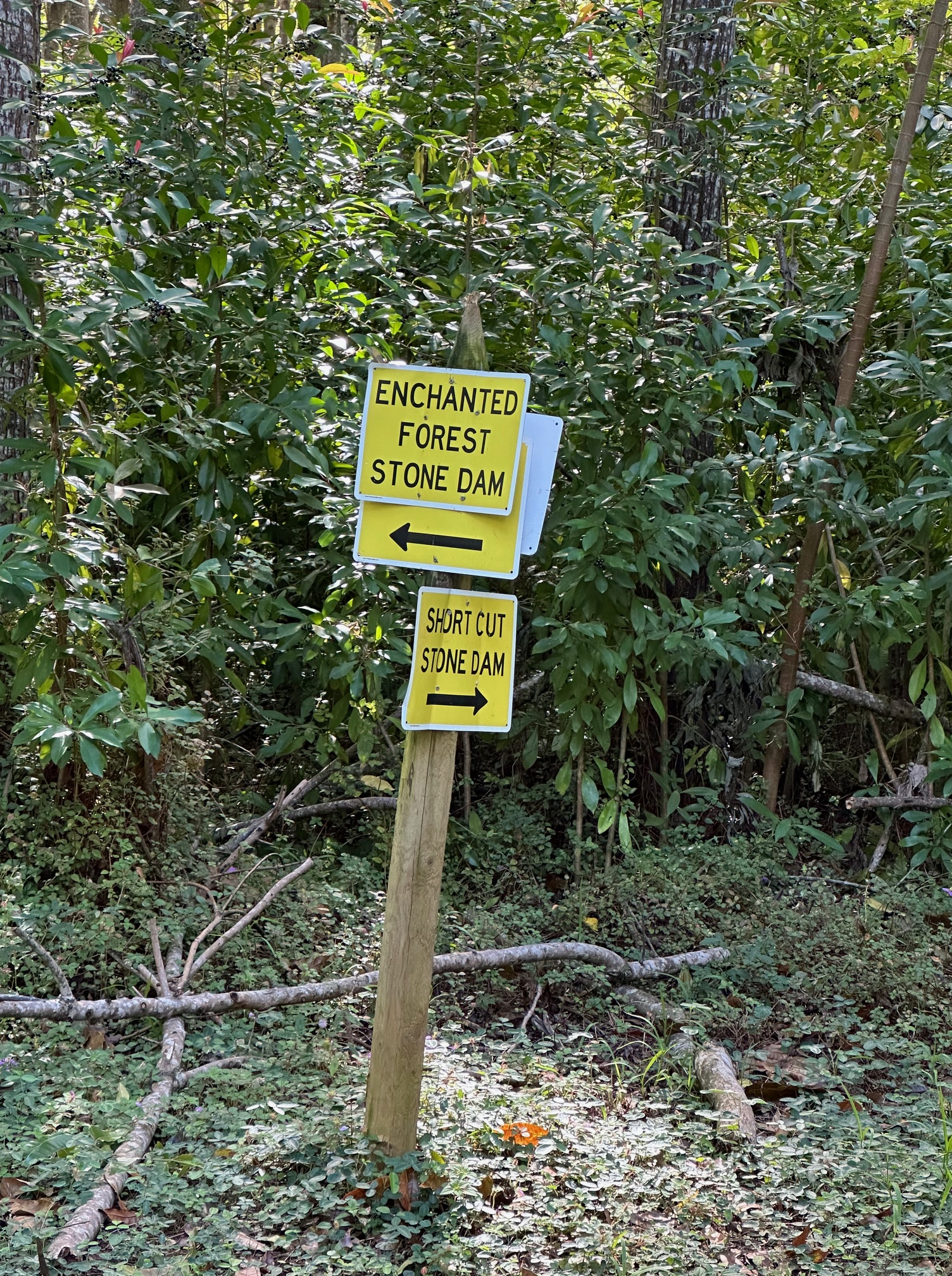
Wow. Tough decision here. Duh. Is this a research project? 0.002% of humans might go left here.
Here’s the waterfall you come to at the end of the trail:

Here we are walking back past the mahogany forest, David, Megan, Victor, Eric and Stephanie.

We saw several monarch butterflies. Here I captured one in flight. Do you see it?
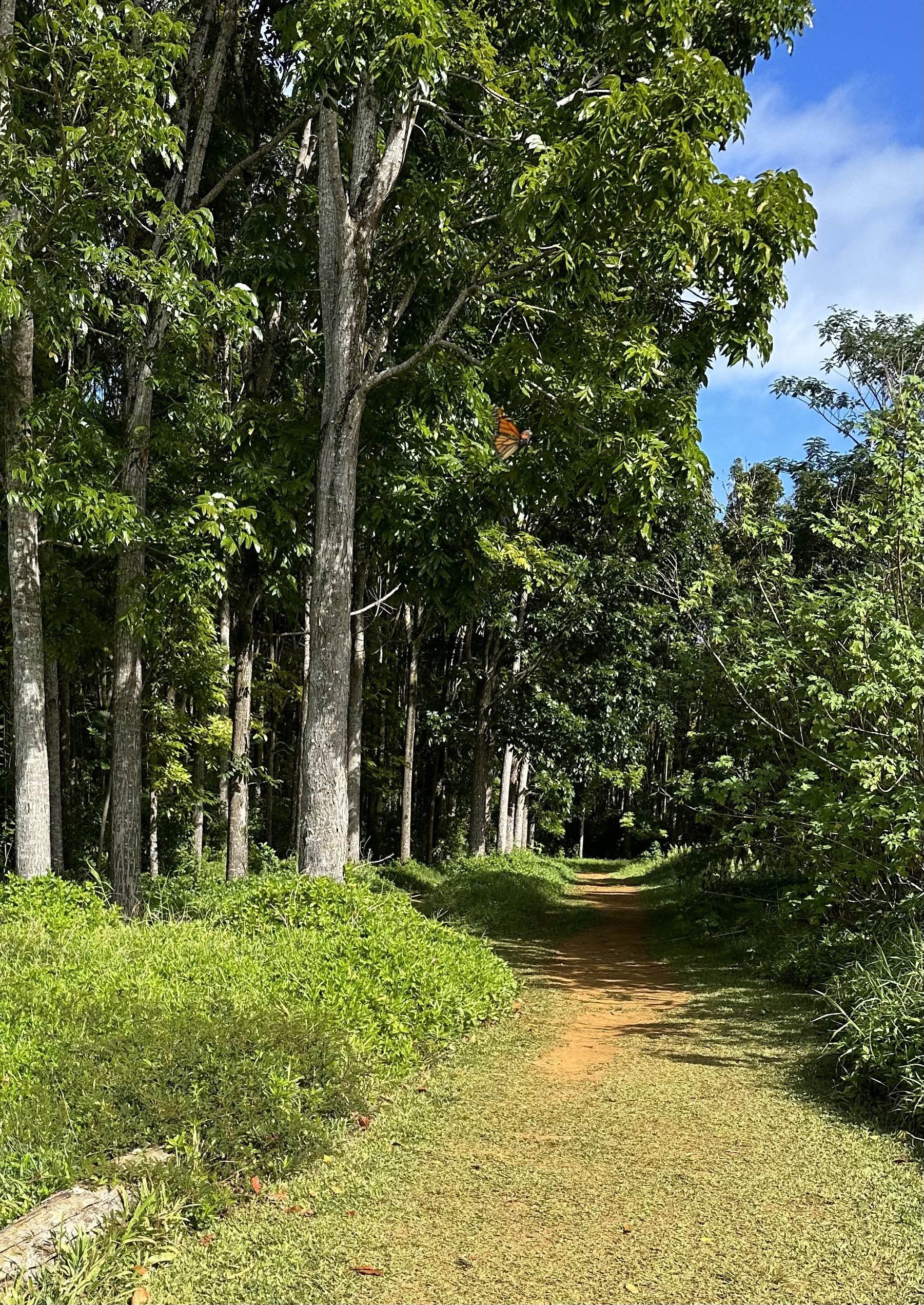
Wonderful.
There now. I feel a little better. After all, I am writing a blog about our two-week trip to Paradise, where you are so close to nature that you might just discover your spirit animal guiding you along your life’s journey. Well, in any case, I’m pretty sure that spirit animal wouldn’t be a giant African land snail.


 The Decompression of a Boomer