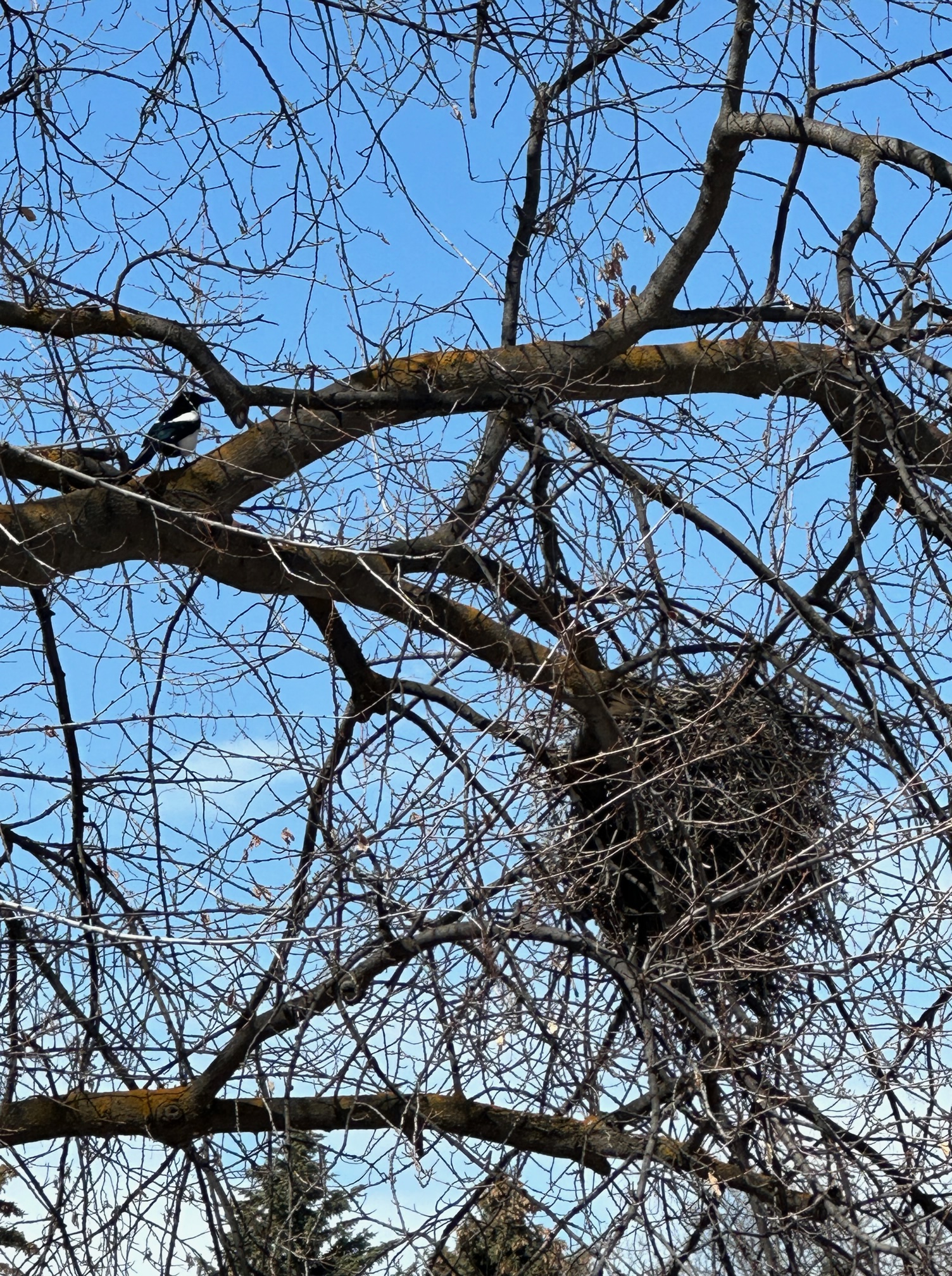
Whenever I tell someone about the magpies nesting in our front yard they almost always react with an “Oh no!” or an expression of, ‘oh, you poor thing.’ Over the 22 years we have lived in this house the only interaction I’ve had with magpies was to run them off, because I don’t want them messing with the robins and other pretty sounding songbirds. Which is easy. You just open the front door and the magpies fly off. I’ve even run them off the the neighbor’s yard across the street, to protect the nesting duck in their front marigold patch. I’d open our front door and clap. Off they flew. They have very sharp senses. I’ve never seen a magpie nest, or even imagined magpies nesting near us during the past 22 years we’ve lived at this address. Until now.
It is still a surprise to look out at our front may tree.

I don’t see no nest, do you? Yeah, it’s like the elephant in the room, or in this case, the elephant in the tree. I’ve been closely watching them and I’m about positive the female laid her first eggs this past Tuesday, April 11. I told a friend that, she said, no way. There is no way those eggs will survive the weather. I wonder too. We had about 3 days of spring, when she appeared to be nesting and perhaps laid her first eggs, then winter was back.

The female would hop out of the nest, shake herself off, then hop back in. Good thing the nest is domed. Although not leak proof! The male is close-by. And sure enough he is feeding the female.
And look! The robin is back! Assuring us, everything is fine.

Magpies have such a horrible reputation, the yakkity, garbage eating bullies of the bird world that will destroy your gardens and decimate the populations of nearby nesting, more sweet sounding songbirds. But how much of that is true? I did a little research. The Romans believed magpies were highly intelligent with excellent reasoning abilities. In ancient Greece, magpies were sacred to the God of wine, Bacchus. Native Americans considered magpies to be sacred messengers of the creator or even a guardian with shamanic properties. They wore magpie feathers to signify fearlessness.
In Korea the magpie is celebrated as a “bird of great good fortune, of sturdy spirit and a provider of prosperity and development.” Korean children were taught that “when you lose a tooth, throw it on the roof singing a song for the magpie. The bird will hear your song and bring you a new tooth.” https://en.wikipedia.org/wiki/Oriental_magpie. Similarly, in China magpies are seen as an omen of good fortune and killing one would bring the reverse. The Manchu Dynasty (the Great Qing Dynasty and last dynasty that governed China from 1636-1912) adopted the magpie as a symbol of its imperial rule, declaring it the official ‘bird of joy.’ Mongolians believed magpies controlled the weather.
The magpie was seen as a very important, positive mythological bird in history, until the Christians arrived on the scene. https://www.birdspot.co.uk/culture/magpies-and-superstition The story was told that when Jesus was crucified, two birds came to perch on his cross, a dove and a magpie. The dove grieved for Jesus and caught his tears but the magpie did not. Thus, magpies were eternally damned in the eyes of Christianity because they supposedly did not grieve the death of Christ. In the 19th century a vicar reported one of his servants explaining that the magpie is the only bird not to enter Noah’s ark, preferring to sit outside chattering and swearing in the pouring rain. The church also started the rumor that magpies carry a drop of the devil’s blood in their tongues. If you were to cut the tongue to release the blood then the magpie would be capable of human speech. BTW, the magpie is already capable of mimicking human speech, how in the world would a human cut its tongue? So who is smarter, (guns and opposable thumbs aside) humans or magpies? One could wonder…
In Britain there is probably no other bird more associated with superstition than the magpie. It is generally considered bad luck to come across a lone magpie. Not entirely sure why, but magpies often mate for life, so seeing a single magpie may mean it has lost its mate and therefore, the chance of it bringing bad luck is higher. Coming across a larger group of magpies could actually bring you good fortune and wealth. To help ward off the bad luck that might come your way when meeting a single magpie you might want to either salute the magpie, or say “Good morning general” or “Good morning captain!’ or say “Good morning Mr. Magpie, how is your lady wife today?” or “Good morning Mr. Magpie, how are Mrs. Magpie and all the little magpies?” or say, “Hello Jack, how’s your brother?” or Doff your hat, spit three times over your shoulder, or lastly, blink rapidly to fool yourself into thinking you’ve seen two magpies. You know, to ward off back luck, just in case.
It’s Sunday, April 16, and we checked on the magpies, first thing. Sure enough they were both out there. I started writing my blog and noticed things started to seem more quiet than usual. I kept glancing out the window, especially when I heard magpie calls. For some reason for the past few hours I’ve only seen one. I’ve seen the female emerge from the nest, alight on a limb and call. And then return to the nest. I’ve glanced out to see a magpie fly out of the nest, was it the male, flying off after feeding the female inside the nest? I hope so. I have to admit that I’m a bit worried. I hope they are fine; I’m just missing the signs. Why is it so quiet and why have I only seen one over the past several hours? Could something have happened to the male? You know their reputation around here. Oh man. I shared my concern with David, had he seen the two of them? No, not since 7:30 this morning. “But hey” David reminded me, “You’ve been running them off for the past 22 years, all worried about the robins, and now you’re heartbroken with worry that something might have happened to the magpies?”
Yep, pretty much. If I see even one magpie I’m going to salute it, “Good morning Mr. Magpie, how is Mrs. Magpie and all the little magpies?” And hope with all my heart that they are fine.




 The Decompression of a Boomer