Archive for the ‘Kauai’ Category

Kauai 2024 – Part 5 – Aloha, Mahalo Kauai!

May 5, 2024

I’ve had writer’s block or something with my blog to where I just can’t move on from our January visit to Kauai. There’s a loose end here. I feel like I’ve left us marooned in Kauai and I need to get us home. Plus, somehow I got sidetracked this year with my blogs, writing about gluttonous invasive bullfrogs, invasive African snails the size of your fist and wild boar hunting with knives and two packs of hunting dogs. Novel idea, how about I wrap up this past January trip with some fun photos from Paradise?

“I agree,” said the rooster …
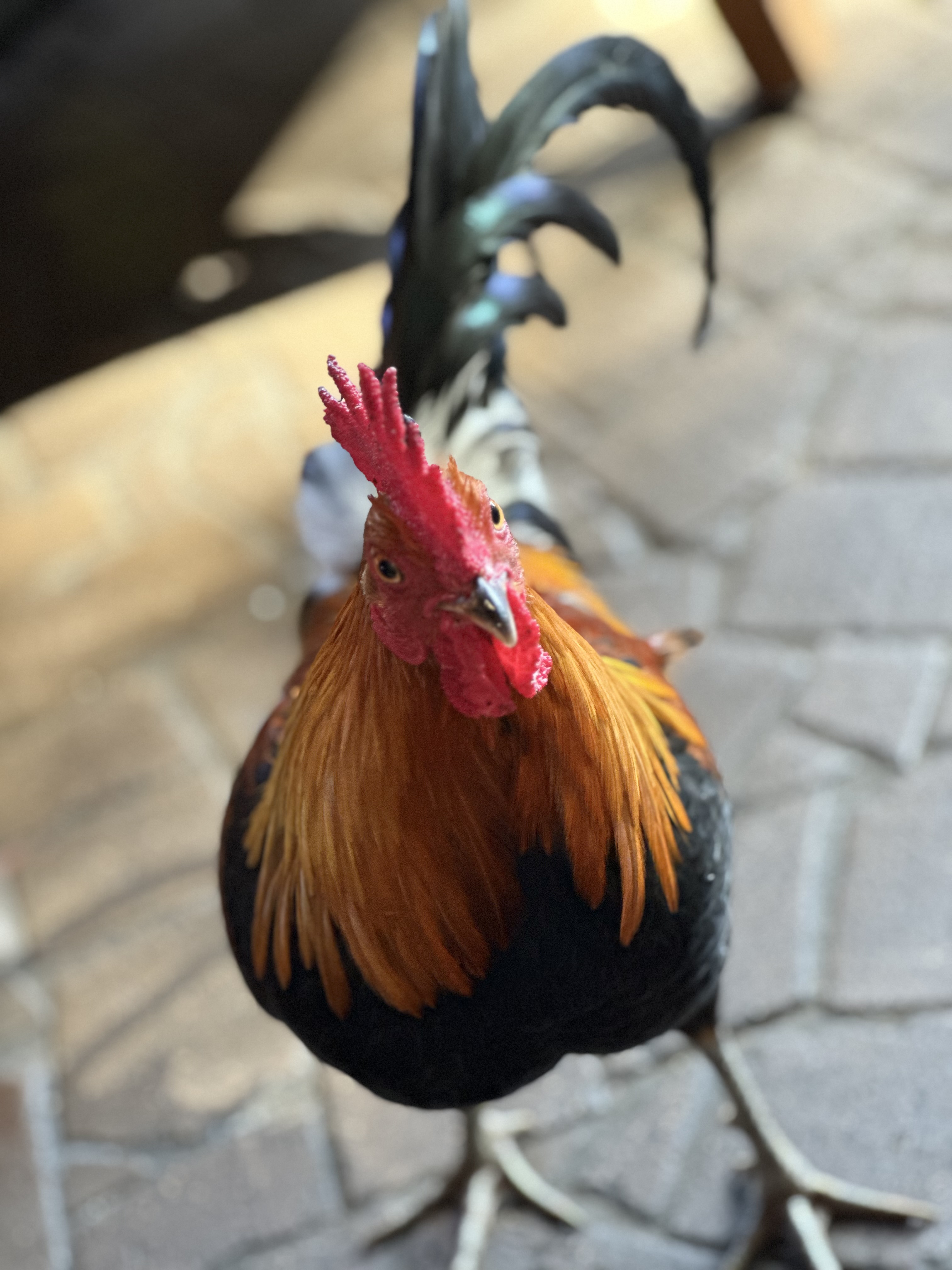
stalking us during lunch on an outdoor patio. A “Please do not feed the birds” sign is posted nearby, but how can we resist that face? Yeah, well, if you don’t resist, the rooster persists. Feral? You bet! Just try to catch that rascal.

We’ve made about ten visits to Kauai, David and I and my brother Eric. Our daughter Megan came with us the last couple of years. I usually write about 6 blogs after each trip, filling you in from beginning to end, getting us safely back home to Idaho. I reminisce and post my favorite tales and photos of Paradise, until spring gets here. Which, well I’m still good this year, time wise, since, here in southeast Idaho, we woke up yesterday to snow.

When we visit Kauai, we stay on the north shore with my sister, Stephanie and husband, Victor, at their home in Princeville. On the north shore of Kauai you absolutely have to visit Hanalei Bay; walk to the end of the dock.

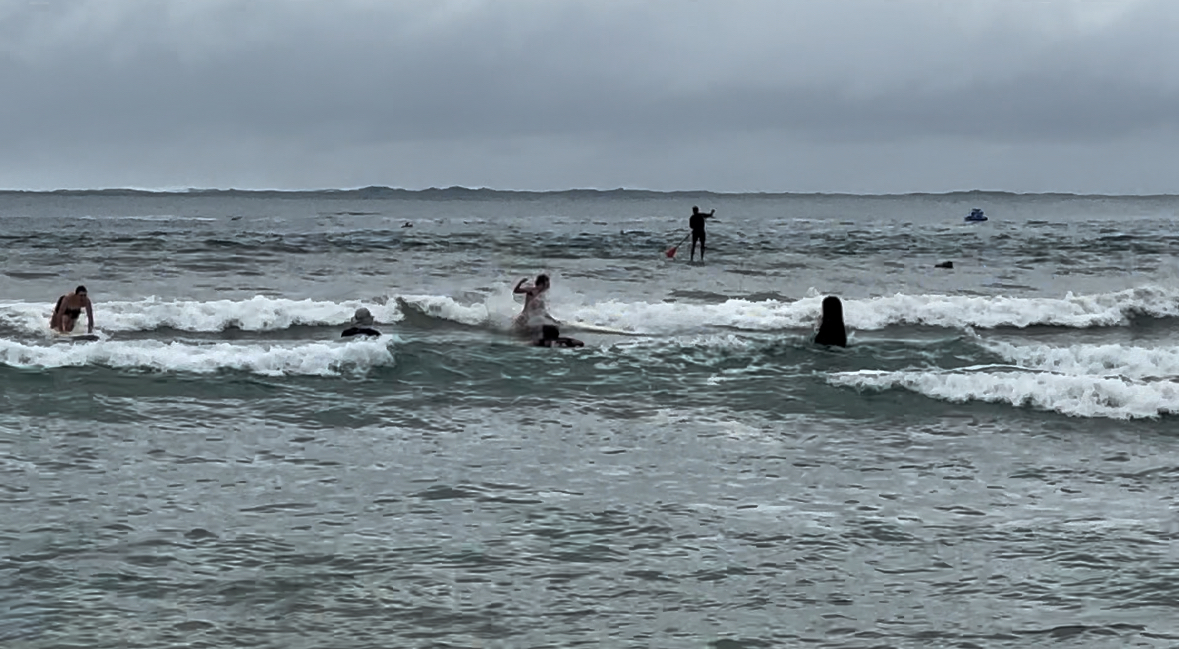
Swim or surf the waves. Or, in my case, swim or surf vicariously through other more enthusiastic water lovers, while you walk the beach. Here, I’ll take you along… you’re wearing your bathing suit, right? Let’s head into the crashing surf!

Or take up the surfboard. Can we catch a wave?
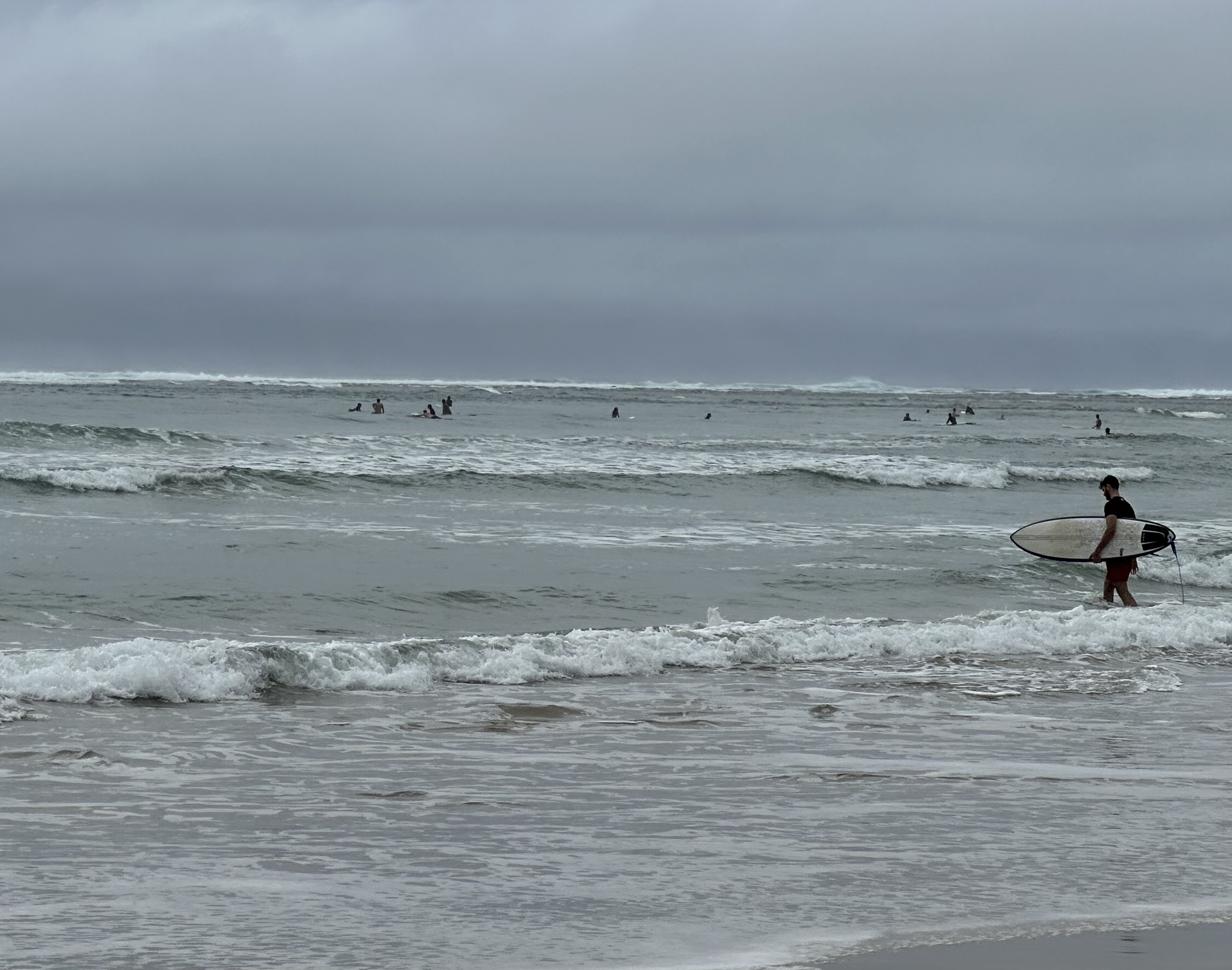
Yes we can! We’re up!… Uh, for about 3 seconds.
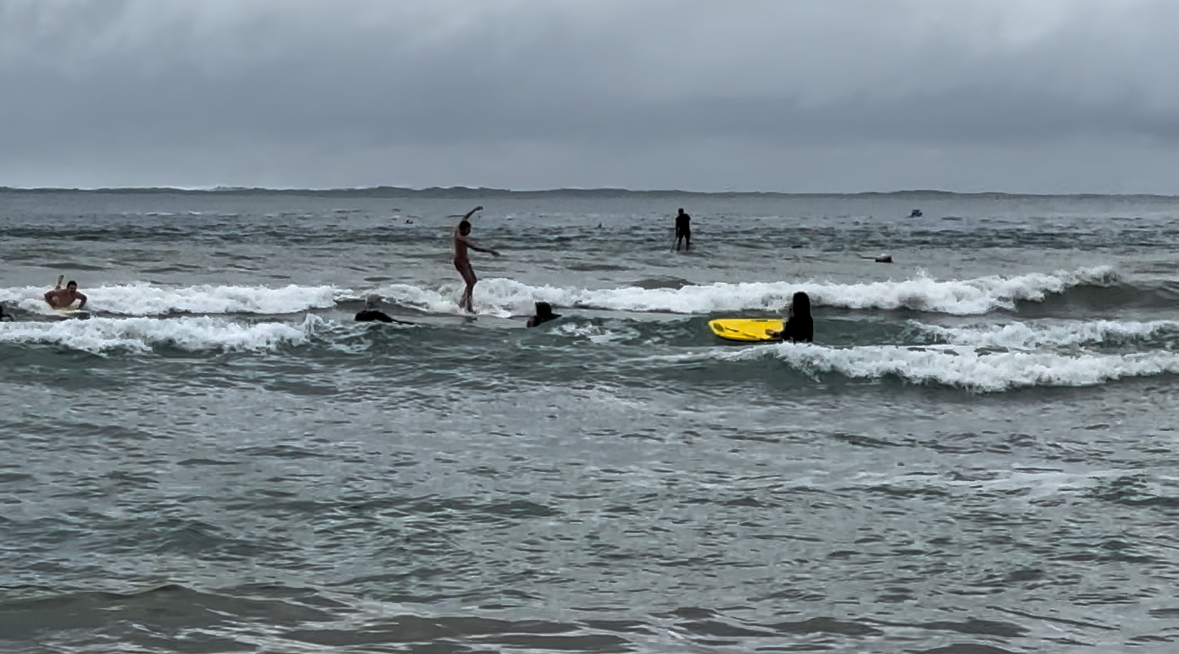
We just have to try surfing again. Like, 500 times. How about paddle boarding?

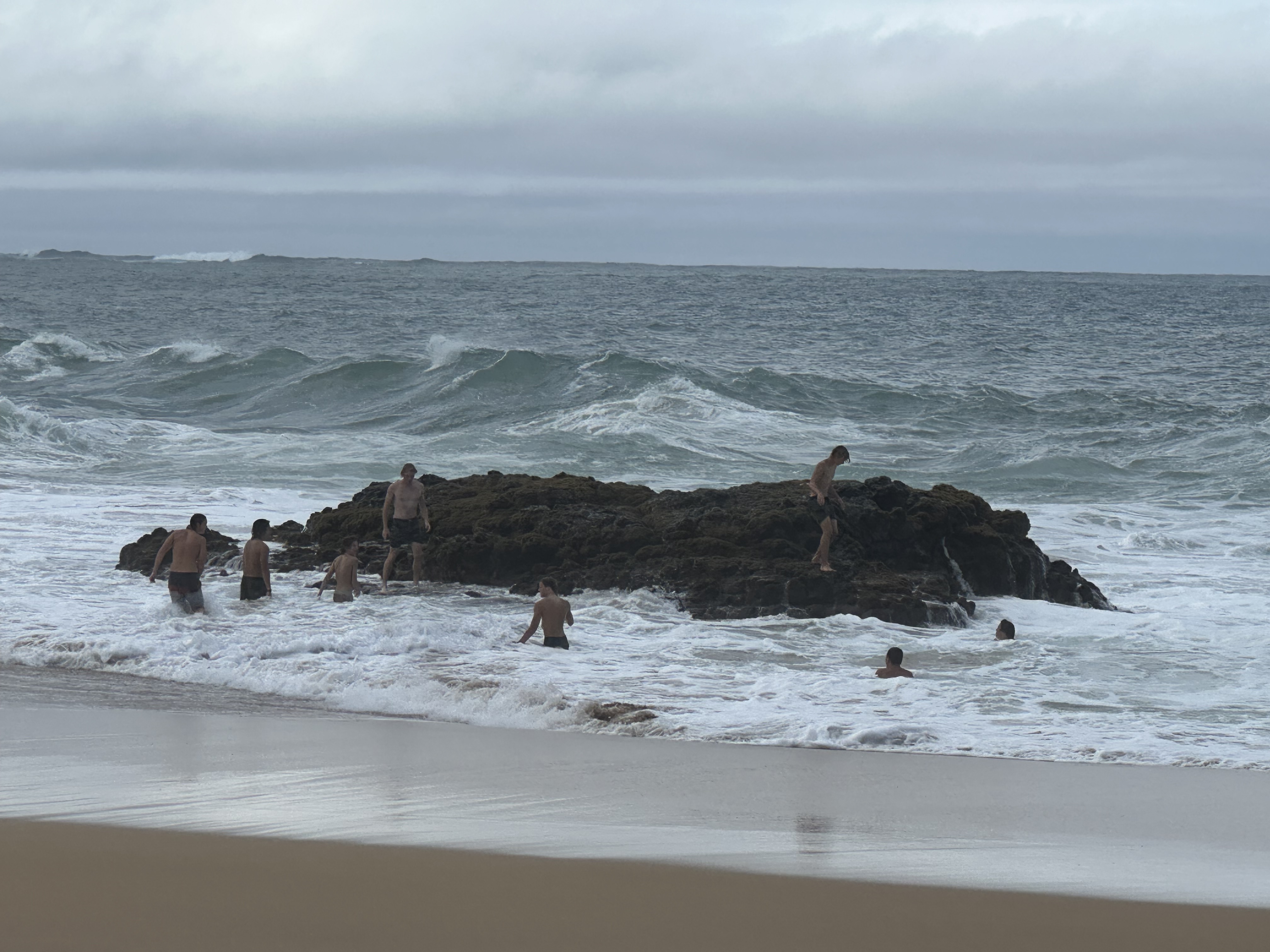
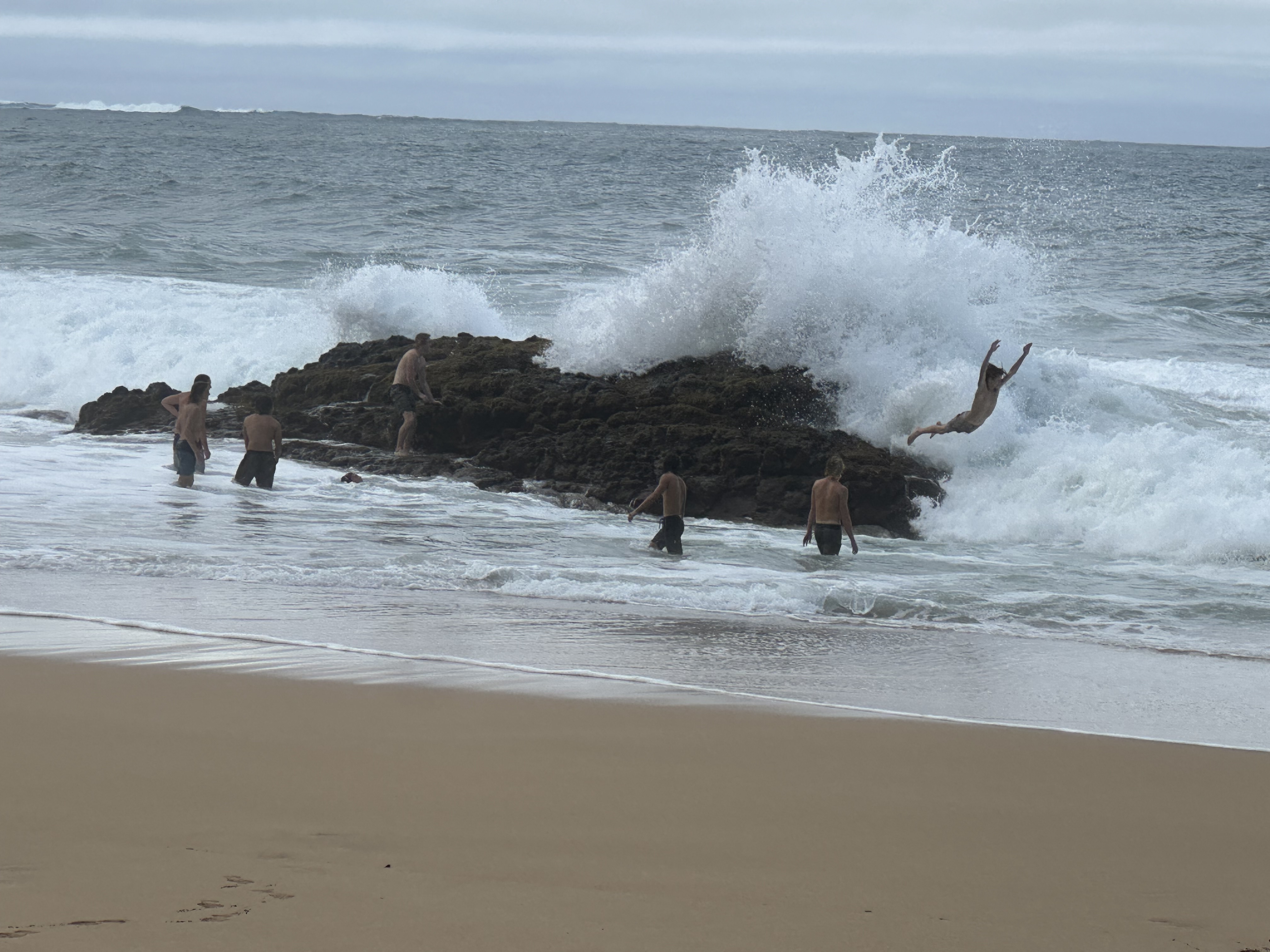
A few miles further north from Hanalei Bay is Lumaha’i Beach, especially thrilling in a high surf. Climb on this rock to play chicken with the roiling surf. Or as a 70-yr-old, do it vicariously through these strapping teenagers (hey, it’s a weekday, aren’t you supposed to be in school? I doubt this is some kind of planned field trip. Do your parents know where you are?)
There are so many beautiful hikes in Kauai. As you explore the lush landscapes, navigating sometimes steep, muddy trails, dodging tree roots, ducking your head under hanging tree limbs, hopping over rocks to forge streams, listening to exotic birds, mesmerized by the tropical scenery, you might miss something. As you gaze at a tree branch, there might be a wonderful little creature staring right at you that you don’t even see. For example, dear reader, we are now on a hike overlooking Larsen’s beach. Do you see anything in the sand below?

At first glance you might just see a shadow. That shadow is an endangered sea turtle!

Do you see the lizard in this photo?
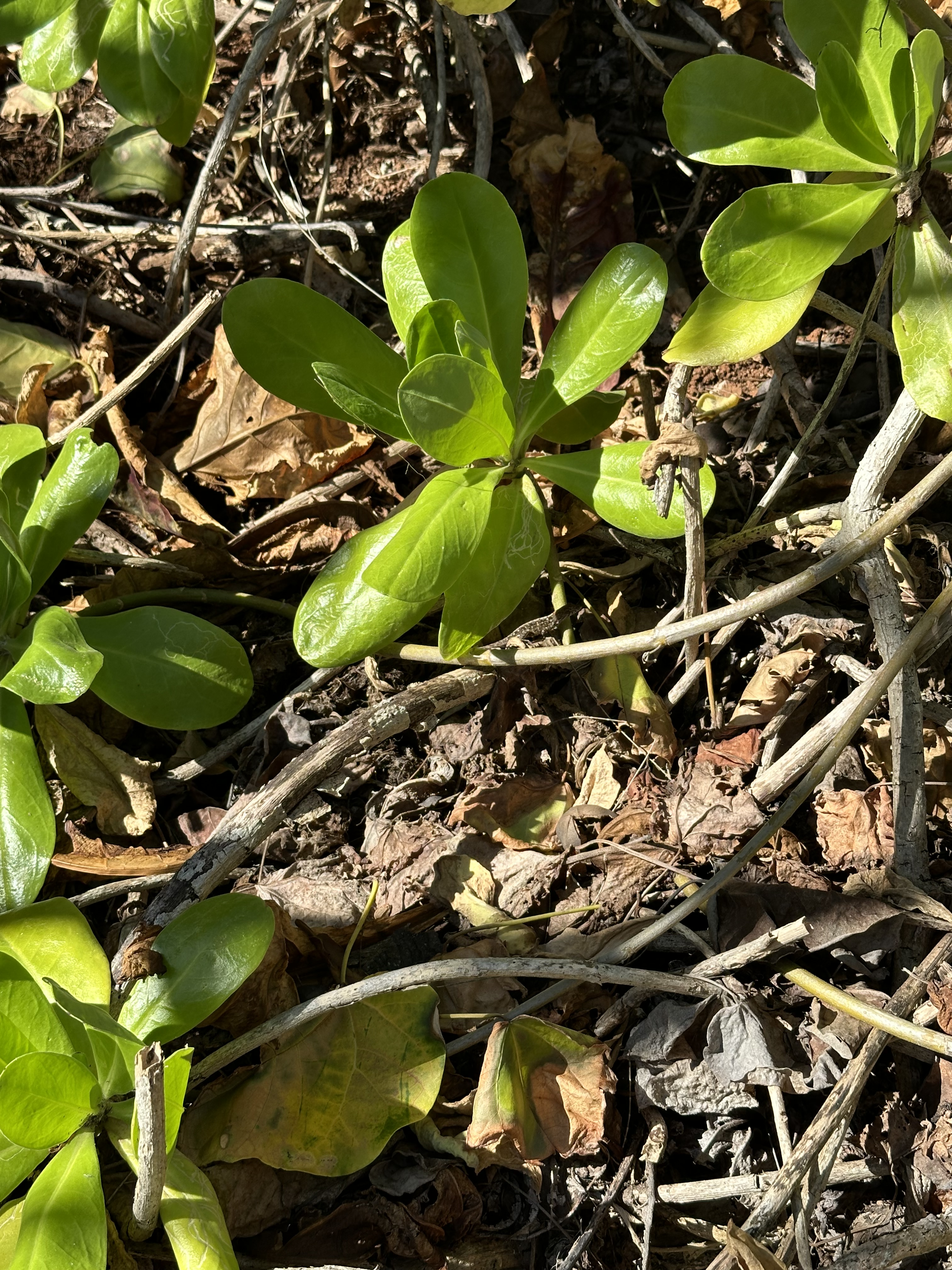
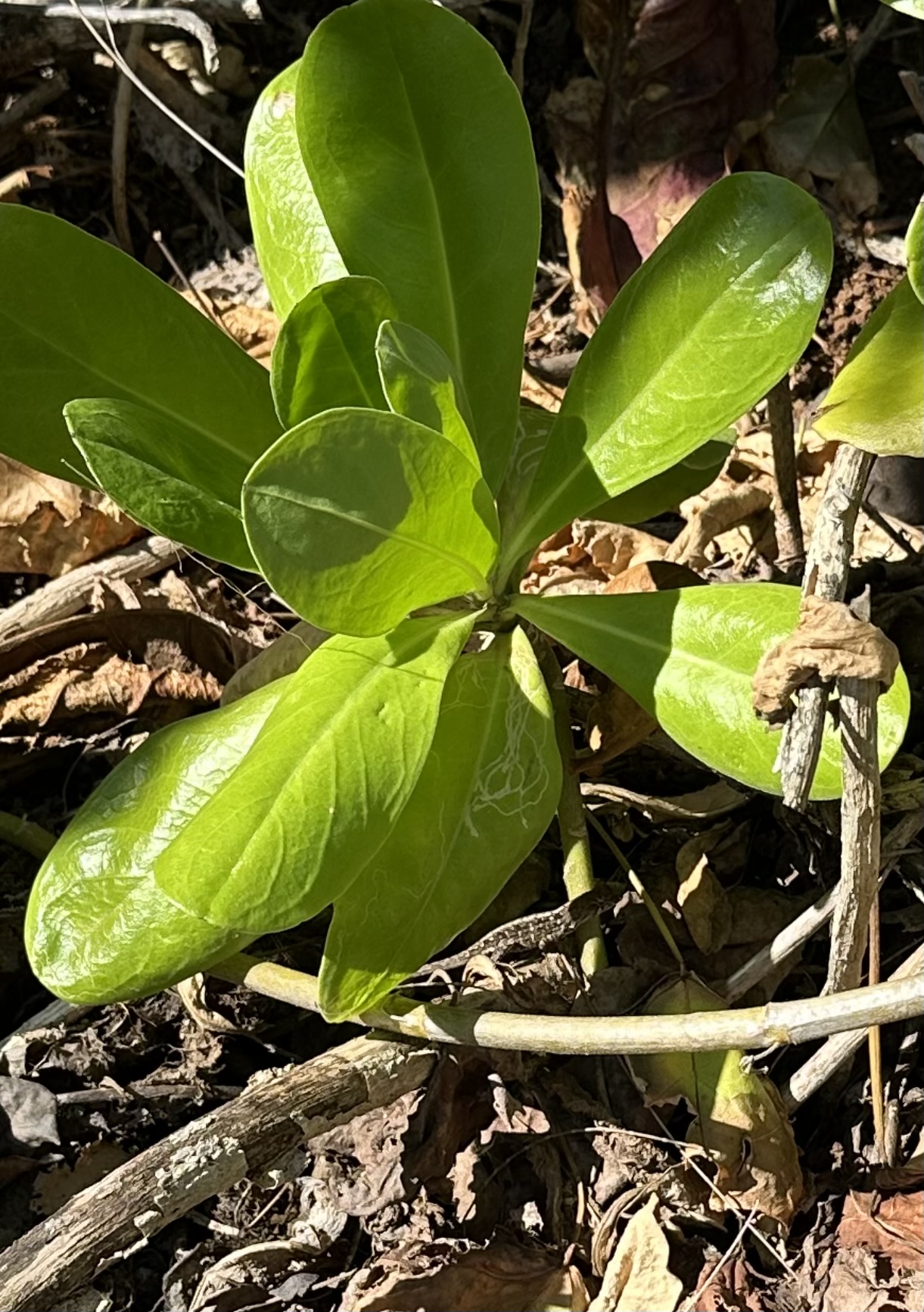
Of course not! you say. Look just above center in the photo right under that middle leaf structure. Still don’t see it? Here I’ve zoomed in:
Find the bee in this photo:

You found it, right? Find the butterfly:
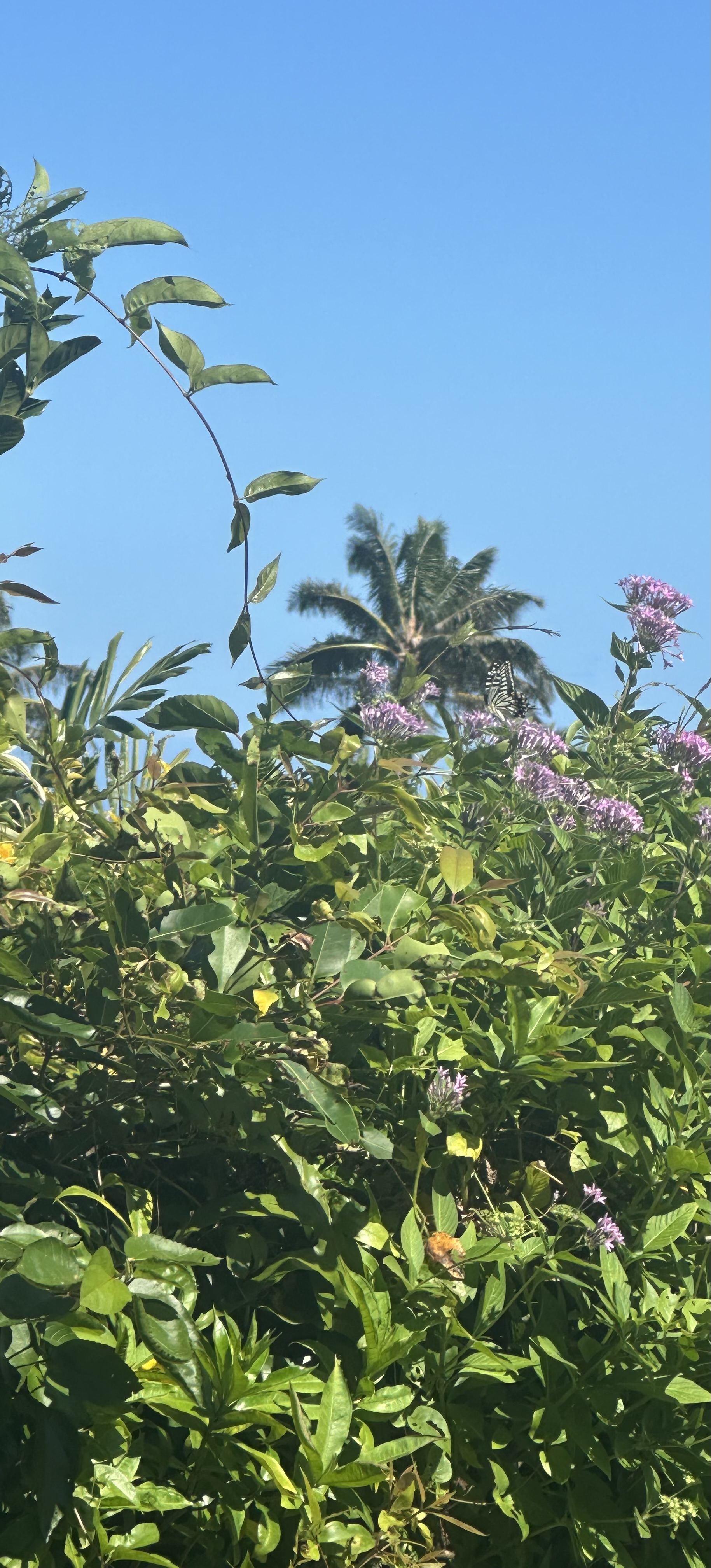
It’s in the middle of all those blossoms.

One more butterfly:

(Upper right side.)

Find Stephanie. (A little small compared to the ancient tree)

Find Eric, literally in the belly of the forest

I have panicked at times on a hike, dilly-dallying, taking photos or something and then look up and everyone has disappeared.

Find Megan:

Thank goodness with me bringing up the rear, someone in our group had the sense to wear bright clothing.

Find the lizard:

Don’t mind him. He’s just a little notch attached to the gutter.

Find this lizard!

Find not one, or two, but three bees (there’s probably more):

Enough already. You’re giving me a headache! You say.

Oh, you need a drink at this juncture? Here you go. A yummy Mai tai!

Oh, but surely you see the fly!

Well, I gotta get us home to Idaho. But not until you enjoy one last breakfast with us at the Hotel 1 in Princeville.

Count the birds. How many do you see? I dunno. As we get up to leave our table by the fireplace, half a dozen birds descend on our leftovers. My review of this very pricey restaurant is that the atmosphere is far more impressive than the breakfast. Even the coffee is hardly drinkable, at least to my standards. (Spoken like a true coffee addict.)

We’ve about come to the end of our visit to Kauai. On our last night we enjoy a fine dinner at the Terrace Restaurant in Hanalei. Here’s the view from our table:
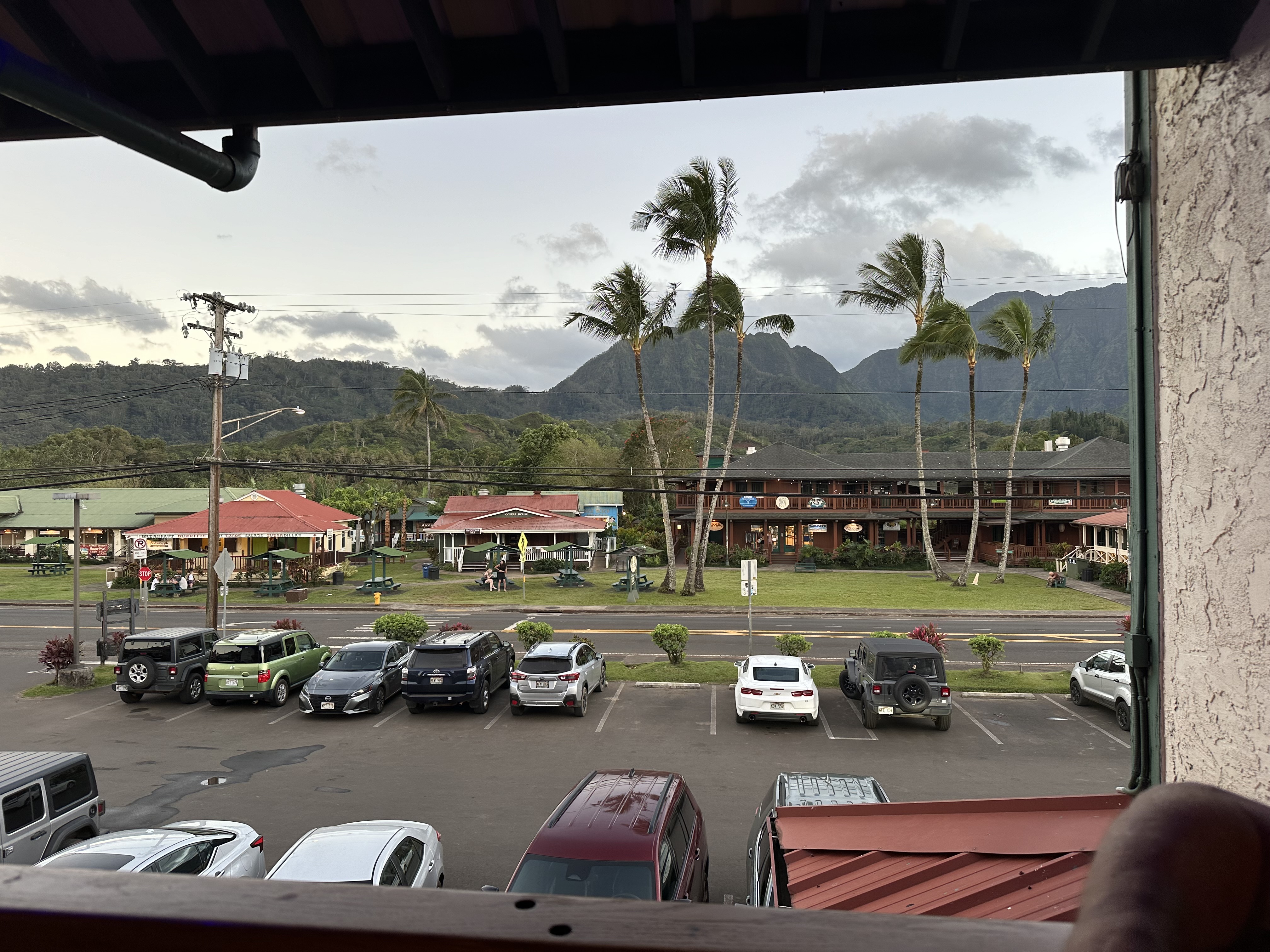
Terrace Restaurant, Hanalei

I take a photo of us after dinner: Victor, Steph, David, Eric and Megan
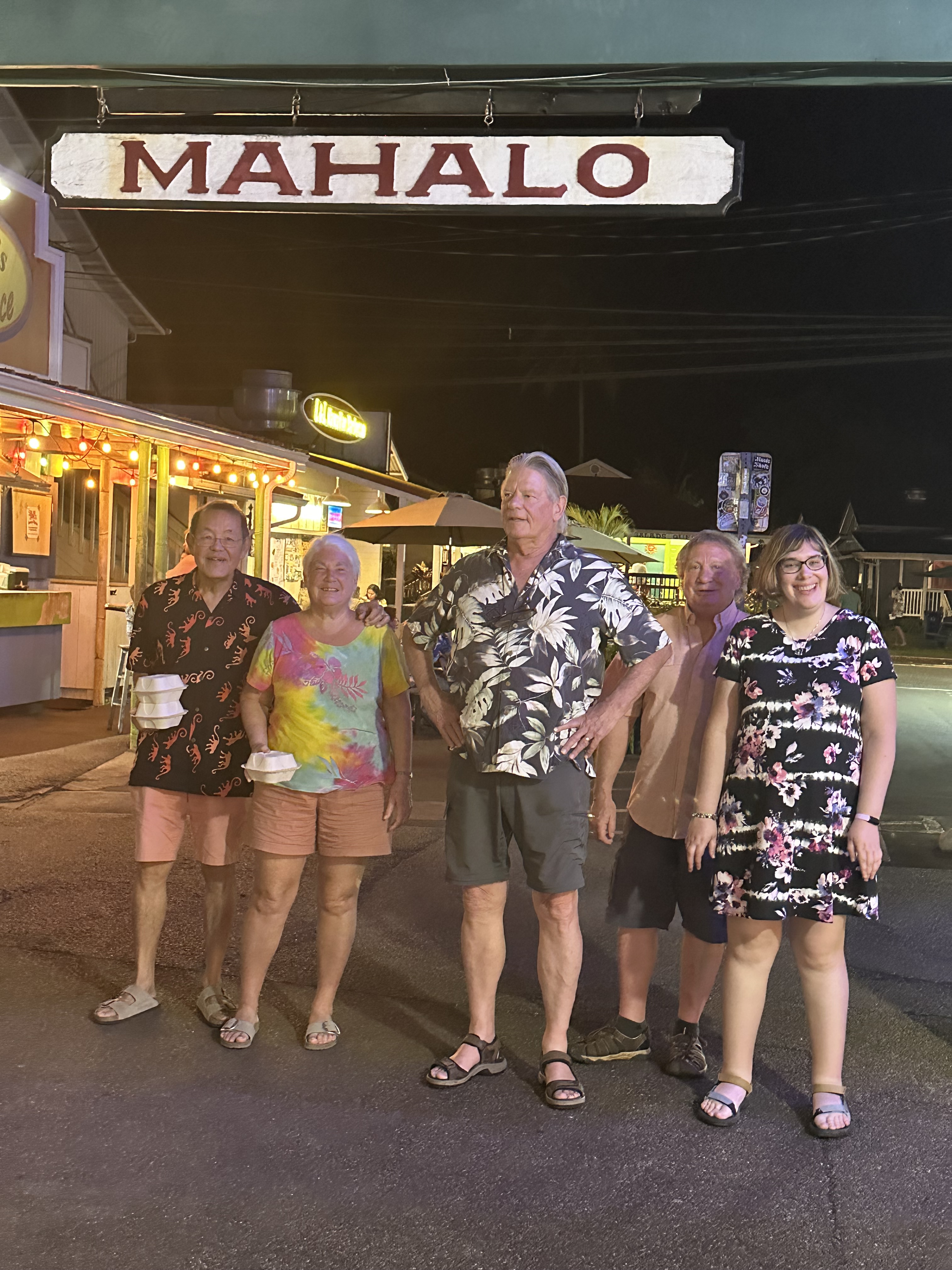
Mahalo, Kauai!

But before heading to the airport we bid one last farewell to the egret:

The red-crested cardinal

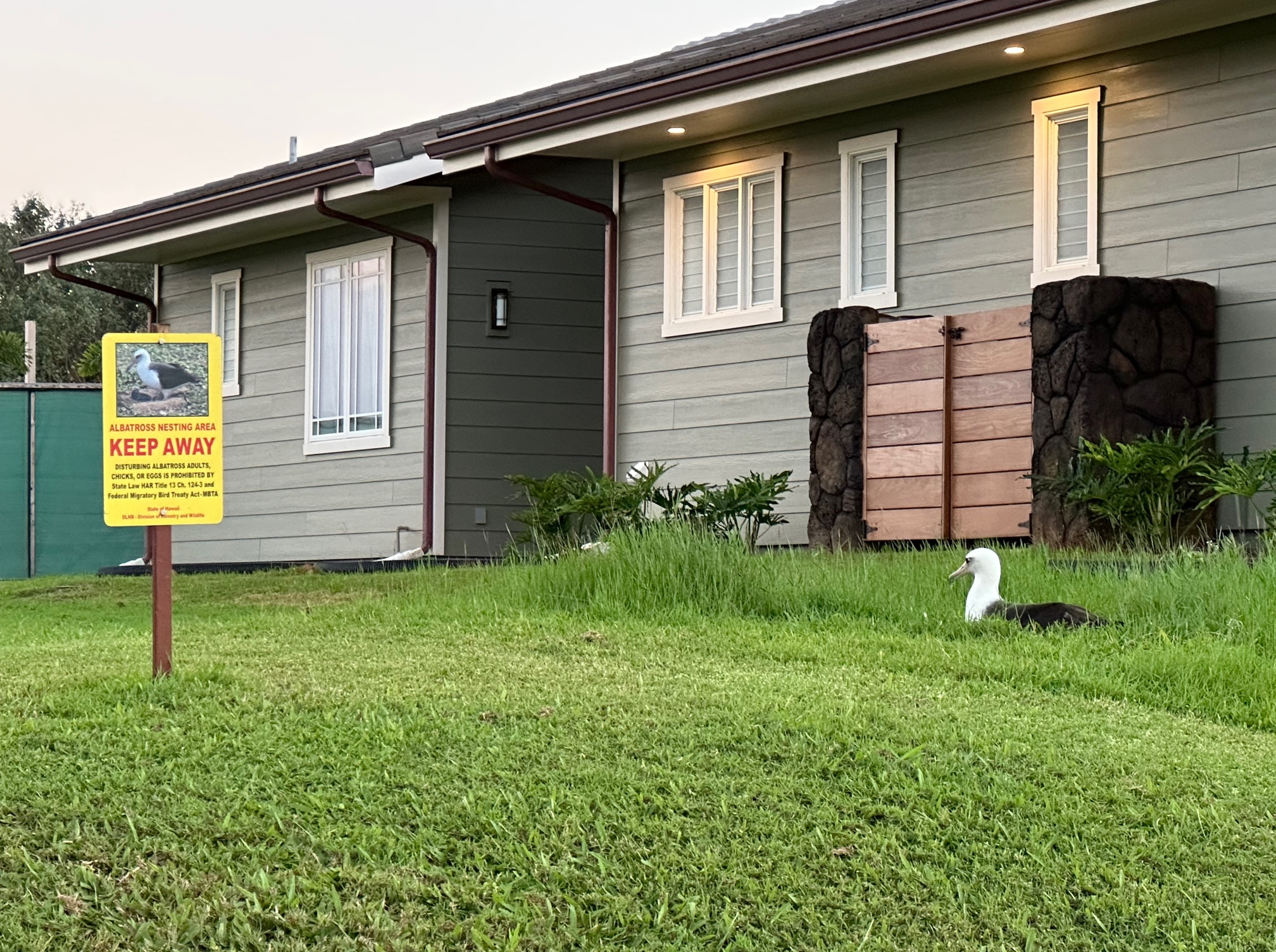
and the magnificent albatross

This pickup pretty much summarizes how you feel after a two-week vacation in Kauai:
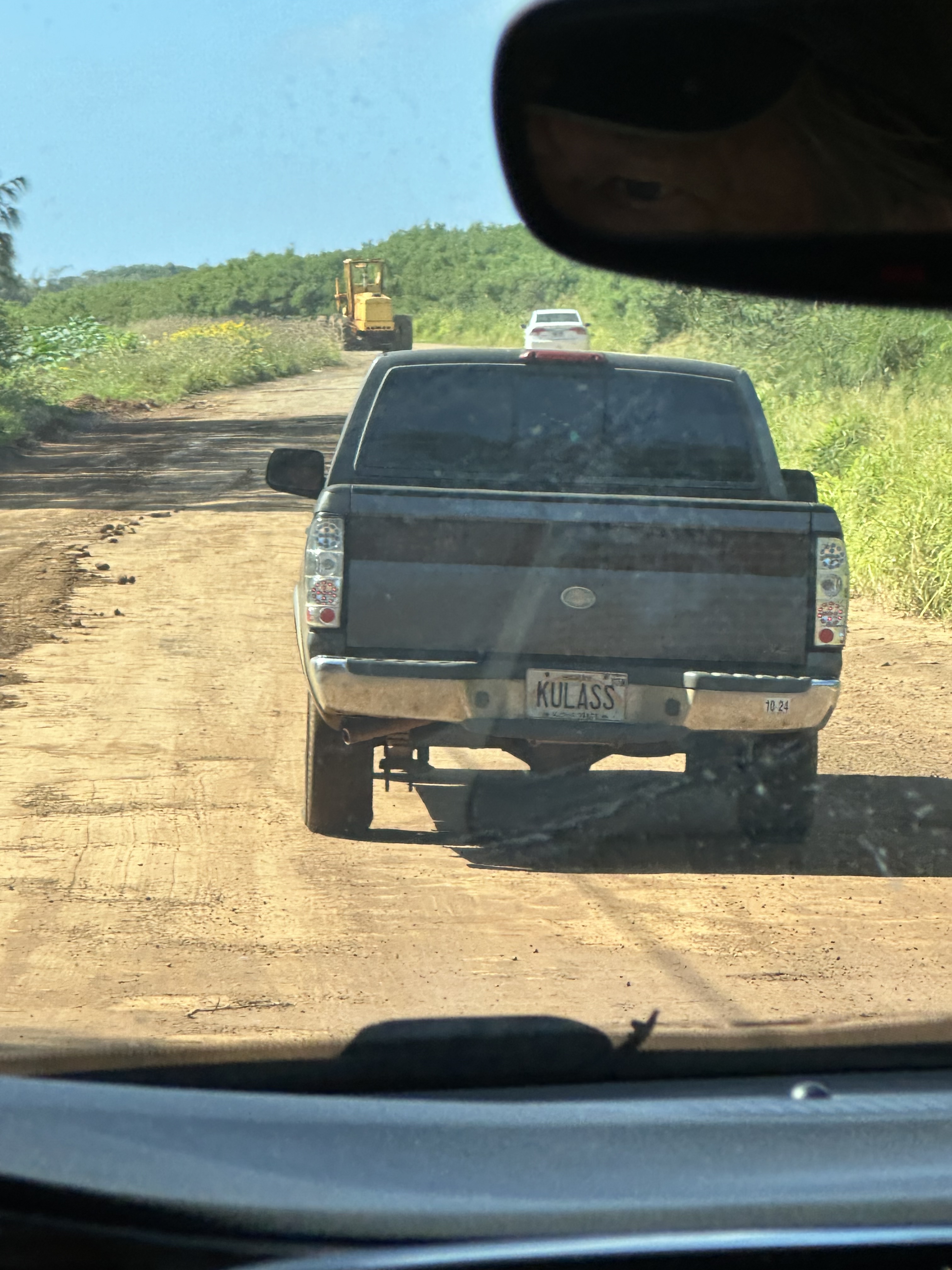
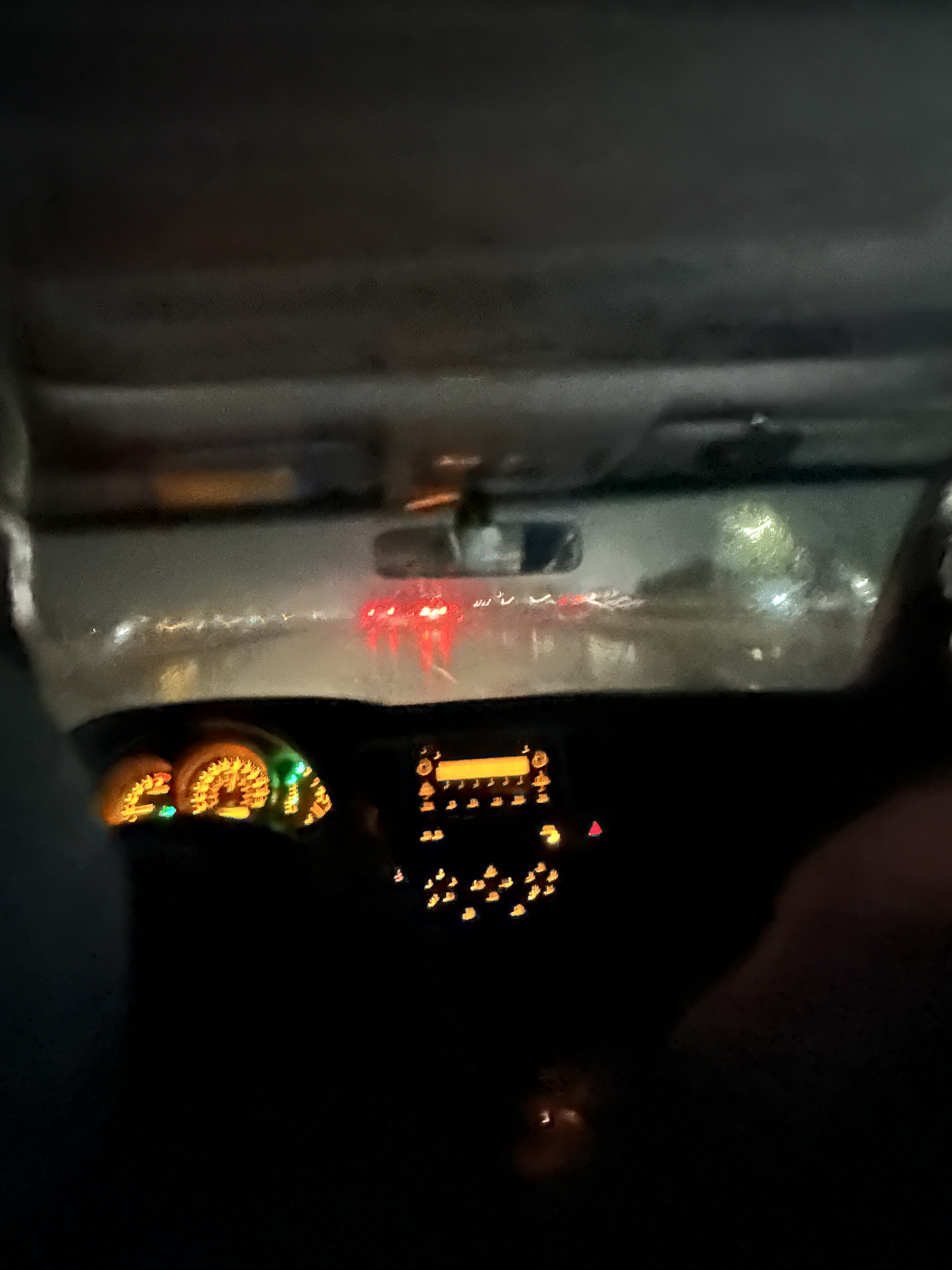
Alas, David is driving us in the rain after dark to the airport in Lihue to catch the 10:30 pm red-eye to Los Angeles.
We’re pretty much silent through the hour drive to the airport, dropping off the rental car, riding the shuttle to the airport entrance, when Megan blurts out, “Hey, look at that rooster!” We all share a laugh over seeing one last feral rooster by the front entrance to the airport terminal.

It takes a while to get through security, and we’re already a bit flagged. We park ourselves down on a bench inside the terminal and hear this strange flapping. We look over and darned if we did’t spot that same rooster inside the terminal.

Who has the job of capturing that wily feral fowl? Maybe the TSA employees who let him get past security? Yeah, good luck with that.

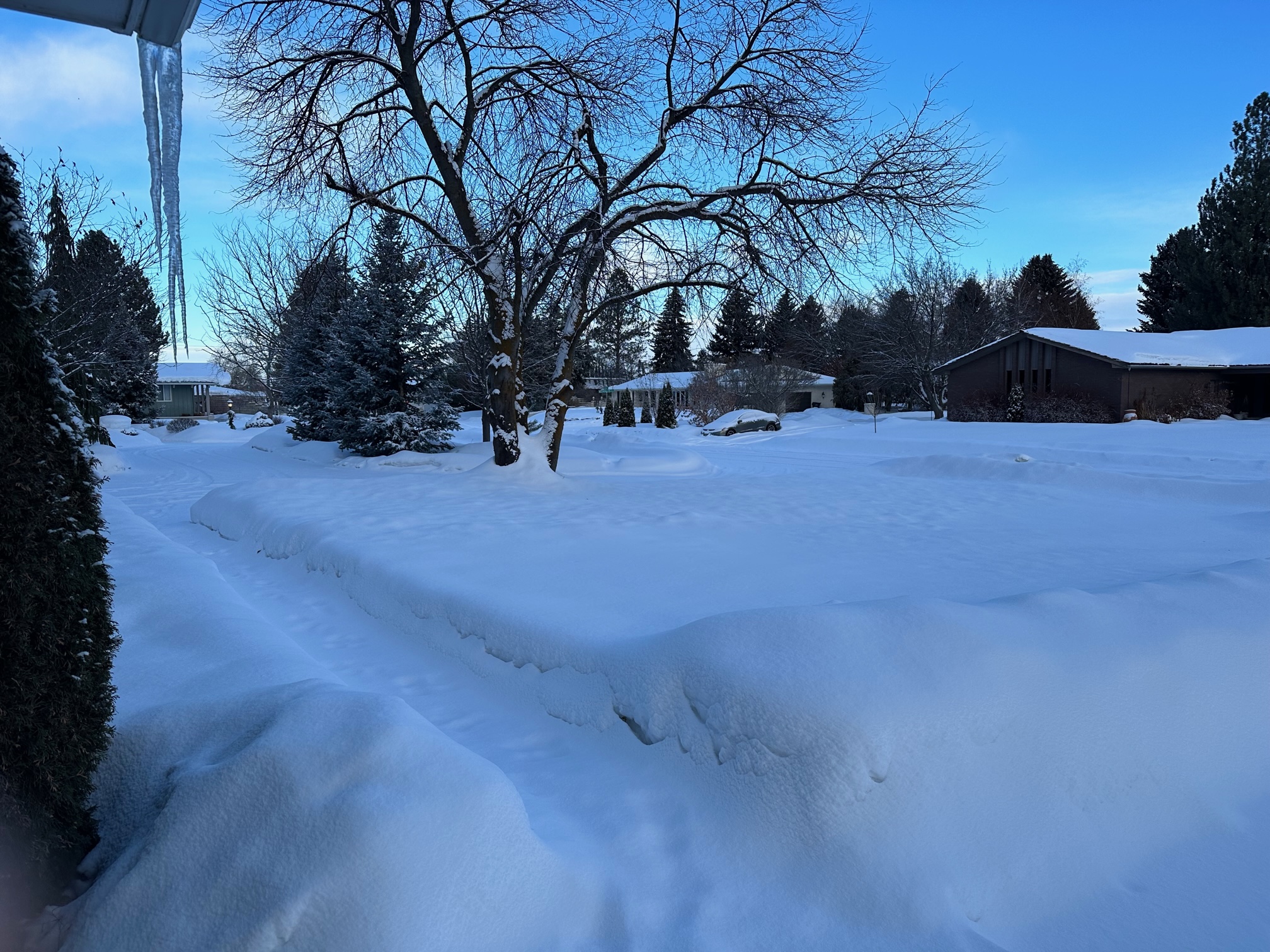
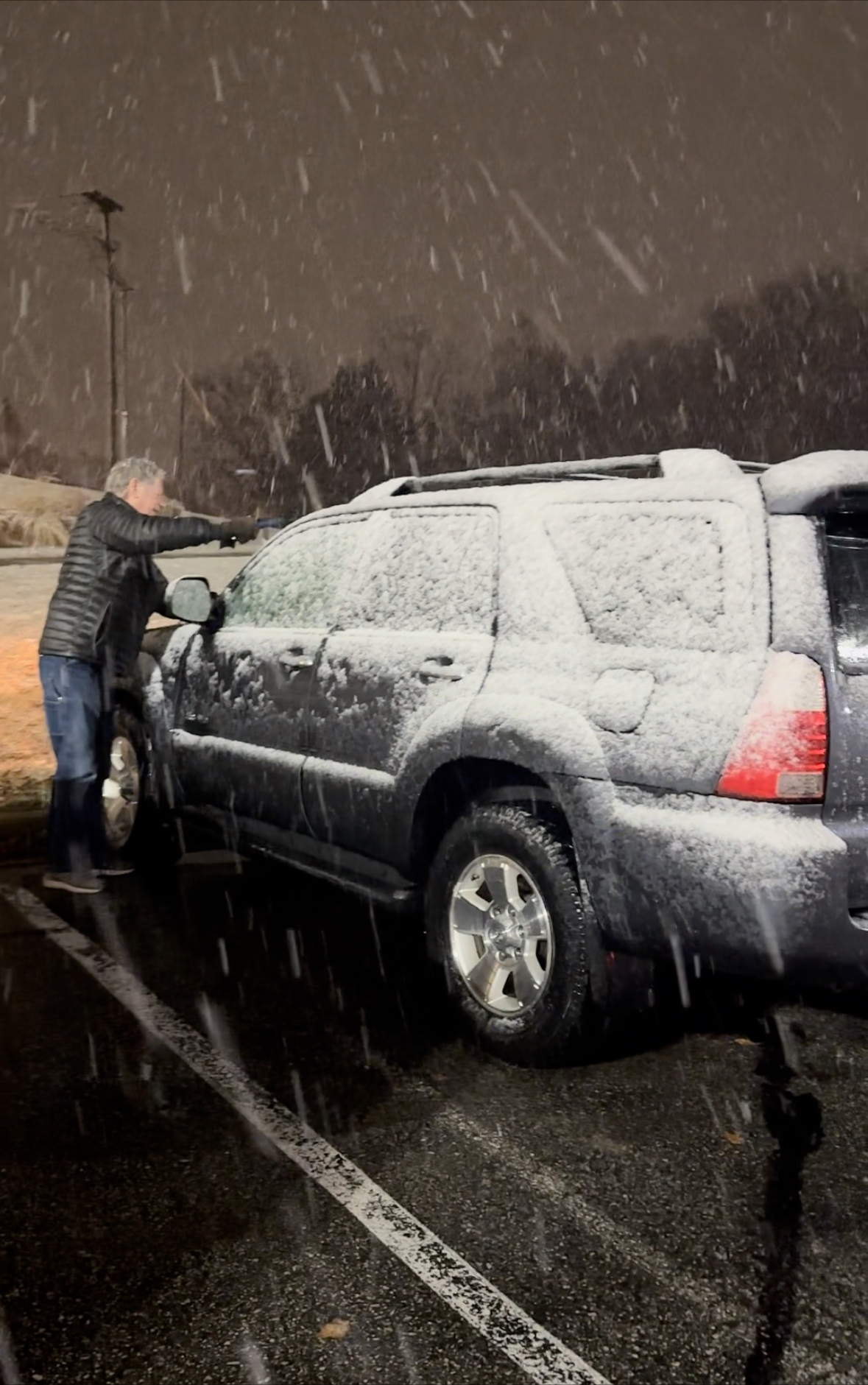
Okay, well, yeah, we’re home. Been back in Idaho Falls since Feb 1st. Here, I’ll share one winter photo with you. It’s our back yard on March 2.

Well at least I finally put a wrap on this year’s Kauai trip. Some pretty kulass memories!

Wild Boar Hunting in Kauai and the Powerline Trail

March 31, 2024

One of our favorite hikes near Princeville is the Powerline Trail. It’s 13 miles long from Princeville to the Arboretum. Here’s a tripadvisor link with reviews: https://www.tripadvisor.com/Attraction_Review-g29218-d208648-Reviews-Powerline_Trail-Kauai_Hawaii.html

From Princeville it’s largely an old rutted road that is a horrible mess after a rain, so you want to go after a long dry spell in the weather. We enter it in Princeville and typically only go 2-3 miles before turning back. It’s 9am on January 26, and we’re on the trail. That’s Eric and David ahead.

About a mile in you come across this view of Hanalei Valley with a waterfall:

Do you see it? It’s just a trickle coming down alongside that sunlit fern on the left.

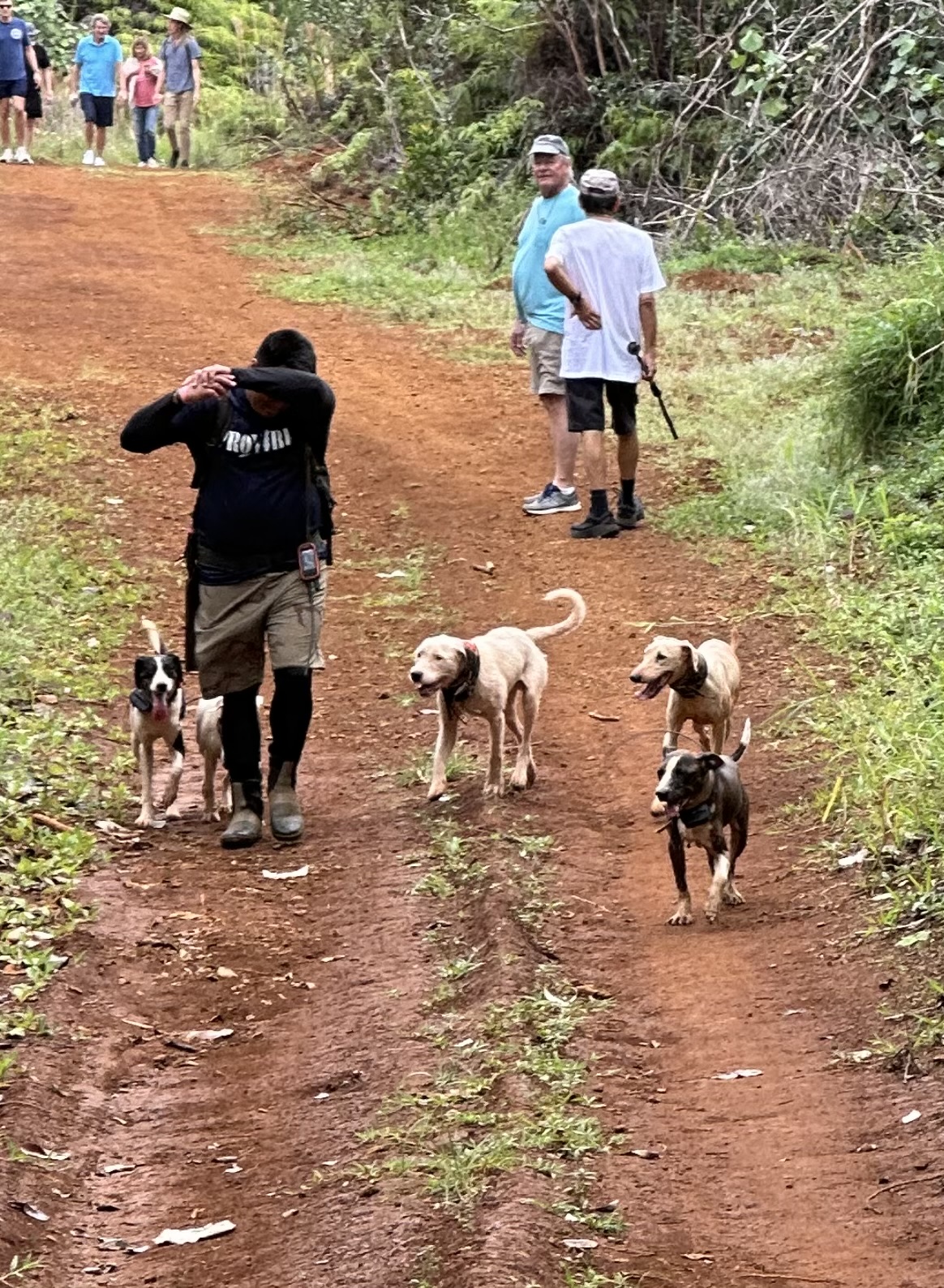
Suddenly we’re approached from behind by three men with, uh, how many dogs?

They stop and visit with us (David and Stephanie). The dogs are just as curious as we are.

This fellow explains that they are participating in a wild hog hunt tournament. (Uh-oh. Is that dog smelling the bacon we had for breakfast? If they mistake us for hogs we are done for.) The rules of the tournament are that you can only hunt and kill the hog using a knife and you have to carry the hog out (on your back, I assume!) whole. I Googled it, but couldn’t find anything about these tournaments per se, but you can certainly sign up for a hog hunt adventure through various companies, if that’s your thing. Here’s a link:

https://outdoors-international.com/hog-hunting-hawaii

Hog hunting in Kauai is a tradition that has been passed down for generations. Traditional hog hunting is with dogs using only a knife or spear. You can also hunt with a bow or rifle.

“A boar hunt is a great add-on to your Hawaiian vacation.” Okay …

They were on their way again – how many dogs?

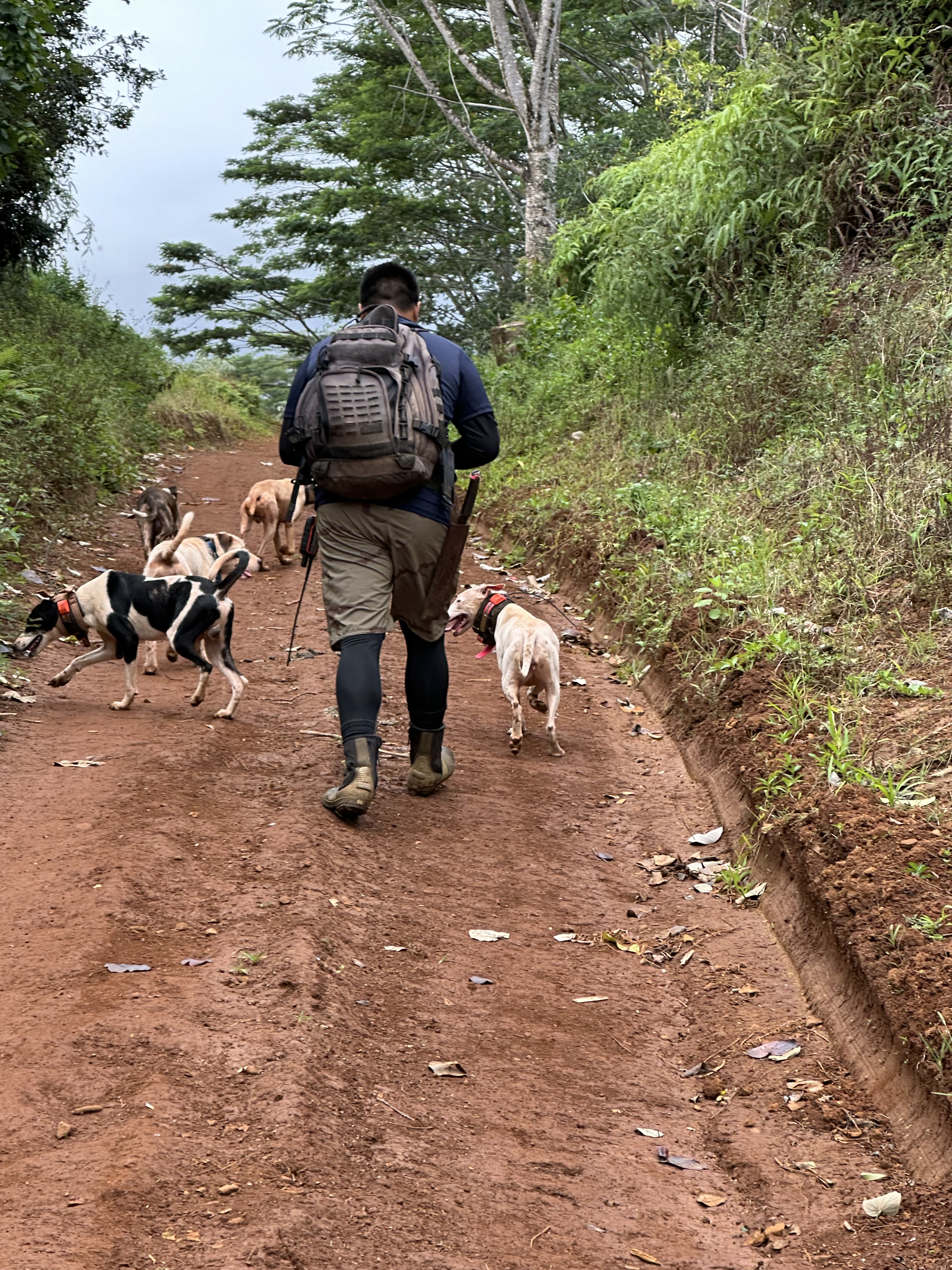
We counted eight. But that’s not all they needed for this hunt. Because a few minutes later we ran into the brother of the guy in black (and obviously the one in charge)

Rushing up behind us. He told David and Victor that he was with the same hunting party, but he had overslept and was trying to catch up with his brother. With, how many dogs??

All tallied, 4 males, 13 dogs on the hunt for a wild boar. In the photo above, you can see the length of the knife from the sheath hanging from his belt. About 12″ long. According to the above link, the dogs will chase the pig until it “bays up.” The humans listen for the barking and try to keep up. Once you get to the pig you finish him off with a large knife. “It isn’t for everybody.” Duh. How much of a rush are you looking for on your Kauai vacation adventures?

Just a brief history of pigs on Kauai, researchers believe pigs were brought to the islands by the Polynesians at least 800 years ago. They were kept as pets and food sources and relied heavily on their families for survival. Pigs were beloved and embedded in the Hawaiian culture and traditions. But then large bearing fruit trees were introduced in Hawaii, such as guava and mangos and pigs were then able to survive in the wild. Other visitors to the Island, like Captain Cook in 1778, brought their own larger pigs who interbred with the more native pigs. Then hurricanes Iwa (1982) and Iniki (1992) set a whole lot more pigs loose and now feral pigs have become a significant problem in Kauai, destroying crops and native plants. Hunting is the only thing keeping wild boar populations in check.

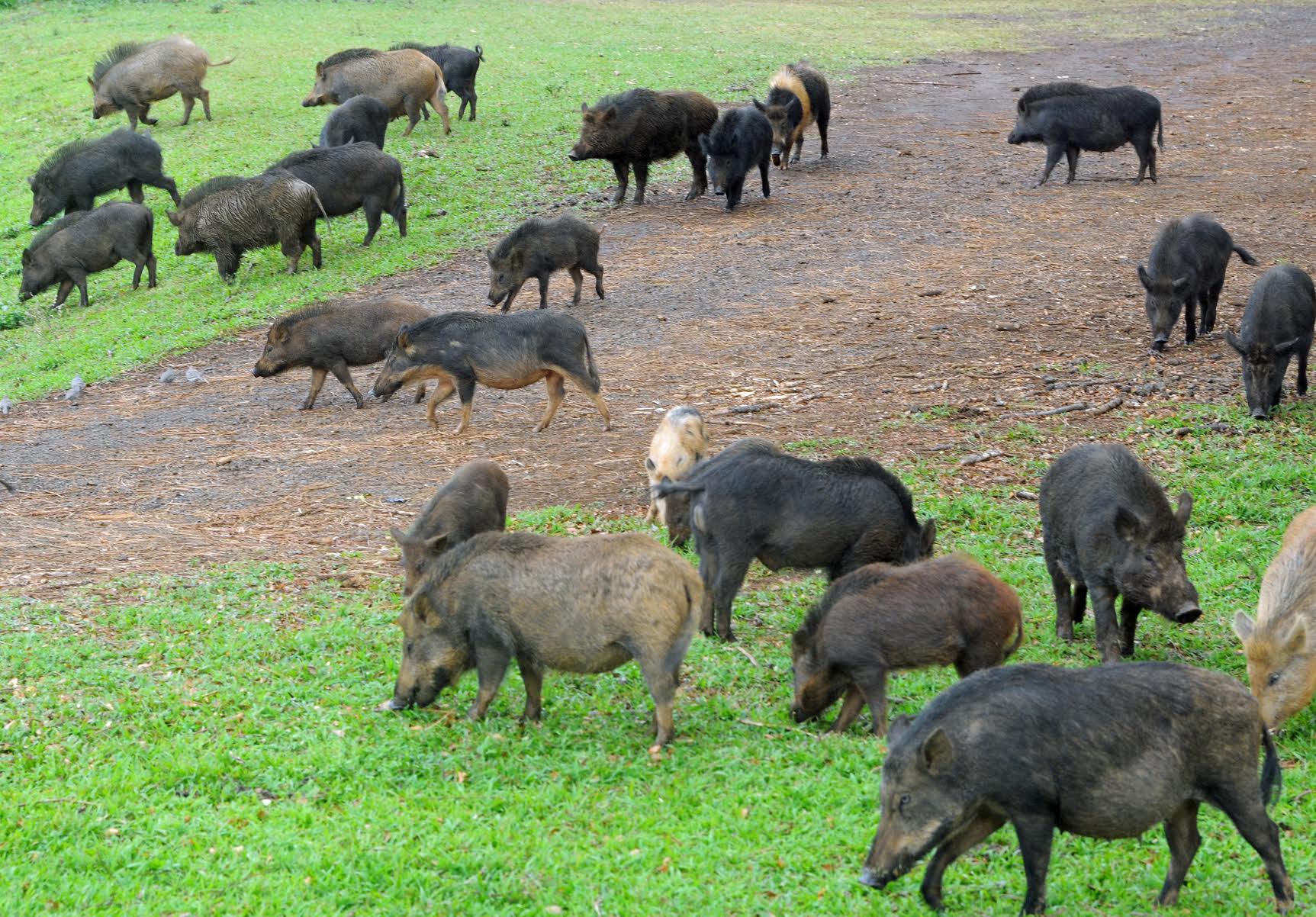
There’s no way of knowing how many feral pigs are on Kauai. Here’s a link to the “Pig Man Of The Garden Isle” Nic Barca https://www.civilbeat.org/2019/03/kauai-the-pig-man-of-the-garden-isle/ who has been studying (and hunting) pigs on Kauai for a while, and he estimates the number at about 11,000. There’s a wildlife refuge near Kilauea we’ve driven past numerous times where we’ve seen a large herd of feral pigs, although we didn’t see the pigs this past January. Here is a photo of the herd (taken from the link above) that captures what we typically see while driving past the refuge.

Photo by Alan Parachuni/Civil Beat – wild pigs gather at a wildlife refuge near Kilauea.

Well I dunno. If after reading this blog you think you want to book an archery hunt for wild boar in Kauai – here’s another link for you. https://www.huntfishkauai.com/wild-boar/ For $1050 per shooter you get a crossbow and ‘all equipment necessary’ and camouflage attire. Plus a “100% shot opportunity guarantee.” Yikes. I’m all over that camouflage attire. I just don’t want any confrontation with a wild boar. On a vacation to Paradise? Well, on the other hand, if you’re looking for a rush …

“Wild boar hunting, not boring.”

Yeah, how about a boat ride?

Kauai 2024 – Part 3 – Froggy, Snail and the Enchanted Forest (What’s Your Spirit Animal?)

March 10, 2024

My last blog was about ‘Froggy,” the bullfrog croaking in the bushes beside Steph and Victor’s pool at their house in Princeville. David, Megan, Eric and I returned home from Kauai over 5 weeks ago and I’ve been wondering about Froggy. Is he still there? I asked Steph last week, and yes, he is, still croaking away. I wonder if Steph and Vic will soon have tadpoles floating in their pool?

I had become totally smitten with the bullfrog over the two weeks in January we stayed with Steph and Victor. He croaked several times a day, and it cracked me up every time. Several of us would be carrying on a conversation in the kitchen when Froggy’s croak would blast from the bushes like a fog horn. It was all I could do to stop myself from raising a palm to pause the conversation with a “Shhhhhh….Froggy is speaking.” He tickled me so much that it even made me seriously wonder for maybe the first time in my life, could I have a spirit animal? Could the bullfrog be my spirit animal? This link might be helpful:

https://www.mindbodygreen.com/articles/how-to-find-your-spirit-animal

In some Indigenous cultures spirit animals are a spirit that helps guide or protect a person on their specific journey. Common spirit animal guides include a Crow, Bear, Butterfly, Cat, Deer, Dove, Dolphin, Elephant, Fox, Horse, Hawk, Lion, Mouse, Owl, Peacock,Turtle, Tiger, Wolf, Frog (“the Frog is often thought to help heal physical and emotional wounds. It speaks to the importance of checking in with oneself and healing from the past in order to live in the present.” Huh…)

Well anyway, I carried my intense froggy love back to Idaho with me and just couldn’t wait to write my blog about ‘Froggy.’ It started off great and wonderful until I started a Google search on American bullfrogs (native to the Eastern and Central United States) only to discover that they are a highly invasive species that prey upon and out-compete native frogs, seabirds, and other aquatic species. They will basically eat anything that walks in front of them that fits in their mouths. But, hey, I covered this sad story in my last blog. Here’s one final link on the subject, an article from the Washington Post about hunting and eating invasive bullfrogs in Utah: https://www.washingtonpost.com/climate-environment/2023/03/05/utah-bullfrogs-catch-eat/ Sigh …

While we’re on the subject of invasive species in Kauai, enter Snail. Uh, that is, the Giant African Land Snail or GALS. While merrily hiking along a grassy path just beyond an enchanted mahogany forest, I nearly choked on my breath with the site of this guy.

Giant African Land Snail

You’ve heard of Nine Inch Nails, but what about Four Inch Snails?https://kealakai.byuh.edu/creature-feature-the-invasive-giant-african-land-snail Giant African Snails can grow as large as 8 inches long with a shell 5 inches across. They are one of the world’s largest and most damaging land snails, eating over 500 different plant species, including peanuts, beans, peas, cucumbers and melons, and many more crops. If fruits and vegetables aren’t available they will gorge on a variety of ornamental plants, tree bark, and even paint and stucco on houses. They are native to coastal east Africa but are now found across Asia, the Pacific, the America’s and Europe. According to invasivespeciesingo.gov, these snails were first introduced to Hawaii in 1936, imported for educational purposes, as pets (really?) or in cargo. Not only has it become an agricultural pest, but it also carries rat lugworm disease from a parasitic worm that can cause meningitis in humans and other animals. Geesh!

The giant African snail I met was truckin’, even if it was at a snail’s pace. By all means, don’t pick it up! Instead I took a video just so you can see what a ‘snail’s pace’ looks like:

The top recorded speed for a snail is 0.002 mph, or about 10 feet/hour. They won’t move on average more than 250 meters (273 yards) in a year. Giant African land snails are hermaphrodites, which means each snail contains both male and female reproductive organs. They don’t need to mate to reproduce and can lay up to 500 eggs at a time, about every 3 months. They are sexually mature after six months. This gives you an idea of how fast even one snail by itself can multiply.

We saw two of these snails on our recent 2-week trip to Kauai. We saw the second one at, I mean on, the restroom at Makauwahi Cave:

Oh yum. Let’s suck the red paint off this building. Makes you wonder. Should you take gloves with you on your hikes and snatch up every one of these you see and dispose of it? (How? In a trash can?) I dunno.

The state of Florida has gone through great lengths to eradicate the invasive giant African snails. According to this article, https://www.npr.org/2023/06/23/1183784344/giant-african-land-snail-florida-problem in 1966, a Miami, Florida boy smuggled three giant African snails into South Florida upon returning from a trip to Hawaii. His grandmother eventually released the snails into her garden. By 1975 the snails were declared eradicated after destroying more than 18,000 adult snails and thousands of eggs. The snails popped up again in 2011, it took ten years, but they were declared eradicated again in 2021. Then this headline from June 20, 2023: https://www.nbcmiami.com/news/local/quarantine-zone-established-after-giant-african-land-snail-spotted-in-broward-county/3056940/, One giant African land snail was spotted in Miramar on June 2, 2023, where they have established a quarantine zone. The snails are sprayed with the pesticide metaldehyde (in snail bait) and also the state uses Labrador retriever dogs trained to sniff out the giant snails.

Since they were introduced in 1936, Hawaii has also tried to eradicate or at least control the giant African land snail population. In the 1950’s rosy wolf snails were deliberately introduced in the hopes they would eat the giant African snails. Except they didn’t eat those snails; they ate endangered native Hawaiian snails instead, driving some to extinction. This is the point in my blog where I can really gross you out. Or maybe offer you some gory entertainment if you’re bored out of your skull. Or if you have a child or grandchild whining at you, “I’m b-o-o-o-r-ed!” – Click on this Google link about the cannibalistic rosy wolf snail. Scroll down and you will see a YouTube video capturing the live action of a rosy wolf snail stalking and then devouring a native Hawaiian snail.

https://www.google.com/search?q=rosy+wolf+snail&ie=UTF-8&oe=UTF-8&hl=en-us&client=safari

Yuck! I can’t end my blog on this note! Here, I will include a link to the fantastic walk we made through the enchanted Mahogany forest near Kilauea on the north shore of Kauai, the same walk where we met that crazy giant African land snail. It’s called the Wai Koa Loop Trail, which ultimately leads you to a beautiful waterfall and a path by a sitting Buddha. Here’s a Tripadvisor link with lots of photos that capture it beautifully.

https://www.tripadvisor.com/Attraction_Review-g60620-d4154204-Reviews-Wai_Koa_Loop-Kilauea_Kauai_Hawaii.html

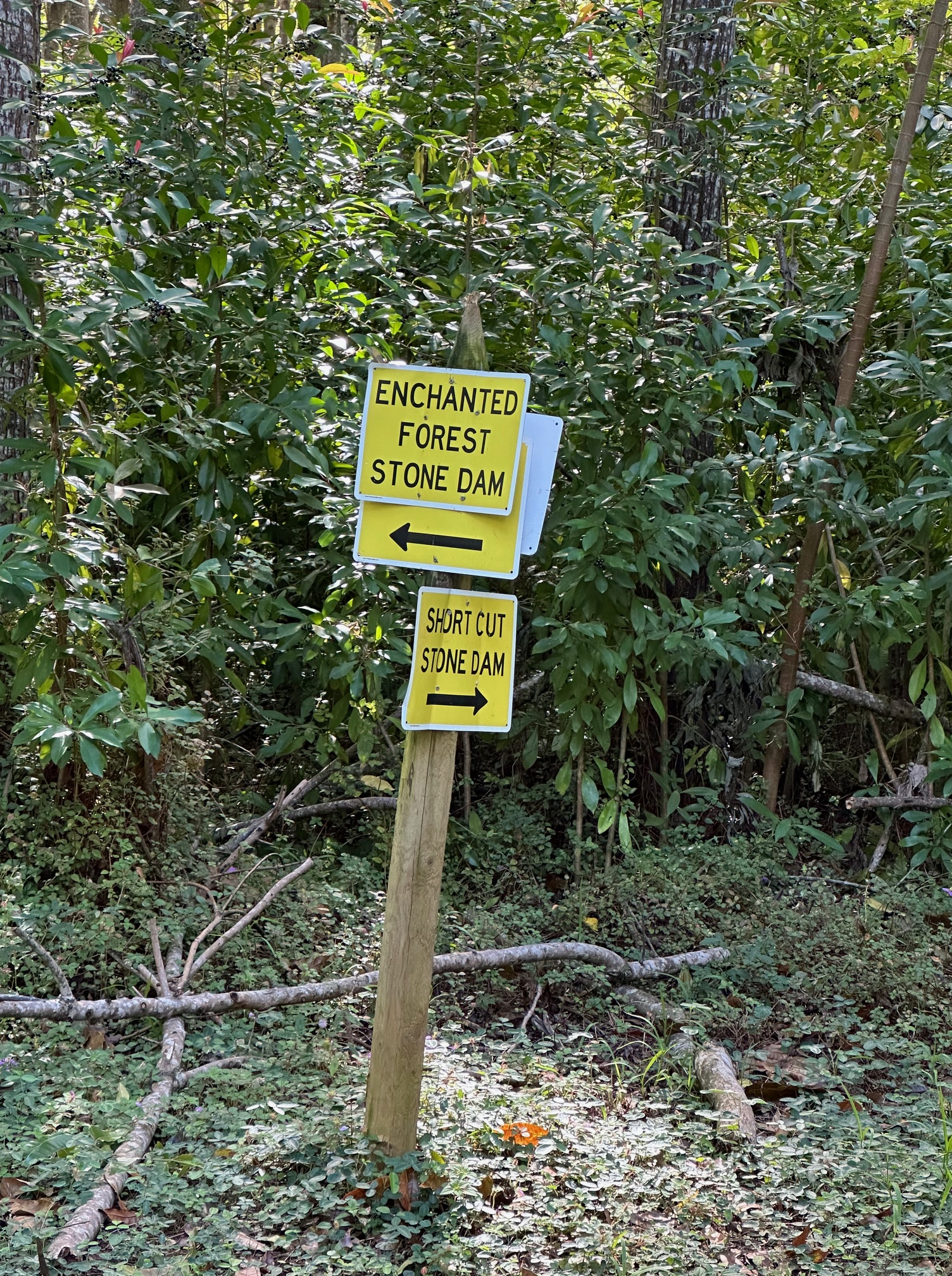
And a few of my own. First we come to a sign:

Wow. Tough decision here. Duh. Is this a research project? 0.002% of humans might go left here.

Here’s the waterfall you come to at the end of the trail:

Here we are walking back past the mahogany forest, David, Megan, Victor, Eric and Stephanie.

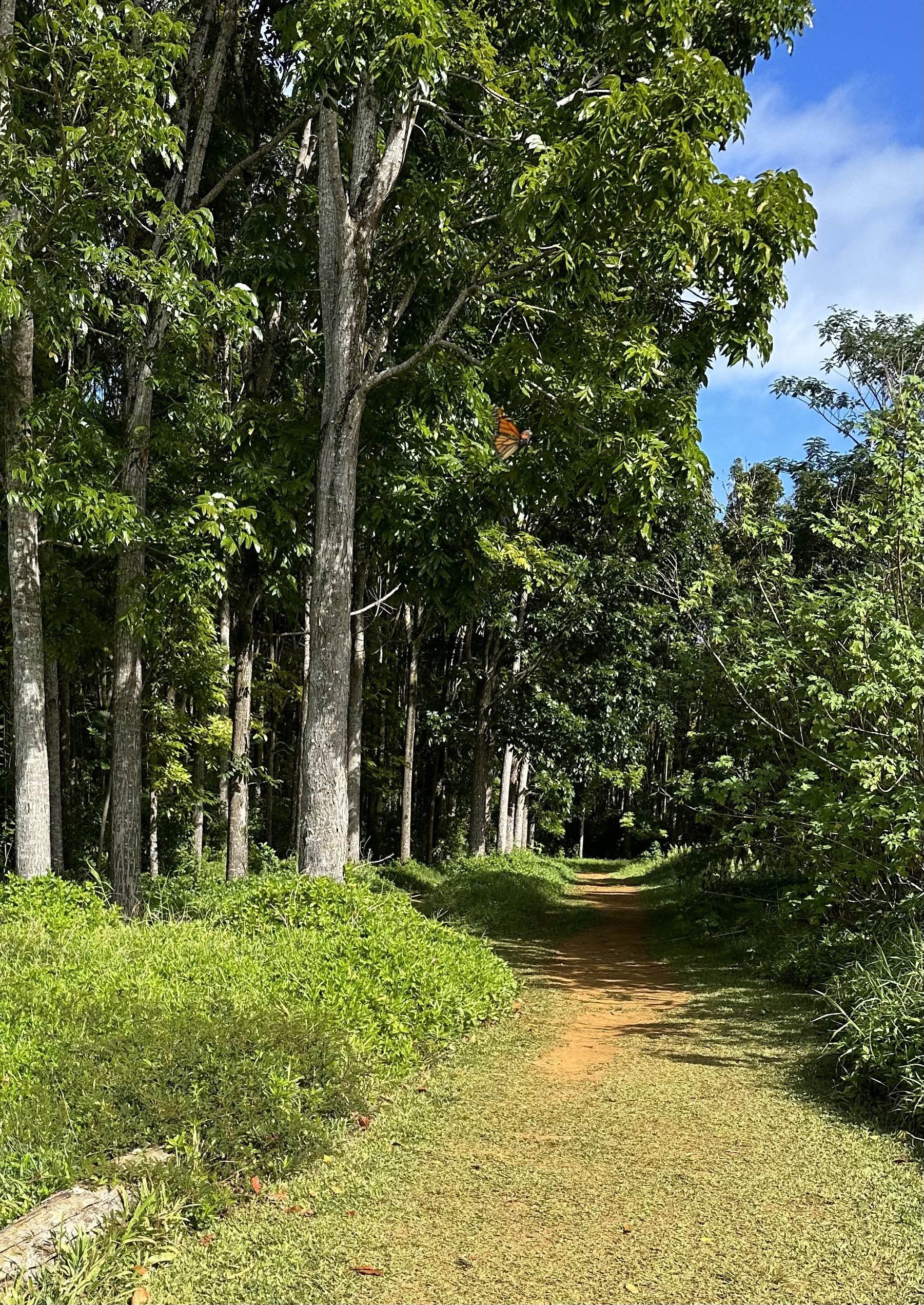
We saw several monarch butterflies. Here I captured one in flight. Do you see it?

Wonderful.

There now. I feel a little better. After all, I am writing a blog about our two-week trip to Paradise, where you are so close to nature that you might just discover your spirit animal guiding you along your life’s journey. Well, in any case, I’m pretty sure that spirit animal wouldn’t be a giant African land snail.

Kauai 2024 – Part 2 – “The Strange Tale of Bullfrog”

February 18, 2024

I ended my last blog with a video I took of the weird sound coming from Steph and Vic’s back bushes. What in the world?

Here is the video again.

“Oh that’s a bullfrog,” said Steph. We’ve had it for a while. Maybe a year. You haven’t seen it before?”

“No, Steph. In all the visits we’ve had with you over the past 11 years we have never seen a bullfrog.”

Which was true. In all our previous 10 visits to Kauai none of us visiting from Idaho had ever seen or heard a bullfrog in Kauai. They don’t exist in southeast Idaho where we have lived the past 23 years.

Even though we lived in Georgia for 11 years before moving to Idaho, my last memory of encountering a bullfrog was in childhood about 60 years ago in Mystic, Connecticut. We lived near some woods with a path to Pee Pond, a frog haven, where my older brother David loved to catch bullfrogs. We’d see one perched on a rock and he’d stealthily sneak up behind it and grab it. They were quick jumpers though and he missed most of the time. But he’d catch them too. My brother would wrap the captured frog in his hand like a burrito with its head poking out and raise it eye level so we could stare at that adorable frog face. “Gotcha!” Then he’d let the frog go. Except for one prized giant bullfrog he captured and carried home. Named him “Junior.” Sadly, Junior met with a violent end. He quickly escaped from the bucket of water my brother set him in as a temporary habitat. We searched all over for Junior. A couple days later we found him splatted in the neighbor’s yard. Apparently the teenage neighbor kid, Trevor Bogue had run him over with a lawn mower. Bad Trevor! That’s the story I remember about Junior, anyway.

So it was pretty exciting for me to discover that bullfrog in Steph and Vic’s bushes just inches from their pool. I named him ‘Froggy’ and I chuckled every time I heard him croak, which was several times a day. And with this link I’ve definitely confirmed it’s an American bullfrog: https://californiaherps.com/frogs/pages/l.catesbeianus.sounds.html

Open the link and scroll down to the ‘Short videos of the American Bullfrog Advertisement sounds,’ click on the picture of the frog and you will experience what we hear blasting out of Steph and Vic’s bushes in Kauai.

Here’s another informational link: https://www.nps.gov/articles/000/american-bullfrogs-fast-facts.htm#:~:text=Bullfrogs%20are%20the%20largest%20species,and%20live%20around%208%20years Only male bullfrogs croak, ‘advertisement sounds’ to attract mates and to aggressively protect their territory. They also don’t sleep; they stay awake and alert even when they appear to be resting. So they croak during the day and are active through the night.

Stephanie said the neighbors next door got so annoyed with Froggy that they captured him and dropped him off at the other end of the golf course. Two days later the frog was back. Frogs have a strong homing instinct as well. Lol

I happened to be out on the patio when the croaking started up and I captured this video. You can hear another frog echoing him although it’s hard to tell how close the other frog is. A bullfrog can be heard from half a mile away.

I suppose the croaking would get a little tiresome. Like when he interrupts your dinner conversation, which actually happened. We were talking over the frog through the open windows and I had a hard time concentrating on the conversation. Then David got up and stepped out on the patio. “There’s the frog!” he said. We all went out there to see. Froggy had jumped in the pool.

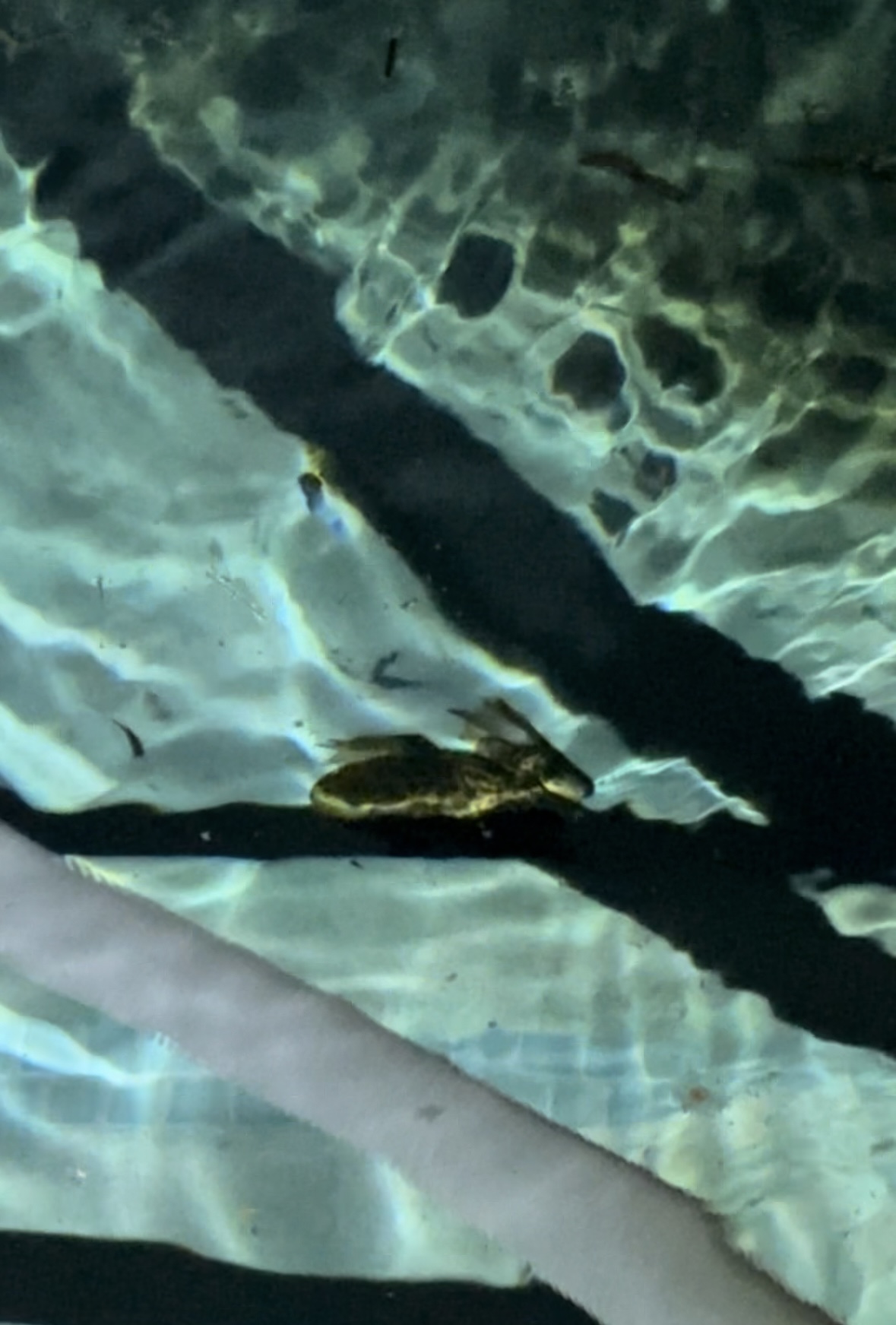
Not easy to capture a photo of a frog in a pool, but he looked to be about 5 inches long. Bullfrogs can grow up to 8 inches long and weigh a pound.

He took off swimming

“Hey, it’s a friggin’ frog!” I know. I seem to have experienced some strange attachment to this fella. Do you suppose I’ve connected with my spirit animal? https://a-z-animals.com/blog/frog-spirit-animal-symbolism-meaning/ “When a frog hops into your life, get ready for a big change!” For starters, they are associated with transformation as they start their lives as tadpoles in the water before morphing into land dwelling frogs.

Speaking of transformation now this blog is morphing into recognizing the dark side of bullfrogs …

I grew up in Connecticut around bullfrogs in their native habitat. And I hadn’t seen one for 60 years until this trip to Kauai. I’ve been rather excited about it until I started doing more research about the proliferation of bullfrogs around the globe and their devastating influence on the native species of the areas they have propagated. The bullfrog’s natural range extends from Nova Scotia to central Florida, from the Atlantic coast to Wisconsin and across the Great Plains to the Rockies. However, they have been introduced around the world by humans because we like to eat their legs (apparently), dissect them in labs, keep them as pets (did you ever keep a pet frog in a fish bowl?) and through other means. They have voracious appetites and will eat about anything they can fit in their mouths – birds, bats, rodents, frogs (yes, they are cannibalistic) newts, lizards, snakes and turtles. They prey on native species and are able to out-compete them for survival.

Bullfrogs are an invasive species even in states like California and Arizona where they were intentionally introduced as a food source but are multiplying at a fast rate with few predators. Check out the you-tube video in this link “Help Stop the Spread of Bullfrogs in Wyoming” (!!) https://www.invasivespeciesinfo.gov/aquatic/fish-and-other-vertebrates/american-bullfrog

So my happy bullfrog love tale has taken a dark turn … I had no idea …

A student, Heidi Beswick Cutia, is researching the invasion ecology of the bullfrog in Hawaii. https://spectrumlocalnews.com/hi/hawaii/environment/2022/02/12/a-researcher-s-quest-to-learn-more-about-hawaii-s-invasive-bullfrogs

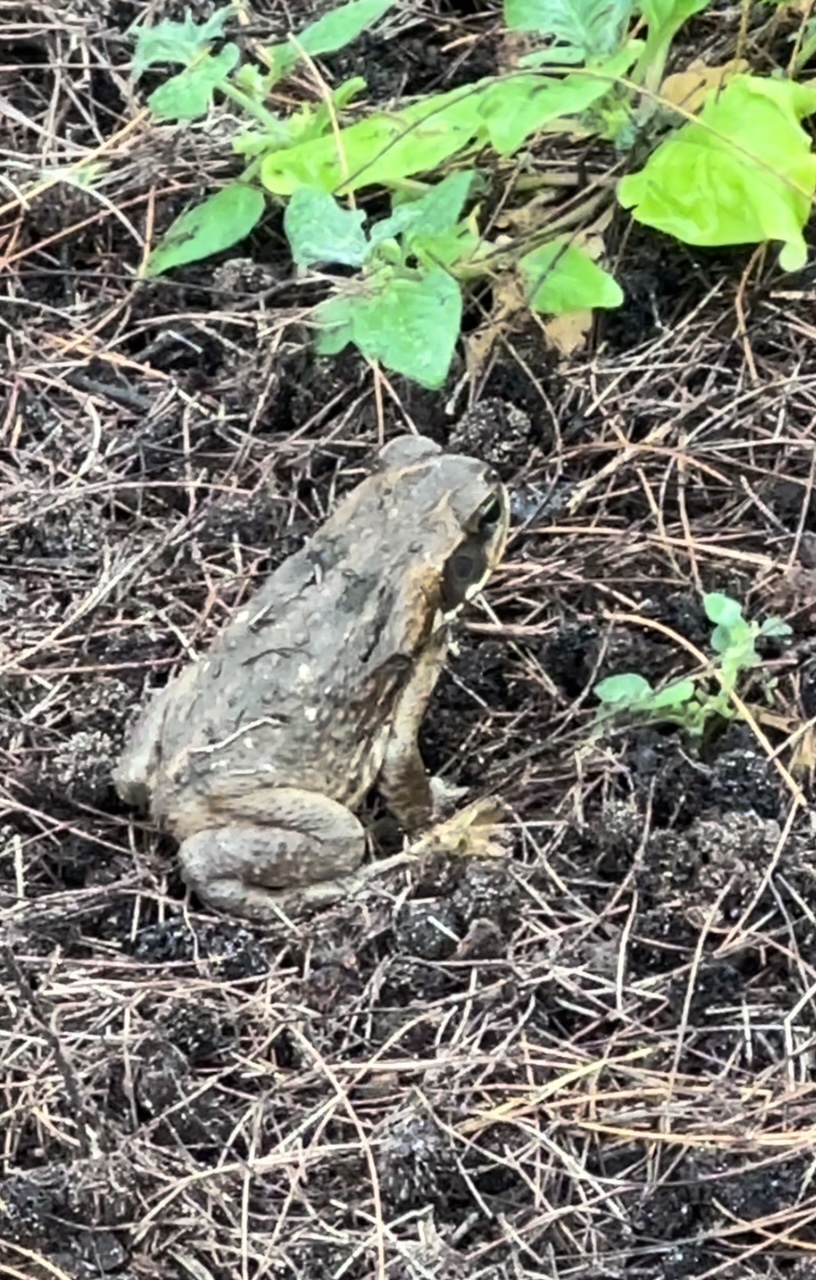
Bullfrogs were brought to Hawaii from eastern North America about 120 years ago so people could eat their legs. They have spread to all the main Hawaiian Islands. Although people haven’t been paying much attention to them. Bullfrogs should not be confused with the more commonly spotted bufo toads. We’ve only spotted this native toad once in all our visits – January of last year near Kahili Beach.

Bufo toad

Little is known about Hawaii’s bullfrogs, except that they are inhabiting the wetlands and eating other native animals such as endangered Hawaiian stilt chicks, snails and native insects. “A U.S. Fish and Wildlife Service study from 2004 put radio collars on endangered stilt chicks at the James Campbell Wildlife Refuge and found that when they could determine the cause of death for the stilts that 77% of them were being eaten by bullfrogs.” Stilt chicks are a long-legged, back and white, slender shorebird with a long thin beak. https://en.wikipedia.org/wiki/Hawaiian_stilt And they are an endangered species.

Along with the harm they cause in the low-lying wetlands, bullfrogs can also scale steep waterfalls into high-elevation streams and wetlands where there are a lot of native species.

So what about that bullfrog in Steph and Vic’s hedge? It might be a great place for it. If it mates with a female and she lays eggs in the pool, then the pool maintenance guy will dispose of them. So even if Froggy thinks he has a cushy spot (which he certainly does) he is not going to produce any offspring.

That fence behind Froggy’s habitat will be coming down after they complete the construction on the adjacent golf course. And if Froggy hops out there he might just get run over by a lawn mower.

Aloha Kauai! January 2024

February 13, 2024

Alright, so I’ve already written 62 blogs on Kauai, about 6 blogs after every trip we’ve made over the past twelve years – invited you along to experience the trip vicariously, if you will. It occurred to me this trip that maybe after 62 blogs I could just let the blogging thing go – go to Kauai, come home and get on with reality and stop with the reminiscing. But don’t you want to go back to Kauai? Let’s go! We fly from Idaho Falls to Salt Lake, to Seattle, then Lihue all in one day. We can do this! Are you packed and ready?

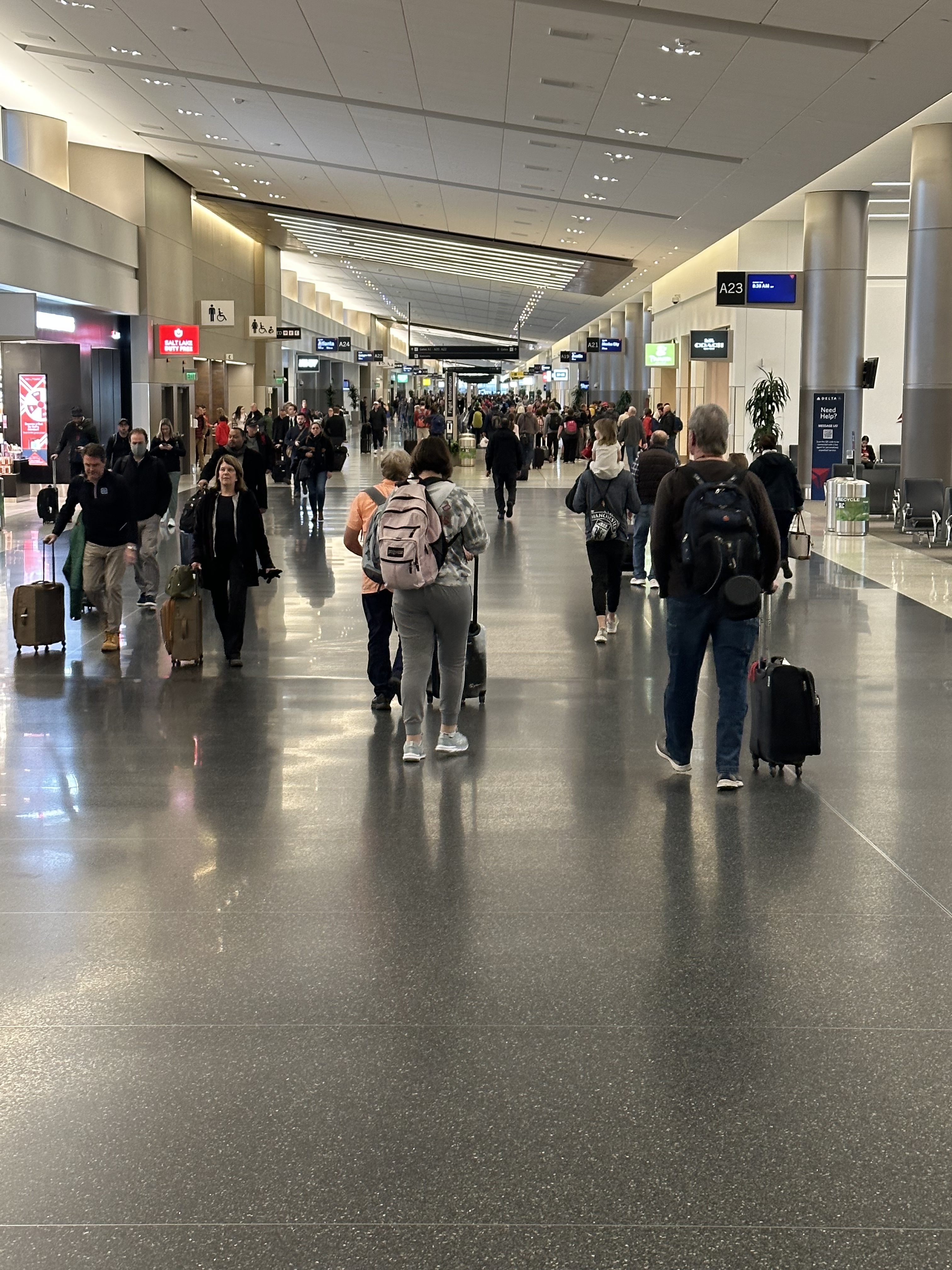
Wednesday, January 16 – Alarms blast off at our house at 4 am and we head to our first flight – leaving Idaho Falls at 6am. Yay! We (David, Megan, me and my brother Eric, who spent the night with us) hop into David’s truck, park at the airport, board on time, arrive in Salt Lake. With a four-hour layover, we have plenty of time to enjoy a leisurely breakfast, get a few extra steps in, before heading to the gate for our flight to Seattle.

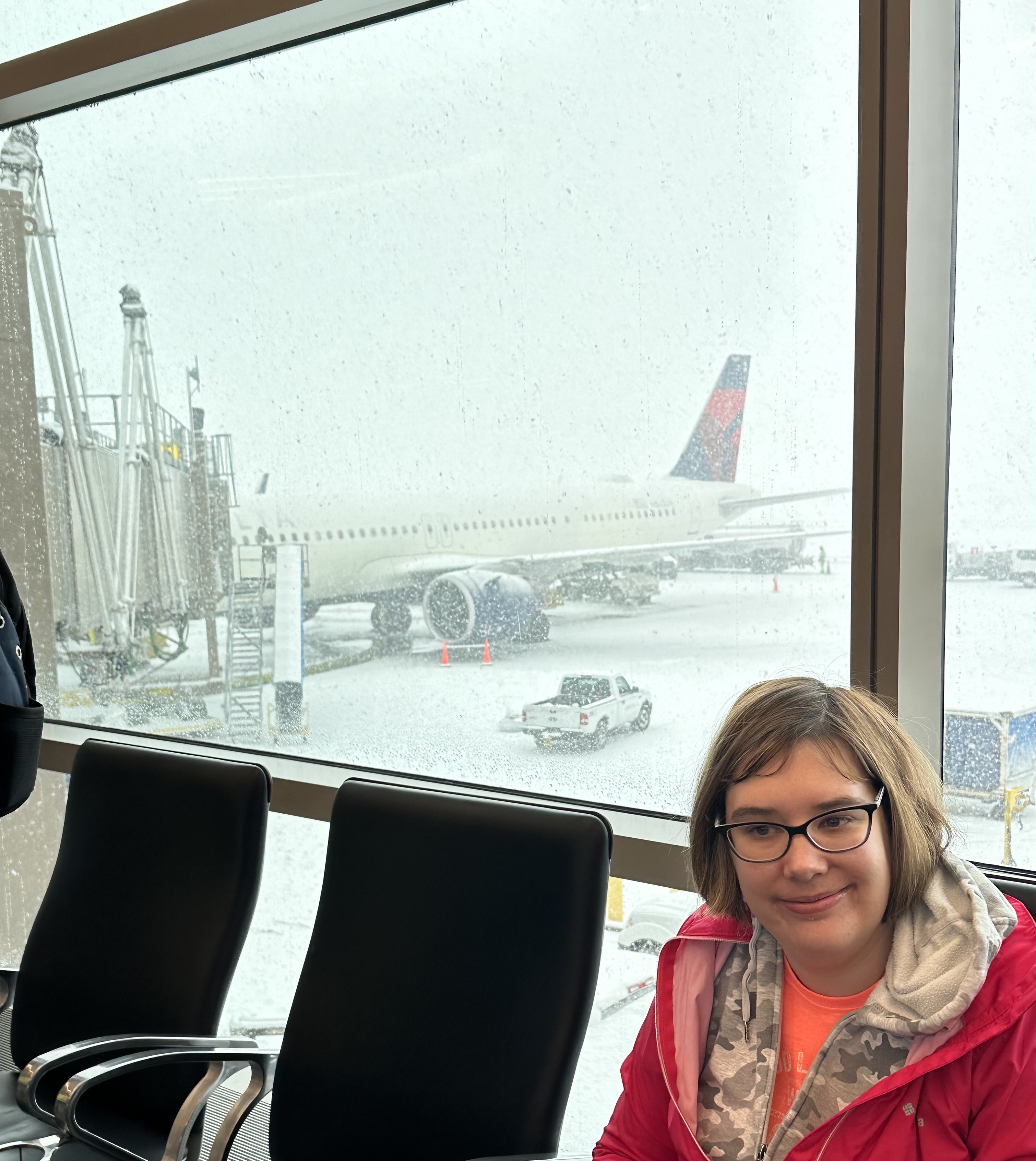
Our plane to Seattle is at the gate. Hey, Megan, pose for a photo! (We’re already flagged from lack of sleep.)

Salt Lake City – 10:40am

We should be boarding now for the 11:15 am flight. Uh, well there is the minor detail of the weather … No worries. We go ahead and board with only a 20-minute delay due to the massive snow collecting on the runways. And luckily we have a 3 1/2 hour layover in Seattle (so smart!) so still plenty of time to enjoy a nice meal in Seattle before boarding our flight to Lihue.

We board the flight and settle in with our noise cancelling headphones and cushy neck pillows and … uh, the plane doesn’t seem to be moving. Of course the plane will need to de-ice. Not a problem. Just pick out a movie on your own personal movie screen in front of you! I’ve got a great book. Relax … We have a 3 1/2 layover in Seattle. The plane pulls out of the gate and moves a bit and we’re stalled again. It’s hard to tell what’s going on outside with that heavy snowfall but there sure are a lot of planes lining up.

Well, long story short, we are asked to stay in our seats as we could prepare for take off at any time. And we sit right there for the next three hours as they plow the runways. Megan finishes her movie. Finally we’re in line to get de-iced, good sign! We do take off. It’s a 2-hour flight to Seattle. By the time we land in Seattle we’ve been strapped in our seats on the plane for 5 1/2 hours.

The 6 1/2 hour flight to Lihue has already boarded by the time we land in Seattle. David and Eric run to the gate to hold the plane while Megan and I race to the nearest ladies room. But we do make the flight to Lihue. Thank goodness for that 3 1/2 hour layover. Of course we’re starving. Well, this trip isn’t as bad as when we booked first class tickets to Kauai two years ago (yeah!) from Salt Lake to Lihue through San Francisco. You can guess how that turned out. We boarded our first flight in Salt Lake which had eliminated first class because they had changed to a smaller plane. Then we ended up landing in Monterey because San Francisco was socked in with fog. Sat on the tarmac in Monterey for three hours waiting for the fog to lift in San Francisco. Re-booked a later flight to Lihue in cattle car. I blogged about it of course. In case you want to read the hot details here’s the link: https://decompressionofaboomer.com/2022/02/06/kauai-2022-do-you-know-the-way-to-monterey/

So now we fly ‘Comfort Plus’ on Delta, which gets you seats at the front of cattle car, with a little extra leg room (maybe?) and free drinks and one extra slightly larger bag of chips beyond the usual snacks from the snack cart. That way, if you get bumped from your flight (which, at this point seems likely) you have a better chance of rebooking similar seats (not at the back of the plane in cattle car when you have a connection to make…)

So now we’re all settled in on our flight to Lihue. Try to cop some ZZZZ’s on the 6 1/2 flight. (Impossible.)

We land in Lihue, Kauai about 8:30 pm. Rent a humongous van and drive in the dark to Steph and Vic’s house on the north of the island. I roll down the window and inhale the ocean breezes. “Hey, Megan, out your window there’s the Pacific Ocean! Can you smell it? Hear it? Maybe we’ll see it tomorrow!” We arrive at Steph and Vic’s about 10 pm – 1 am Idaho time, which, added up to a 21-hour travel day. Steph and Vic had prepared a nice meal for us. We had finally arrived! Boy was it was wonderful.

Thursday, January 17 – It takes a bit to decompress once you arrive in Paradise. I heard the most beautiful bird song our first morning. Wonderful, and I wanted to know what kind of bird it was. I had downloaded a free app called “Merlin Bird ID” where you press ‘record’ and capture a bird song and it will identify the bird. Steph and Vic had a western meadowlark singing away in their back yard. So, imagine yourself, waking up in Paradise that first morning, walking toward the kitchen, bare feet over cool tiles, looking out at the brilliant sun, when you hear the sound of a meadowlark – check it out on this you tube video: https://www.youtube.com/watch?v=fRgU4xS06sM

We took a morning walk around the Princeville golf course and heard a lot of Myna bird song – (identified by Merlin) – here you can hear it too (skip the add…) https://www.youtube.com/watch?v=3Ix1hugefpo

A major golf course in Princeville (behind Steph and Vic’s house) is being refurbished and is enclosed in a tall green mesh fence. You see a lot of that fence in my photos. Hopefully the golf course will be reopened in the next year. But on our first walk we also saw a nesting Albatross – right up against the fence about three houses down the street from Steph and Vic.

I wonder how the nest even survives. They nest on the ground right in people’s yards. It might be because they are imprinted to return from the sea to nest in the place they were born, and maybe these albatross were here before the houses were? Albatross don’t find a mate and start breeding until they are at least 7 years old. https://ypte.org.uk/factsheets/albatross-wandering/breeding-5e050f07-1dc7-477a-adcd-dfe1fbc0b194

Here we are on our walk through the wooded path along that same golf course near the Westin resort.

Eric, David and Megan

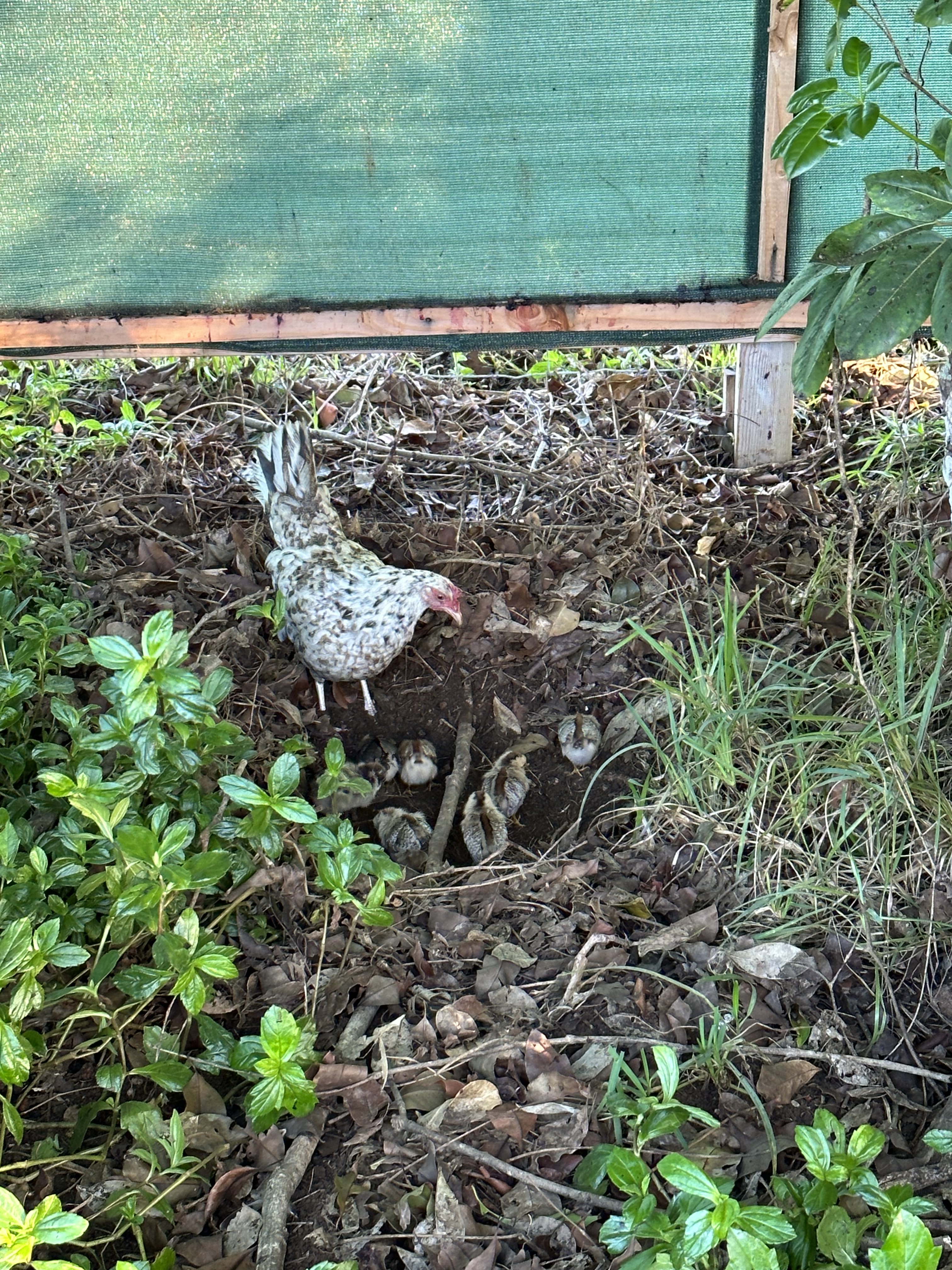
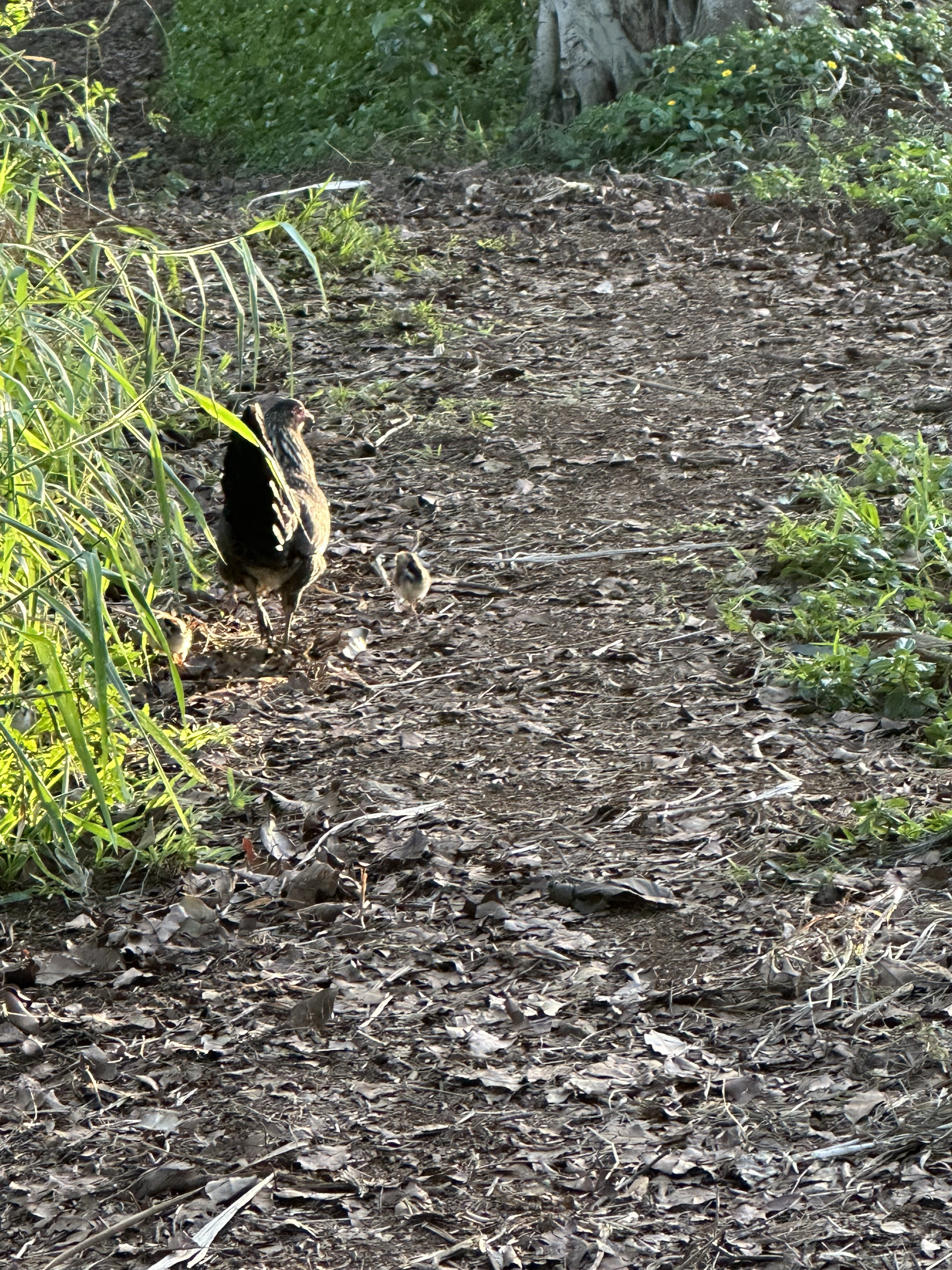
You will always come across feral chickens on this path. Likely with clutches of newly-hatched chicks. Here’s a photo I took and a video (I hope you can open the videos!).

Back home at Steph and Vics I recorded this really strange sound coming from their back bushes. Is it a bird? Merlin did not recognize it. Do you?

Well that about wraps up our first full day in Paradise. We’ll have to solve the mystery …

Aloha, Kauai!

March 19, 2023

Kauai 2023 – Part 4

I feel weird, like I’ve left us marooned in Kauai. I have to get us back home. Spring in Idaho is nigh upon us! (Yeah, right.) Somehow I can’t move on from Kauai until I wrap up our January 2023 trip and get us safely home again.

Our last hike was on the Club Med Ruins path in Princeville on the north shore where we enjoyed gorgeous views of Hanalei Bay from the east and checked out the surfers. Well now we are in Hanalei Bay walking the beach. Here you see a view of the ‘dock of the Bay’ looking north – that greenery in the background is where we were walking yesterday – where the failed Club Med and other resorts were never built.

Okay so you’re walking the beach with us now. Here’s a video. Feel the ocean breeze on your face and the sounds of the roiling surf:

Let’s walk the whole expanse of the beach and back again. Oh, wait a minute. Too late. While we were busy taking photos and videos the rest of the group made it to the end of the bay and are already on their way back toward the dock.

That’s Eric, David and Victor on the far left side of the photo. Steph is on the far right – she likes to walk along the shore and soak her feet in the salt water.

And look who washed up the beach!

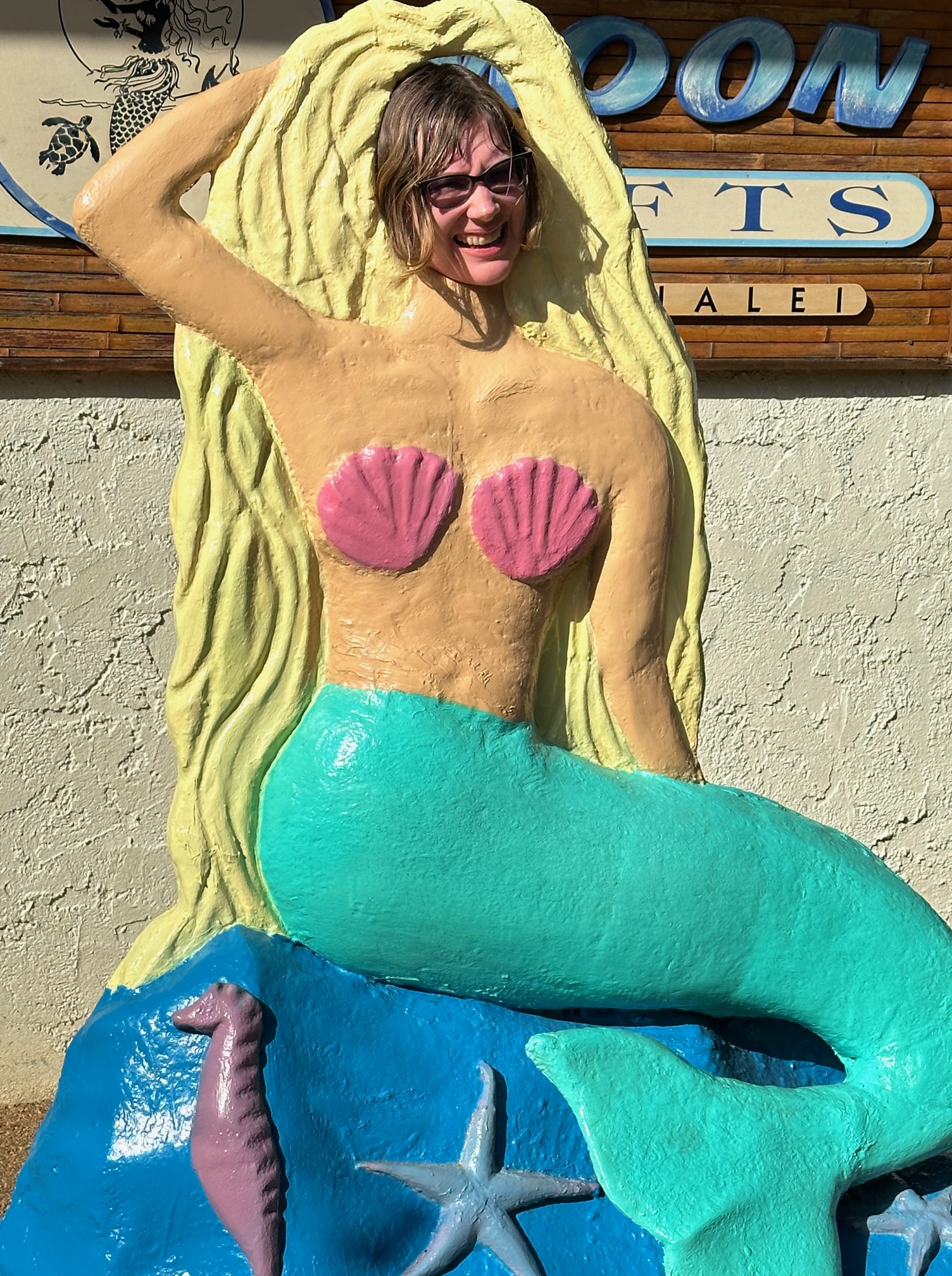
A mermaid named Megan!

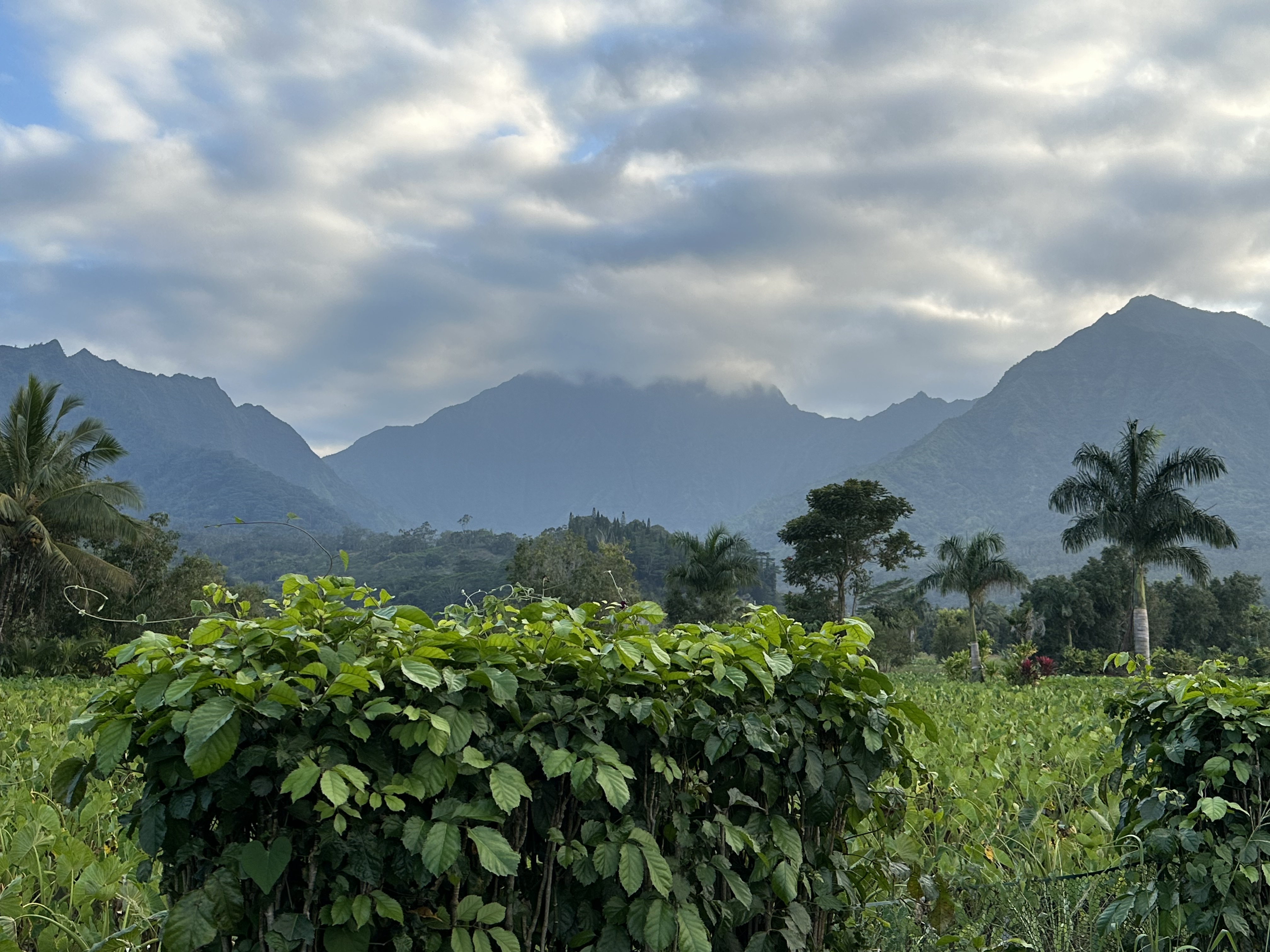
We pull up in the parking lot behind the Hanalei Market. I’m always dragging behind. But when I climb out of the car I can’t help but take a photo. Check out the view!

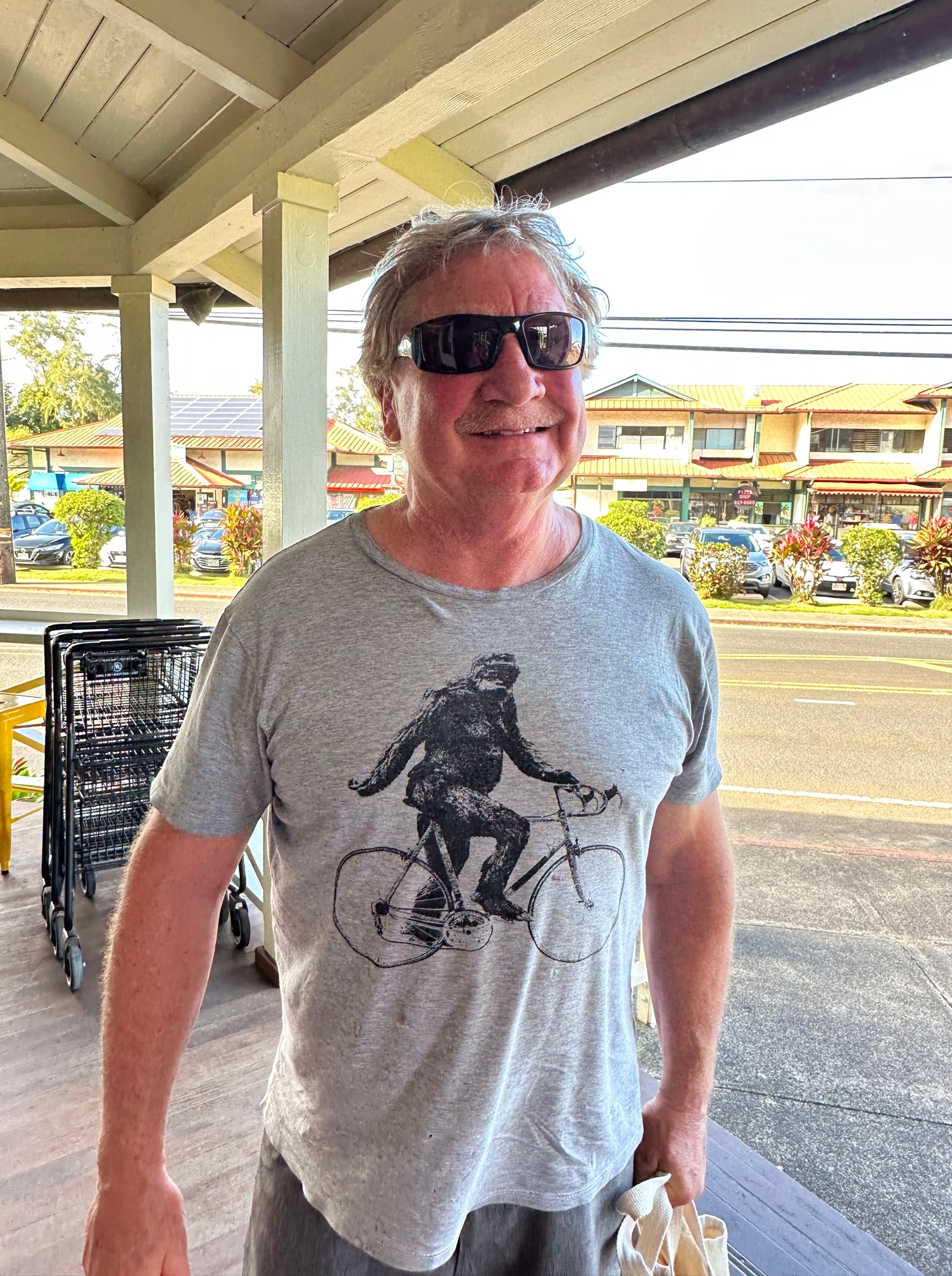
We shop for a bunch of organic food. Yum! Eric’s got the goods.

I hope Sasquatch doesn’t carry Eric off on his bicycle

Oh but there’s a high surf today so of course we have to drive just a few miles further north on the northern tip of Kauai to Lumaha’i Beach! You pull off the side of the road above the beach and park. Then walk down a short, steep, windy path to the beach. Whoa. No swimmers today. Better stay back a ways from the crashing surf! Here, I took a photo. And a video …

I leaped up onto a ledge when a rogue wave came crashing in – almost lost my sandals. Ran into a couple on the ledge. They allowed that it wasn’t a smart move to be standing on the beach today taking videos. (Smart for tourists, though, who may never make it back here?) Yeah, do you know what the locals call this beach? they said. LumaDIE’ i beach. Oh!

To give you a little perspective on what a Lumadie’i surf might look like, here’s a You tube video – ‘Big surf at Lumaha’i January 28, 2016.’ (This might be the same You tube video I shared in a previous blog – but it’s worth sharing again.) Let me just say, a lot of girls in string bikinis risked their young lives to bring you this video, which, I assume is not being taken by their parents:

We’re headed back up to the car now, on a path through a mini-jungle.

You’re welcome, fellas! Hey, this is Kauai.

But before we leave the island, I must share the most charming experience of all, that of witnessing the nesting Layson albatross. Which, by the way, are an endangered species. Here’s a link for you: https://www.google.com/search?q=Laysan+albatross&ie=UTF-8&oe=UTF-8&hl=en-us&client=safari

Layson albatross spend most of their lives flying over the open ocean and can spend up to six years at sea. They only return to land to breed and raise their chicks on nesting sites on the northwestern Hawaiian Islands, mostly Midway and Layson Island but also on the north shore of Kauai. Albatross have a 20-40 year life span. They return to the very place they were born (called imprinting) and engage in elaborate mating dances until they find a mate at about 8 years old.

We always encounter albatross when we visit Steph and Vic in Princeville because there are usually a few nesting albatross on their street. Sure enough, this year there are two nesting albatross right in the yards of a neighbor 3 doors down. I took this photo from the street just walking past it.

We always encounter albatross when we hike Larsen’s beach. They have a nesting site on top of the bluff at the end of the point. Larsen’s beach is probably our favorite hike on Kauai’s north shore, as we also frequently encounter endangered sea turtles and Monk seals sunning themselves on the beach. I’ve blogged about our hikes there several times, but we just can’t leave Kauai (sigh) without me sharing photos and videos from this year. Are you coming along?

They are magnificent in flight

There’s one flying overhead!

Walking back now, we encounter one all by himself, engaging in mating calls, perhaps? Certainly he’ll catch the attention of another albatross!

We encountered a monk seal too. Do you see it in this photo? Look in the sand.

I’m always lagging behind. Do you see Eric and David in this photo? We’ve almost made it to the point at Larsen’s beach.

Find Eric in this photo:

Here’s a photo of Megan as we head back toward the trail head at Larsen’s beach.

Enough already. Get your butts home to Idaho! Okay…

Aloha, Kauai.

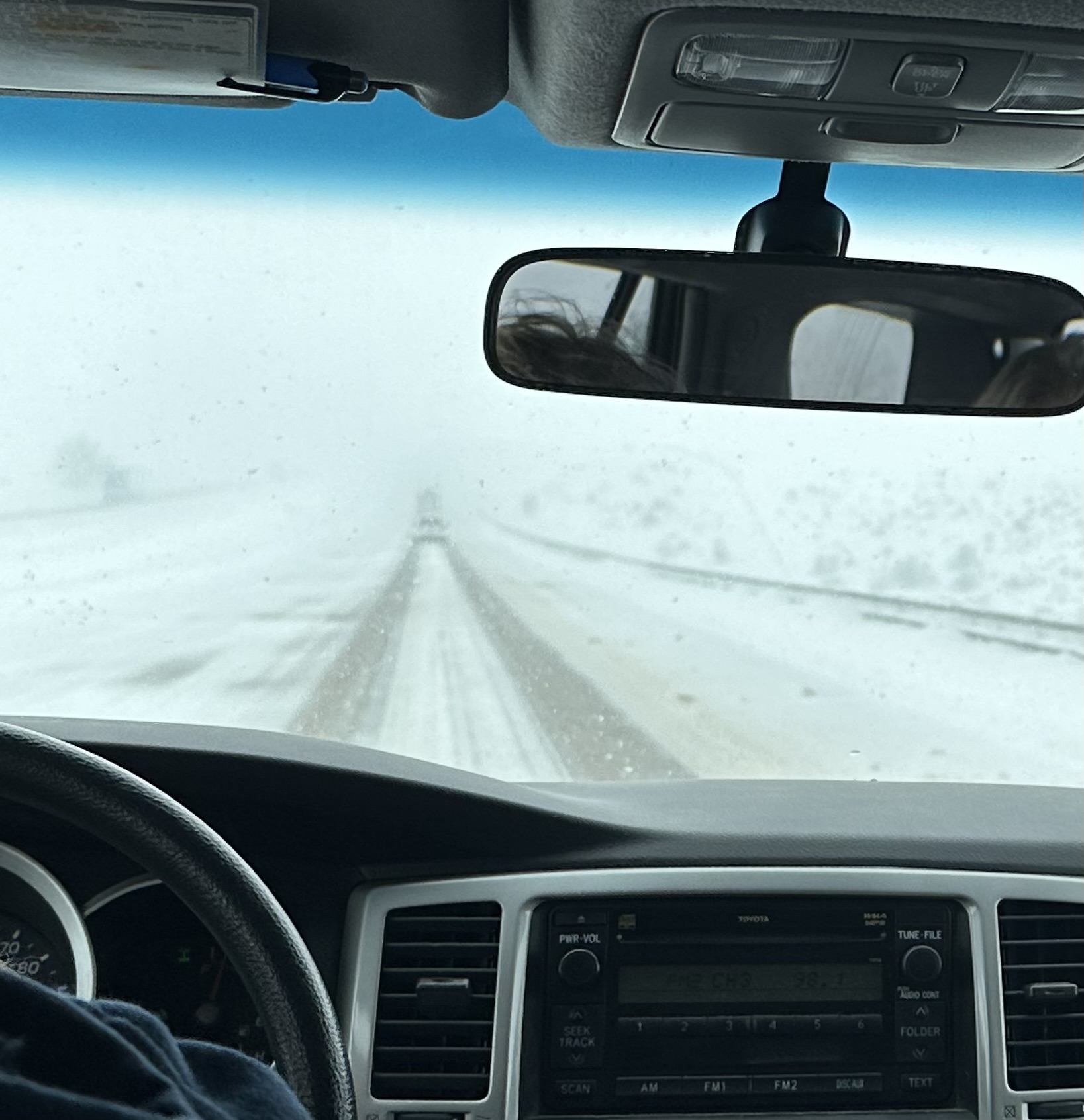
Thursday evening January 26, 2023, and we’re headed to the airport in Lihue to catch the red eye to Los Angeles. I’m a little sad and my phone is stowed away in my purse. Enough photos! We land in LA without a hitch (thank goodness) about 7am Friday and catch our second flight to Salt Lake City. We land in Salt Lake before noon. Of course I just don’t sleep well on the red eye so I’m glad I’m not the one driving us the 200+ miles home to Idaho Falls. Accompanied by ‘old man winter.’ I pull my phone back out and capture a few photos of our drive home from the back seat. Here we are nearing Malad, Idaho. David is driving.

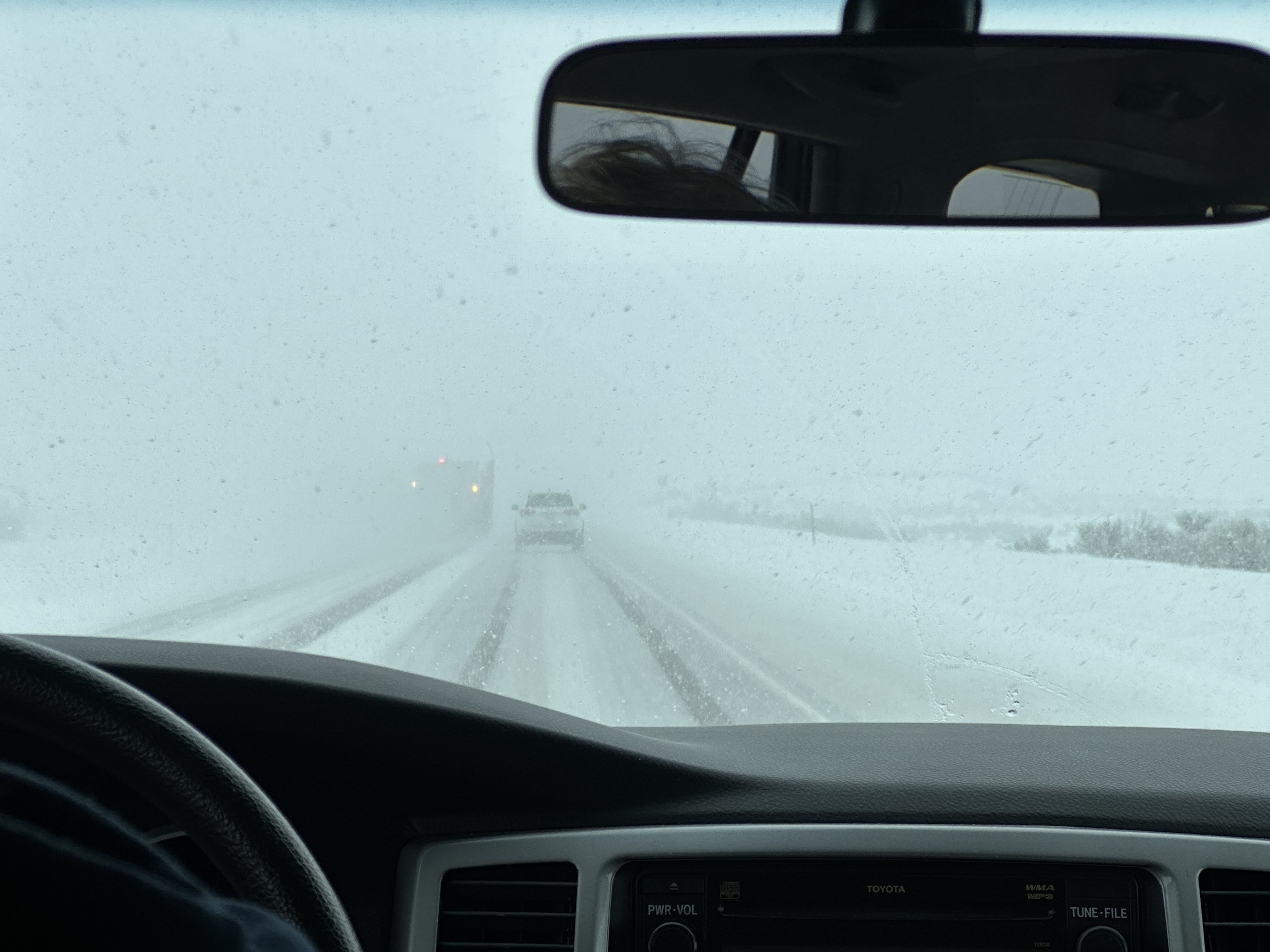
Make sure your seatbelt is securely fastened. It gets messier.

Eric takes over the wheel. David didn’t sleep well on the red eye either.

Near McCammon, Idaho now. Snowplows are a welcomed sight! Well, if you have enough visibility to see them…

Near Inkom, Idaho now. Uh-oh.

Dropping into Pocatello

Oh goody! How many miles to Idaho Falls??

We’re just a few miles from home now. Oh no!

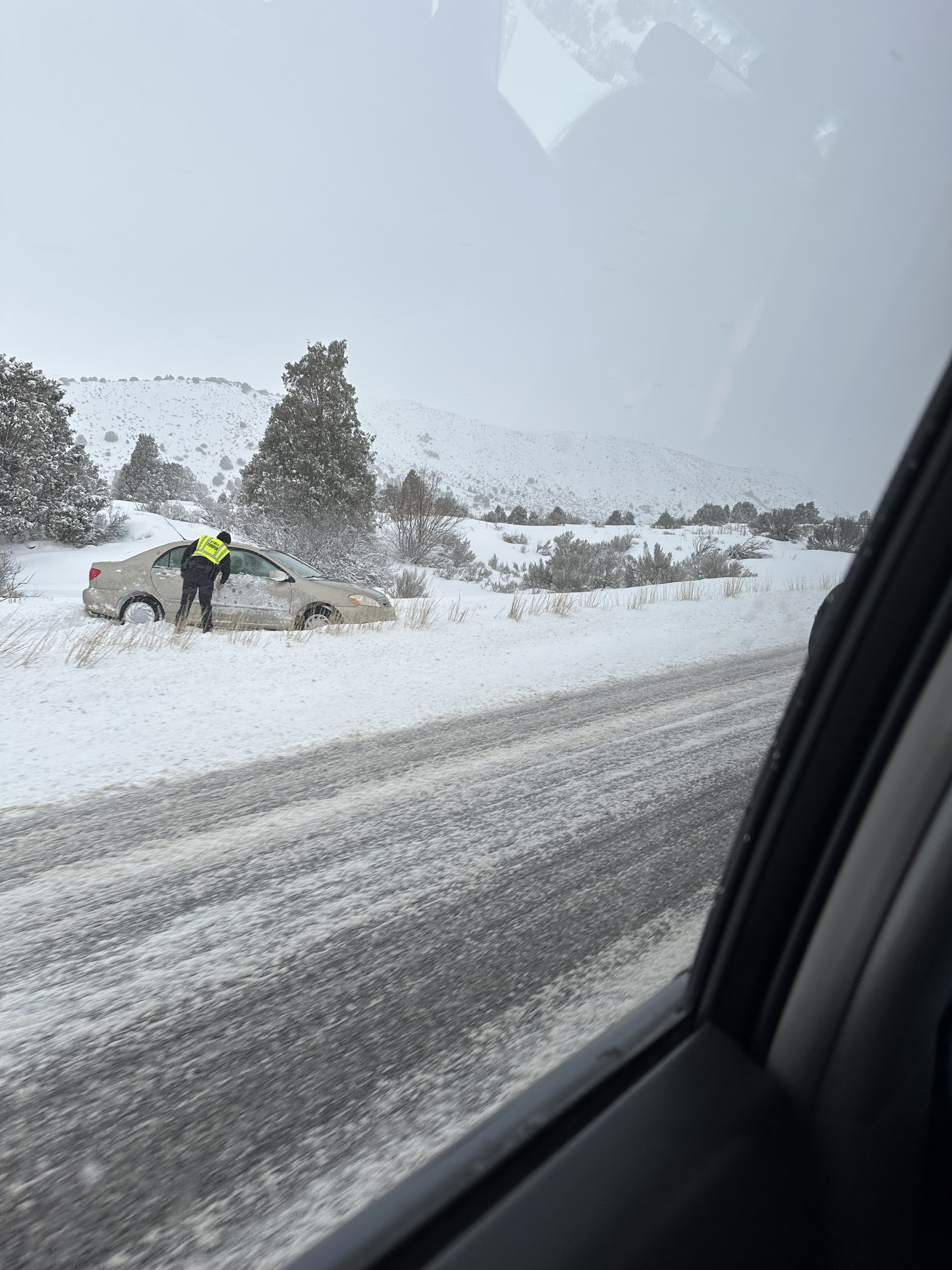
There were five cars off the road in the last ten miles. Oh goody. A tow truck! Somebody will be vey happy to see him!

Just pulled onto our street.

I’m not sure why the photo is so blurry. The scene did seem a bit surreal, arriving home jet lagged and stressed out from travel after spending 15 days in Kauai.

We hunkered in for the long haul alongside old man winter. After we were home, Victor and Stephanie sent us updates from Kauai. On February 1st, just 5 days after we left, the baby albatross on their street (where I had taken the photo) hatched out. Victor sent a photo:

A few days later the second baby in their neighborhood hatched. It seems like a miracle that these babies can survive – sitting in nests on the ground. It’s possible because everyone in the neighborhood is on guard for their safety, keeping their dogs leashed, (what about cats? Yikes!) and there are no mongoose (hopefully) on Kauai.

On February 27 we received this video from Steph and Vic. The baby is now almost a month old. A time for celebration! Watch the video carefully and you will see the baby in the nest to the right of the sign in the video:

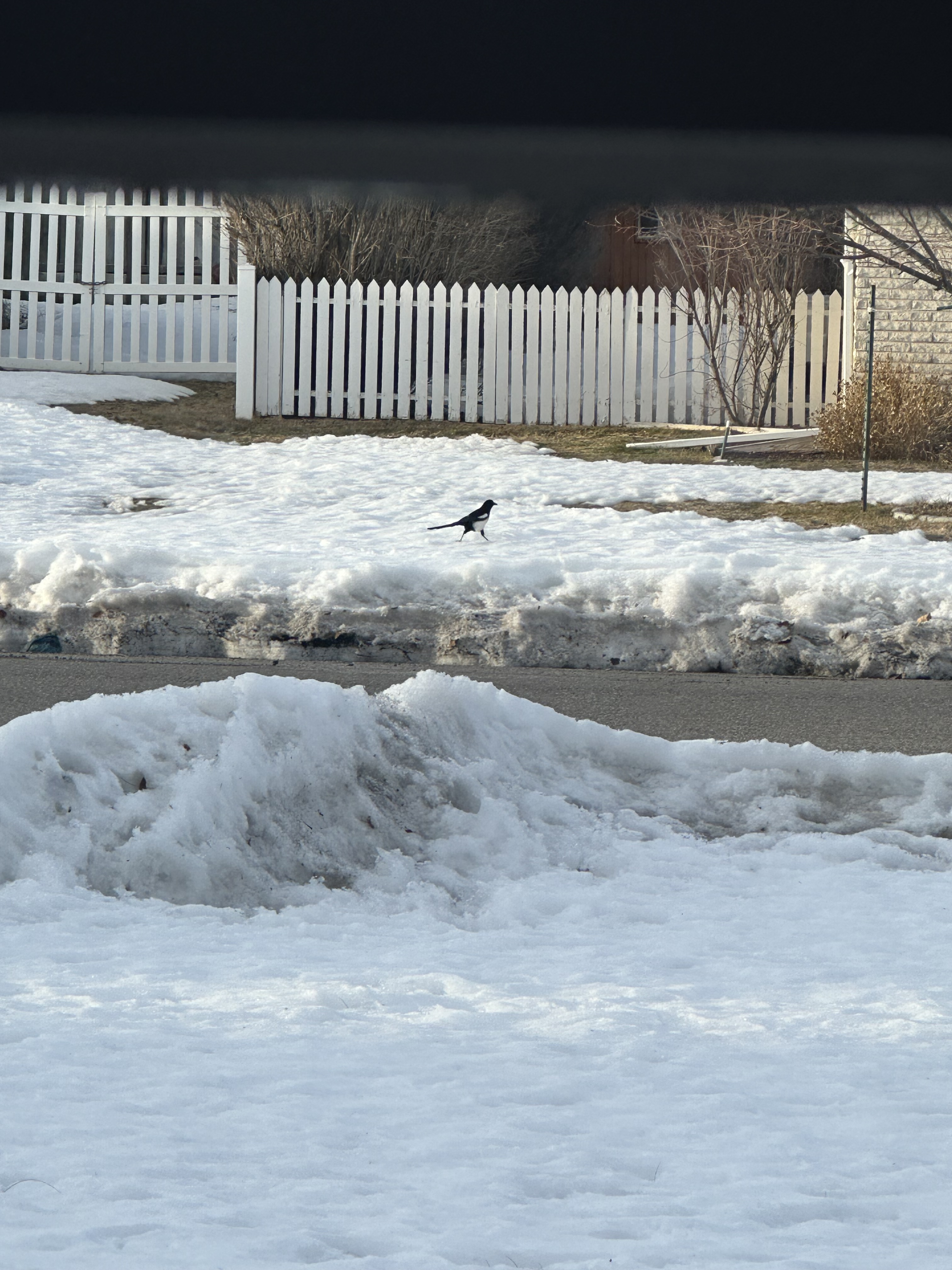
Here in southeast Idaho we’ve experienced one of the coldest, snowiest winters in 20 years. We still have mountains of snow in our front yard, accumulating since November with not much melting in between. We have been hopeful for signs of spring and by golly I saw one the other day when a magpie flew past our front window with a large sprig in its beak. Sure enough a pair of magpies are working feverishly on a 2-story magpie bungalow in our front may tree.

In case you don’t know what a magpie looks like, I just captured this picture of one of the pair. Boy have they been busy.

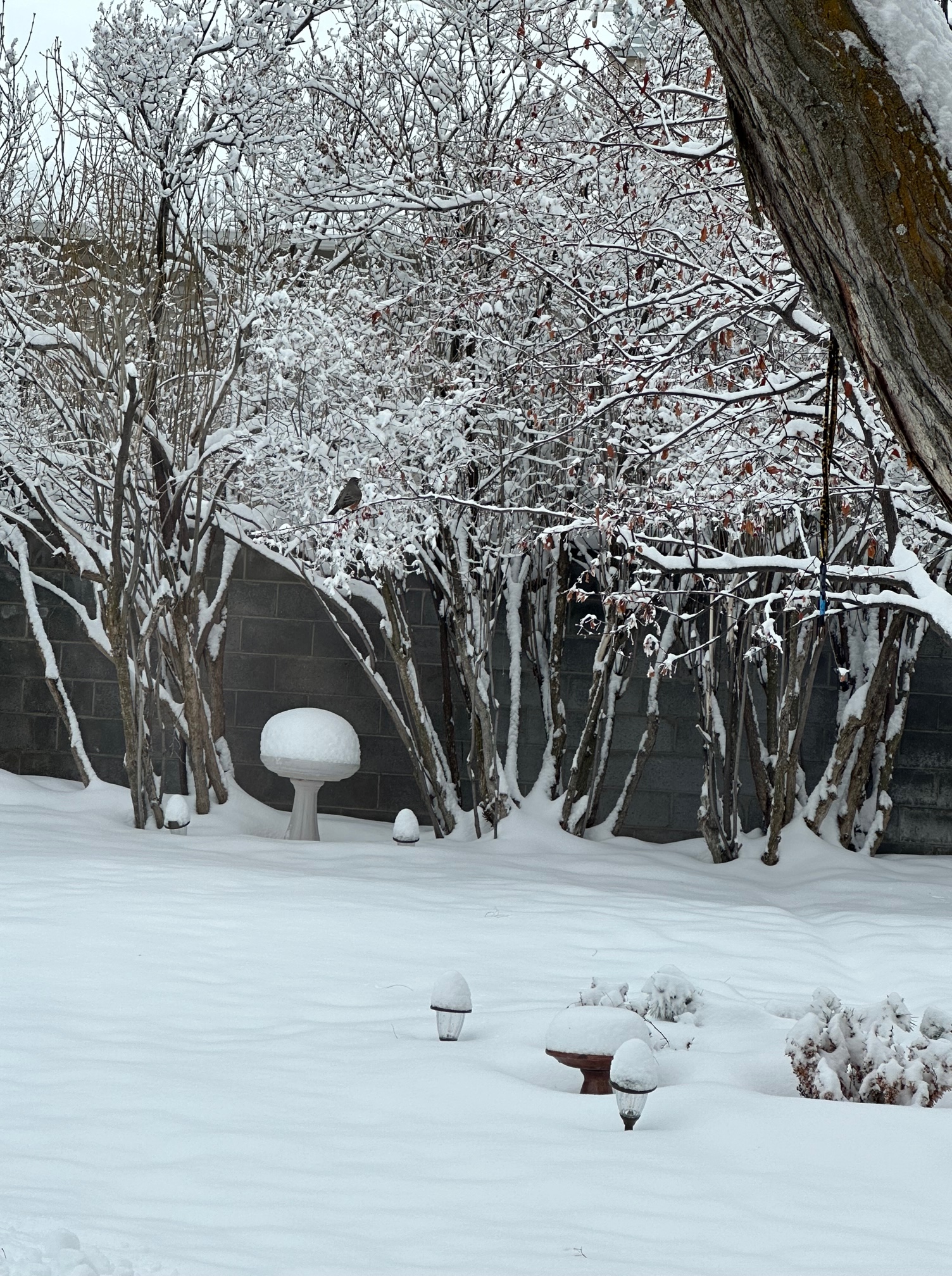
Oh, and did I mention that I also captured a photo of a robin in our back yard? Tough bird, that one. A sign of spring? Hey, I’ll take it!

And what’s the current weather forecast for Idaho Falls? “A return of snow on the first day of spring.”

And now you know why I’ve had such a hard time leaving Kauai.

Hanalei Plantation Trail – ‘Club Med Ruins’

March 11, 2023

Kauai 2023 – Part 3

One of our favorite hikes on Kauai’s north shore is the Hanalei Plantation Trail. The trail starts right below a family owned fresh food stand called Nourish Hanalei at the end of Plantation Road in Princeville – https://www.nourishhanalei.com

The area has an interesting history. Check out this link! – https://www.outdoorproject.com/united-states/hawaii/old-club-med-trail The trail runs through the Old Hanalei Plantation that is now known as the Club Med Ruins because there actually was a Club Med Resort on this property in the 1970’s.

The area was a filming site in the movie South Pacific before it was developed. In the 1960’s it was developed into a resort called the Hanalei Plantation Hotel that was then converted to a Club Med resort in the 1970’s. The Club Med resort operated for a few short years but then closed in the late 70’s due to financial hardship. Then in 1979 Honolulu developer Bruce Stark purchased the property with a plan to build 60 condos. The company poured a number of foundations and some walls and stairs before going bankrupt. The foundations remain, which is why the location is still known locally as the ‘Club Med Ruins.’ The path has remained open so people can walk the grounds and enjoy the views of Hanalei Bay. It is still private property. Signs are posted everywhere to stay on the path. A group is proposing some kind of future development but there is strong resistance from the community that has so far kept it from happening.

Let’s do it! We have arrived about 9am, before Nourish Hanalei has opened to make sure we can get a parking space.

Nourish Hanalei

Take in the view at this little stand! The Hanalei river and Hanalei Bay…

The easy walking path down the center of the ruins leads to a promontory point at the east end of the Hanalei Bay. I assume from the article in the link that this is where the resort lobby was planned. It offers a stunning view of the Hanalei bay and dock.

We’re down at the shore now. You’re standing right next to me looking east at the Hanalei dock.

Take the path in front of us and you can follow the shore all the way to the beach. Or follow the path to the right that leads through the woods to Pu’u Poa Beach. We go right.

Encounter some ancient gnarly trees

The trees in the forest almost look frozen in motion, as if they could suddenly spring to life and those tentacled roots could come tromping toward us. Run those tourists out of the woods!

Path to Pu’u Poa Beach

Ah, but we’re saved by a surfer who suddenly appears on the beach. He must have parked near us and walked the same path down. Here’s Megan, David and Eric settled in on one of those elevated roots to watch him.

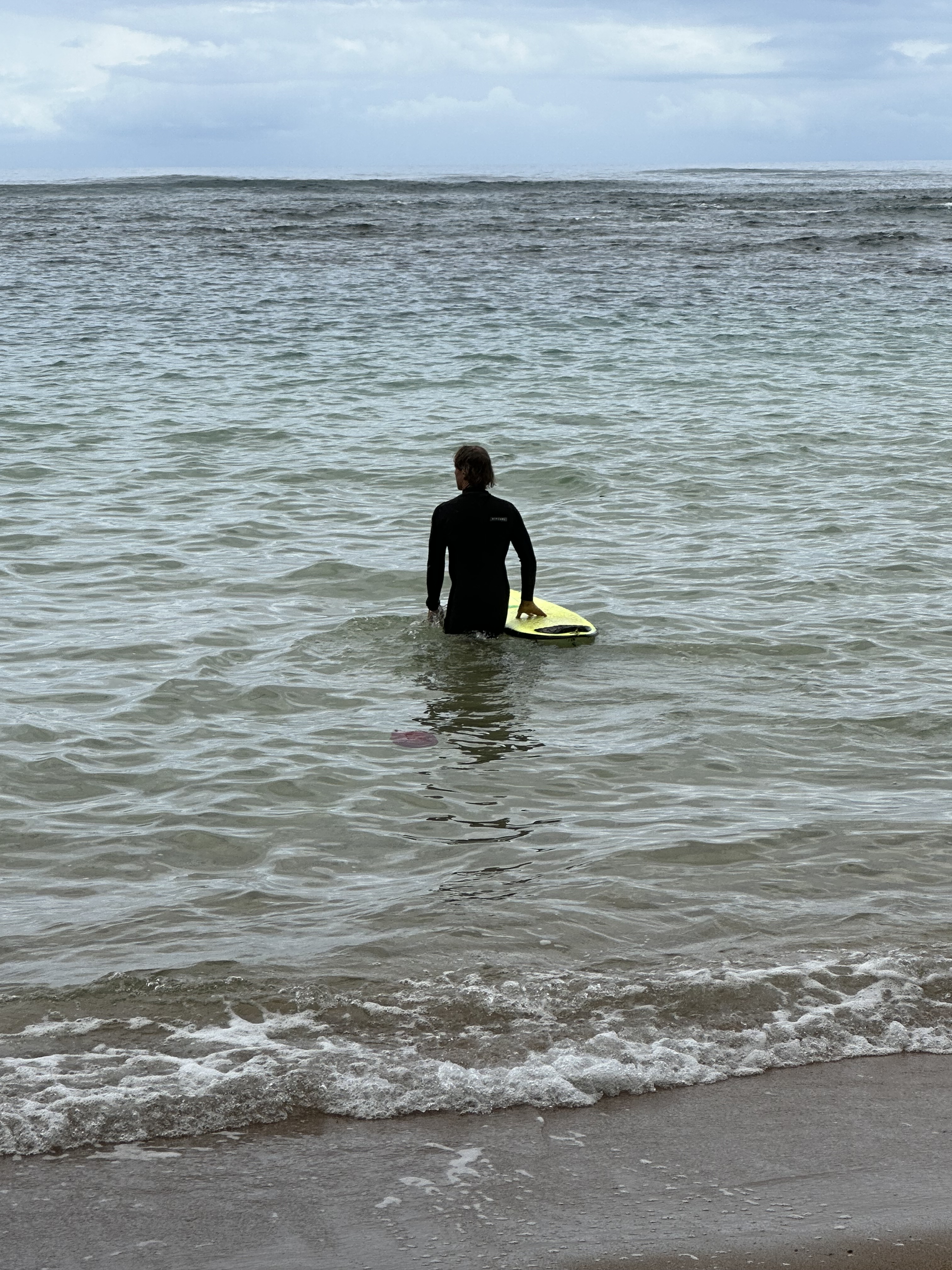
You ready to go surfing? Let this surfer dude show you how it’s done. He’s just entered the water

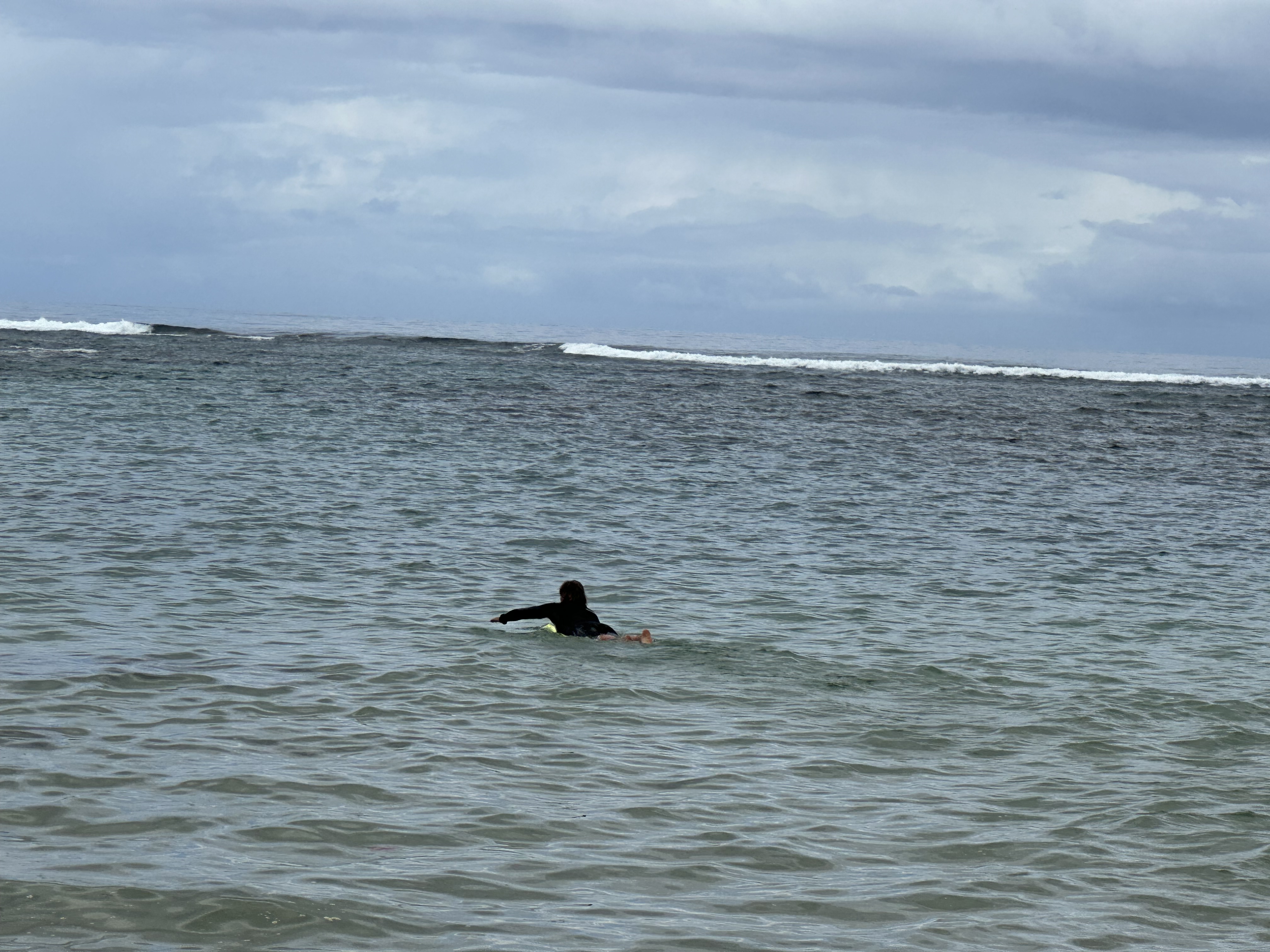
Watch him navigate the wide distance to the waves

He’s way out in the distance now, working his way east toward the other surfers in the bay

He’s up! Well, may not be him, there’s quite a few surfers out there trying to catch a wave. This one is obviously a seasoned pro.

Walking back up the path to the car now.

Eric and Steph

It’s so overgrown you hardly notice any ruins.

I heard a beautiful songbird along the way

No idea what kind of bird that is with such a joyful song.

Life is good!

Uh, wait a minute. We’re not in Kauai anymore. This whole blog had me in a trance. All I have to do is sign off this computer and open our back door…

Yeah, like here in southeast Idaho spring is just around the corner.

Mongoose, Mosquitos, Centipedes and Spiders

March 5, 2023

Kauai 2023 – Part 2

So, exactly how many feral chickens are loose on Kauai? Recent tracking (as of July 2022) suggests as many as 450,000, or about six chickens to every human. Their numbers have grown significantly over the years since hurricane Iniki in 1992. Why? Because the chickens on Kauai have no significant predators. The island is free of mongooses.

Mongooses are native to India. But they are now widespread on the islands of Hawaii, Maui, and Molokai. A brownish weasel-like animal, about 2 feet long, with short legs and long tail, they were originally introduced to Hawai’i in 1883 by the sugar industry to control the rats in the cane fields (with a stop in Jamaica, where they were also introduced). Except the plan failed because mongoose are active during the day and rats are primarily active at night. Oops. Mongoose eat birds and their eggs, small mammals, reptiles, insects … they are especially dangerous predators for the native ground nesting nene and albatross and endangered sea turtles.

Although there are no known populations on Kauai, the Kauai Invasive Species Committee (KISC) is actively controlling the mongoose species. Sightings of mongoose (or any other pests on their target list) should be reported to them immediately. They will come and survey the situation and remove the pest for free. Check out their link:https://www.kauaiisc.org/kiscpests/mongoose/

According to their site, one female mongoose was found dead along a road in 1976 near Kalaheo and sightings have been reported all over Kauai. In May, 2012, KISC captured the first live mongoose near the Lihue Airport. (Yikes!) A mongoose was captured in October 2016, again at the Lihue Airport. Then another mongoose was trapped five years later, in December 2021, at the Nawiliwili boat harbor. https://beatofhawaii.com/mongooses-in-hawaii-why-latest-find-on-kauai-is-so-disturbing/ Very unsettling!

So yeah, because there aren’t mongoose the wild chickens are proliferating. I’m sure the locals don’t enjoy the habits (pooping, cock-a-doodle-do-ing at all hours, aggressively begging for food, and ruining your garden) and antics of the wild chickens as much as the tourists do.

One detail I left out of my previous blog was, while I was following those wild hens around, taking videos of their tiny chicks, Megan was getting eaten by mosquitos. Mosquitos? In Paradise? Admittedly it was near dusk when we walked on that trail, but in the previous nine trips to Kauai I don’t think I got bitten by a mosquito even once. How could it be that in a space of a few minutes Megan got bitten 5-6 times? How was I not aware after all these visits to Kauai that they do have mosquitos? Of course,Google can answer these questions! https://www.scientificamerican.com/article/some-people-really-are-mosquito-magnets-and-theyre-stuck-that-way/ Yes, some humans are mosquito magnets and other humans, well, mosquitos just aren’t attracted to them (try not to take this personally).  The subjects in the experiment with greater amounts of carboxylic acid on their skin were most attractive to mosquitos while those with low amounts were least attractive. And apparently, your blood type or diet has nothing to do with it, your corboxylic acid levels are fixed: Once a mosquito magnet, always a mosquito magnet.

Hawaii hasn’t always had mosquitos, of course. They were introduced in the early 1800’s via the whaling ships. https://reviverestore.org/the-plan-to-restore-a-mosquito-free-hawaii/ Six separate species of mosquitos are now found on the islands. Two species transmit deadly human diseases (dengue, chikunguna, and Zika) while one transmits avian malaria. Native Hawaiian species have not developed resistance to mosquito transmitted diseases and so invasive mosquitos carrying avian malaria are particularly dangerous to Kauai’s forest birds, which are fighting extinction. And as far as humans go, if you are planning a trip to Kauai and wondering about the mosquito situation, here is a site – a trip advisor forum on mosquitos in Kauai with lots of discussion from self-proclaimed mosquito magnets… https://www.tripadvisor.co.nz/ShowTopic-g29218-i304-k10810066-Mosquitoes-Kauai_Hawaii.html

While we’re on the subject of Non-Native invasive species in Kauai, you can imagine how easily cockroaches arrived in Hawaii as stowaways in shipping containers, starting about 200 years ago. According to this article – https://cockroachfacts.com/cockroaches-in-hawaii/ – there are nineteen different species of cockroaches in Hawaii. But in my ten visits to Kauai, I’ve only spotted one roach, a very large cockroach, likely the American cockroach. It was sprawled out, not moving one bit, in the entry to the ladies room in the Lihue airport. The horde of women entering and exiting the restroom simply stepped around it. No one said a word about it and certainly we weren’t going to soil our shoes squishing it!

So what’s the point of this blog, you ask? I dunno. I started thinking more about the feral chickens and why they are so happy and prolific on Kauai, which got me on the subject of the mongoose and other invasive species in Kauai. Like the centipede. Check out this link: https://a-z-animals.com/blog/hawaii-centipedes/

There are three types of centipedes in Kauai. The Vietnamese Centipede (can probably guess where it came from) is giant – can grow up to 8 -10 inches long. Vietnamese centipedes prefer warm damp areas like under rocks, woodpiles and mulch. It is not common to find them inside homes, thank goodness. I have never seen a centipede in Kauai, but I haven’t been camping! I got a charge out of this story, a 5-minute read, by Gabriel Morris – who, in March 2022, decided to pitch a tent on a secluded beach on the northern shore of Kauai. He scraped out an area of thick leaves and scared up three centipedes in the process. Just scraped them out a few feet way with his shovel. Kept his tent zipped up except to answer nature’s call during the night and left his tent flap open for a minute. Well you can guess what happened. Let me just tell you that these huge centipedes have one tough exoskeleton. And they bite, but don’t worry, Gabriel did win the battle unscathed against his unwanted roommate.

To put a wrap on this I will post one insect photo I did take, that of the common garden spider of Kauai. Where did I take it? Off the edge of Steph and Victor’s front porch.

It’s quite thrilling to see a garden spider with its zig-zag patterned web. They’re magnificent, don’t you think? I don’t remember the last time I saw a garden spider on the mainland. Here’s a link to the five biggest spiders in Kauai, the garden spider being one of them: https://a-z-animals.com/blog/the-5-biggest-spiders-in-hawaii/ Garden spiders will bite if threatened, with swelling, pain and redness. It would probably take either a very brave or very stupid bird to try and eat that spider. None of us were going to mess with it.

Lastly, did I mention that there are no snakes in Kauai? Oh, except for the Brahminy Blind Snake that looks like an earthworm, believed to have arrived via potting soil from the Philippines in the 1930’s. https://maalaea.com/are-there-snakes-in-hawaii/ It’s approximately six inches long, and feeds on ants and termites. Now that’s the type of invasive species we’re lookin’ for!

Just for the heck of it, I’ll step out on our front porch and take a photo.

That’s no spider web attached to our gutter. It’s still a freakin’ winter wonderland here in southeast Idaho.

January 2023 – Kauai here we come!

February 28, 2023

You’re kidding, right? The 58 blogs you’ve already written on Kauai aren’t enough? Yep. That’s what I was thinking when we returned a month ago. Enough with the blogs. You’re back from Kauai. Get your feet in the now and get on with your life!

My husband David, brother Eric and I have visited my sister Steph and husband Victor in Kauai every January since 2012, skipping 2020 and 2021 during COVID. Our daughter Megan joined us last year and this year. So, no! No more blogs! Until yesterday, when it was still snowing and I was looking through my photos and videos. And they carried me back to Kauai …. You wanna go?

Tuesday, January 10 – David, Eric, Megan and I hit the road about 4 pm for the 200-mile drive from Idaho Falls to Salt Lake. We will spend the night in a motel near the airport and fly to Kauai tomorrow.

We’ve made it 30 miles already, to Blackfoot! The weather isn’t cooperating.

It’s a rain/snow mix the whole way. Here we are south of Brigham City, Utah about 6:07 pm. My i-Phone says our location is ‘Willard’

Here, I took a video. Turn the sound up to complete the experience from the back seat.

We pull off the freeway in Layton, UT into Red Lobster to grab dinner. Yay! Time for a toast! Let’s kick off this vacation! Margaritas for the old farts and a coke for Megan.

Oh joy. The weather was sure busy while we were celebrating. Back out to the truck at 8PM.

Layton, Utah

We drive our last 10 miles to the motel through a raging snowstorm.

Wednesday, January 11 – 8:40 am. Navigating our way through the Salt Lake City International Airport. You can spot Eric in his ‘Kauai-ready’ orange shirt, Megan behind him, and David next to Megan.

Salt Lake City International Airport

I’m always striving to keep up, even when I’m not taking photos.

We flew to LA and then onto Lihue without a hitch. Rented an SUV and drove about 45 minutes along the east side of the Island to Princeville, at the northern tip. Arrived just in time for dinner!! Tuck yourselves in for a good night’s sleep, we have lots of adventures ahead…

Thursday, January 12. Good morning Princeville! Jump in the car to about anywhere and you circle the fountain.


Princeville’s fountain – statue of Neptune with his trident.

Princeville was named after Prince Albert, the only son of King Kamehameha IV and Queen Emma, who died in 1862 at the age of four. Of course, the fountain doesn’t look particularly Hawaiian. The Roman fountain was constructed in the early eighties by Australian business tycoon Christopher Skase, who purchased 7,000 acres in Princeville. He was inspired by the Fountain of Love when he visited the Cliveden house, one of England’s grand county houses, and commissioned a similar fountain on his property in Princeville. For several years after it was placed vandals frequently sabotaged the fountain and even stole Neptune’s trident. But it has become a beloved landmark. Check out this link to learn more: https://princevillefountain.com

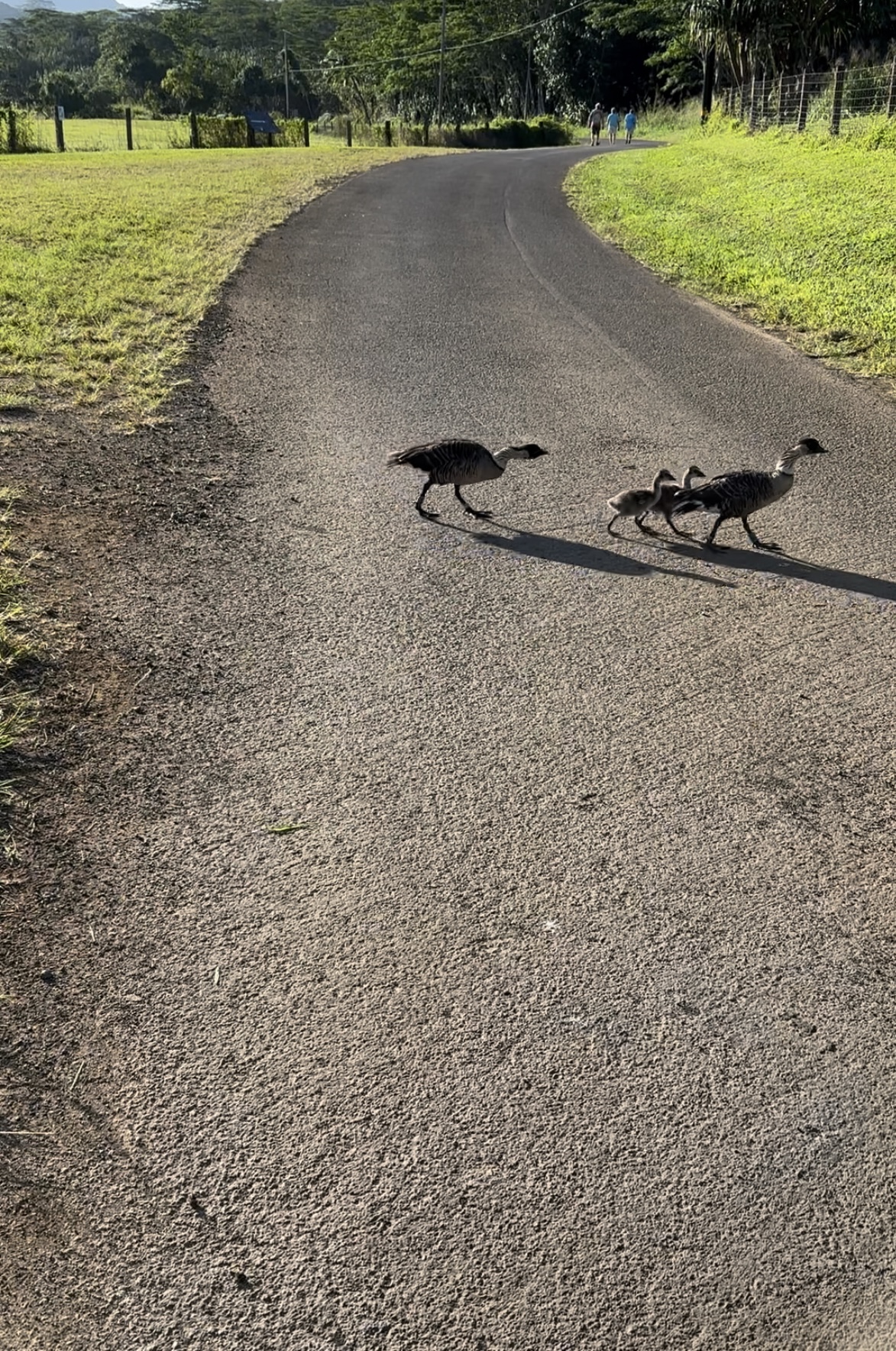
So, off on our daily morning walk! Along the Hanalei National Wildlife refuge. Why did the Nene cross the road?

Nene Geese

Because they own the island. Nene geese are the Hawaiian State bird. And a protected endangered species. How lucky to see a pair with two little ones!

Or perhaps they were crossing the road to get away from chickens. In all my blogs I have mentioned the wild chickens, shared photos of chickens, but never on any of our previous trips have I been up close and so personal with so many feral chickens as we were on this trip!

On this walk in Princeville we took along a bag of wild bird seed. There were chickens and roosters pecking about, lots of fowl sightings and sounds. Eric threw some bird seed out. I took a video. Can you keep count of the wild chickens who scurried from every which direction?

Yes, these are feral chickens. Think you could catch one? Ha. Here’s a fun link about the wild chickens of Kauai: https://koloalandingresort.com/how-many-chickens-are-in-kauai/

The article explains that the wild chickens of today are a blend of jungle fowl and farm hens. “Different theories have hatched over the years but the locals will tell you that the first wave of chickens came ashore with the Polynesians over 1000 years ago. Then in 1982 Hurricane Iwa hit … and the winds destroyed most of the Island’s coops and blew countless chickens out of farms, scattering them from coast to coast.” Ten years later, in 1992, hurricane Iniki hit, further scattering the chickens. The locals don’t bother eating them as their meat is notoriously tough and untasty. Which begs the question, why would you bother trying to catch a wild Kauai chicken?

We sure ran into a lot of them on this trip, one path in particular, a wooded trail beside the Westin Resort. Megan and I walked it several days in a row, just to check on the little chicken families we had become attached to, the industrious hens and their tiny broods.

I imagine about every waking moment of a young chick’s life is a learning experience. We humans could learn a thing or two about tough love from these seasoned mother hens. Like in this video. Mother showing them how to forage for food, but lets build in another lesson

Now you listen up little chicks. You could be knocked on your ass in an instant! And if you get kicked to the curb ….

Pick yourself up and try again!

You could also call on daddy to intervene

Here he comes to save the day! (Turn your sound up, especially if it’s sunrise)

Okay, in case you haven’t had enough videos of feral chickens on Kauai to last you a lifetime, or you don’t care for videos, I’ll throw in some photos.

Yeah, good try little one getting over that curb in the picture cut from the video. You didn’t make it, did you?

Enough already on these chickens! Yeah, I guess I should add a sunset or something.

Did I mention that Kauai has palm trees?

With this, I’ll call it a wrap! Huh, what’s tomorrow’s theme? Wild boars?

Kauai 2022 – P.S. – Did I mention how dangerous rip currents are?

March 13, 2022

I was done with the 2022 Kauai blogs, right? Took you on the whole 10-day ride through seven blogs from our doorstep in Idaho Falls on January 19 to home again January 30, safe and sound, and hunkered in till spring (which always seems to be just around the ‘next’ corner).

Except over this past week I received some terrible news from Kauai. Two swimmers were reported missing and assumed drowned at two of the very same beaches we visited in January (and I blogged about). I made such a big deal about the surfers on Hanalei Bay (including the ‘Surfin’ USA’ YouTube video) in Part-3, even teasing that I was shopping for a suitable bathing suit and surf board because surfing was just too much fun! Then in Part-4, sunbathing on Kahili beach with Megan, watching the surfers, capturing photos and video, while David and Eric hiked to Hissing Dragon. Then my last blog, Part-7, the photos and videos of the teenagers at Lumaha’i beach, jumping into the waves in the high surf, their heads bobbing on the surface. Although I did also mention that Lumaha’i was one of the most dangerous beaches on Kauai.

Well, last weekend, a swimmer disappeared at Lumaha’i beach. There is no lifeguard there and if you read up about Lumaha’i you will be advised only to walk the beach, sunbathe, maybe dip your toe in the surf, especially a high surf, and most especially during winter months. I don’t want you to read my blog, and then decide to race to Lumaha’i and hop in the surf! Oh no!

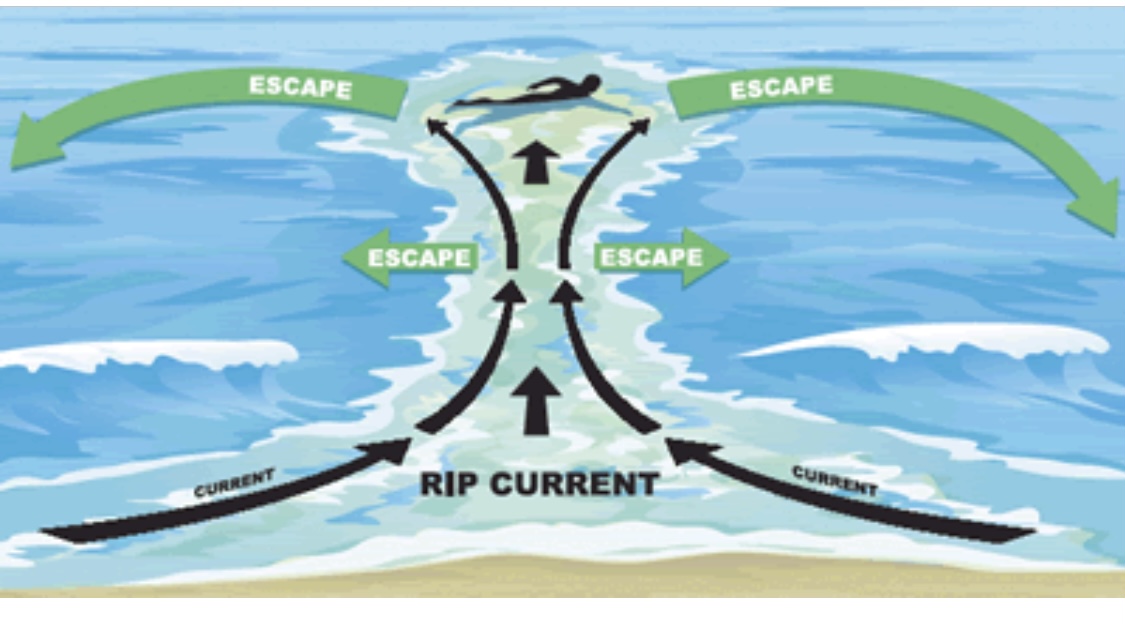
The danger lies in the rip currents, channeled currents of water flowing away from the shore. They generally begin from the shoreline (yikes!) and head through the surf zone – past the line of breaking waves. Here’s an informative link giving you answers to such questions as, What is a rip current? How do they form? How to spot a rip current? And most importantly, what to do if you find yourself in a rip current? http://www.kauaiexplorer.com/guides/beach/rip_currents.php

Here is a diagram of a rip current

From this link: https://www.kauai.com/images/2013/09/rip-current-diagram-1.png

As far as how to spot a rip current, here’s an interesting YouTube link:

(Planning to visit Australia?)

This YouTube presentation comes to you from Australia, but I don’t think rip currents discriminate! According to this surfer, 70 % of people can’t spot a rip current, good luck with that! If you find yourself caught in a rip current what do you do? (You probably want to know this BEFORE this happens).

Per the kauaiexplorer.com link above:

The best thing to do is learn to spot rip currents and avoid them. (Yeah, right) However, if you do find yourself in a rip current, remember the following. It could save your life!

  • Don’t Fight The Rip Current – Conserve energy, keep calm, float, breathe, don’t panic, and wave for help
  • Go With The Flow – You can easily float in the current, there is no undertow. Allow the current to take you away from the beach. In weaker rips, swim parallel to the shore until the current has completely relaxed. Otherwise, the current will eventually release you offshore. Once this happens swim perpendicular and towards the beach 
  • Wait For Help – If there is large surf or shoreline hazards, wave your hands for help and wait for assistance

I’m making such a big deal about this now in contrast to how casual I was about the surfers with not a worry in the world. I posted a video of surfers on Kahili beach (also known as Rock Quarry Beach). But a few days ago we received even more terrible news from Victor and Stephanie, who live in Princeville (we stayed with them on our visit). Another surfer went missing on Kahili Beach just this past Monday.

https://www.hawaiinewsnow.com/2022/03/09/multiple-agencies-search-surfer-who-went-missing-waters-off-kauai/

This hit Stephanie and Victor really hard, as they know this man and his family. They purchase their coconut water from them. Huy Nguyen and his wife have a big farm and three children. He had been surfing before handing his board off to his son, saying he was going to swim to shore. Multiple agencies searched for him until they finally suspended the search this past Friday (two days ago).

So, yeah. Just want to get the word out there about the danger of rip currents on the beaches of Kauai. Here’s an interesting link:

Brittany Lyte: The Deadliest Beach On Kauai Might Surprise You

A researcher, Chuck Blay, analyzed drownings in Kauai from 1970-2012. All told, 316 people drowned in the island’s waters during this 42-year period.

75 per cent of the Garden Isle’s drowning victims were tourists. Drowning is the leading cause of death among visitors to Hawaii.

One more interesting tidbit in the “deadliest-beach’ link above … In May 1964, Frank Sinatra nearly drowned in Wailua Bay while filming the WWII flick, “None But the Brave.” He was staying at the iconic Coco Palms Resort (boy that’s another story) and unknowingly swam himself straight into a riptide. By the time firefighters reached him, the Hollywood icon had been carried 200 yards out to sea. “Sinatra’s face had reportedly turned the same color of his famed set of eyes.”

Yeah, so, the most dangerous thing you can do when you go to Hawaii on vacation is go to the beach and jump in the water.

Although you can still drive past the old iconic Coco Palms Resort on Wailua Bay near Kapa’a, built in 1953, where Elvis Presley filmed “Blue Hawaii” and where Frank Sinatra stayed often (and swam in the bay). Here’s a wiki-link to the resort: https://en.wikipedia.org/wiki/Coco_Palms_Resort

“Coco Palms Resort was a resort hotel in Wailua, Kauai that was noted for its Hollywood connections, Hawaiian-themed weddings, torch lightings, destruction by a hurricane, and long-standing land disputes…”

Destruction by a hurricane? Yep. Hurricane Iniki, a devastating category 4 hurricane, with 145 mph winds, struck the Island on September 11, 1992 – 30 years ago. The immense damage done by Iniki closed the Coco Palms for good. Up until 2015 there were several attempts to redevelop the resort, but it’s way too far gone. Here’s an update on the resort from July 28, 2021: https://beatofhawaii.com/coco-palms-kauai-update/ The Plan was for Coco Palms to reopen in 2020 with 273 rooms, 77 suites, 3 restaurants, a cultural center, 12k feet of retail, and more. The last round of attempts disintegrated with multiple developers unable to make it work. I also blogged about it after our Kauai trip in 2019. Here’s the link: https://decompressionofaboomer.com/tag/coco-palms-resort/

And photos of what it looks like today.

Boy, nature can be cruel!